

Related

Portfolio Strategies
Combining an equity fund with a target-date fund can help capitalize on low drawdown risk years.
by Chris Pedersen | April 2020

Who’s wealthier: a 22-year-old with a freshly minted marketable college degree and $50,000 in student loan debt, or a 65-year-old retiree with $1 million saved and no other debts?
Most people would say the 65-year-old retiree because it’s no small feat to save $1 million and it sounds like a much better place to be than owing $50,000. But that neglects an important fact: The 65-year-old likely has far fewer years and opportunities to work compared to the 22-year-old. Assuming the new college graduate gets a job with a starting salary of $50,000/year, that’s comparable to a $1.25 million annuity paying 4% per year. Even after subtracting the younger person’s $50,000 debt, they are “richer” when you consider their human capital. Yes, they have to work to get their $50,000/year salary but they can and likely will for decades to come.
Most of us have an intuitive feel for the idea that time is limited and it’s important to do the things we can in the seasons of life when we can. It’s a little harder to translate this into financial strategies, though. It’s clear to most of us that we can take more risk when we’re young than when we’re old, but how do we know how much risk is right at any particular age?

In recent years, more and more investors have turned to target-date funds to answer this question. You may not use one yourself, but you almost certainly know someone who does. As of 2018, over half of new retirement account contributions went into target-date funds. Target-date funds adjust risk by shifting from riskier assets in the early years to less risky assets in the later ones. This time-varying asset allocation is called the glide path. Figure 1 is an example from Vanguard which had nearly 40% market share of all target-date fund assets at the end of 2018.
At first glance, it looks like it’s doing what it’s supposed to. By steadily increasing the bonds from age 40 to age 65, volatility is declining nearing retirement. As we look closer though, things start to become puzzling. For example, why have bonds at all from ages 25 to 40? Aren’t these our most risk-tolerant years? Similarly, why not have more high risk-reward assets like small, value and emerging markets in those early years?
To find out whether target-date funds do what they say, we built a backtesting spreadsheet to test different glide paths and asset combinations for every starting month going back to 1970. That’s 576 different overlapping time periods. To make sure every phase of the glide path is tested for every month, we used circular bootstrapping. This means we circle back to the beginning-year returns when we run out of return data. For example, if we were examining only 10 years of history and started in year eight, the years eight, nine and 10 would be followed by years one, two, three and so forth.
From this analysis, we learn things such as the average end balance, the range of end balances and the depth of drawdowns (balance declines from peak to trough) that are likely in a quarter/year/decade or lifetime. The baseline reference we chose was the Vanguard Target Retirement Funds, which we approximated with equity and fixed-income asset glide path allocations in what we call a “Vanguard-like target-date fund.” Figure 2 shows the drawdown curves for two scenarios using this glide path. The one on the left assumes a lump-sum investment, and the one on the right assumes regular monthly investing starting at $0.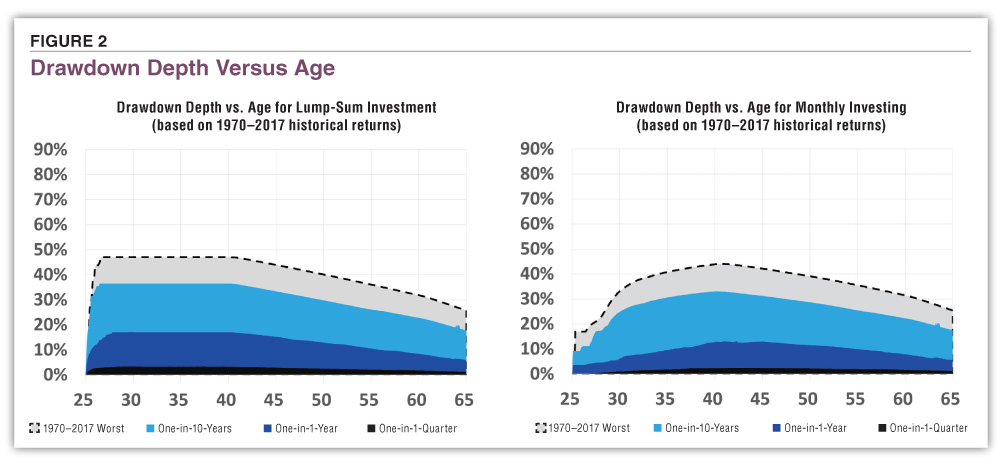
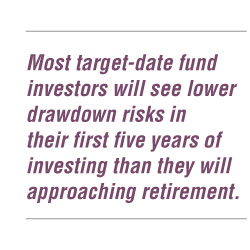 The lump-sum investment chart makes it look like the glide path is doing what it’s supposed to. Risk starts high, then declines starting at age 40 when more bonds are being added to the fund. But the reality is that almost no one saves for retirement in a lump sum. Most people start with nothing and set a little aside every month until they retire. If we look at the drawdown risks for a monthly investor starting at $0 and contributing the same amount every month (shown on the right side of Figure 2), we see much lower drawdown risks in the early years. The reason the monthly investor with a small balance sees smaller drawdowns is that they’re continuously contributing amounts that are large relative to the balance. It’s not that they don’t experience the negative returns, but it’s harder for them to see since the account balance is always going up. Not only do regular contributions raise the balance, but dollar cost averaging further reduces risk since investors are buying more shares when the market is down and fewer shares when the market is up. Ironically, most target-date fund investors will see lower drawdown risks in their first five years of investing than they will approaching retirement. This argues strongly against having bonds in the early years of a glide path and suggests that young investors should take more risk.
Since we can’t easily change the target-date fund glide paths, we wondered what would happen if we compensated by adding risk in a second fund. To avoid increasing risk near retirement, we ramped the amount in the second fund down over time. The approach we chose was to multiply the investor’s age by 1.5 and put that percentage into the target-date fund, with the rest going into a second all-equity fund. We called this approach 2 Funds for Life. For this article, I’ll include the results for adding an S&P 500 index fund, a U.S. large-cap value fund and a U.S. small-cap value fund. Table 1 shows the resulting best, worst and median end balances after 40 years of investing. It also shows how the drawdown risk varies with age.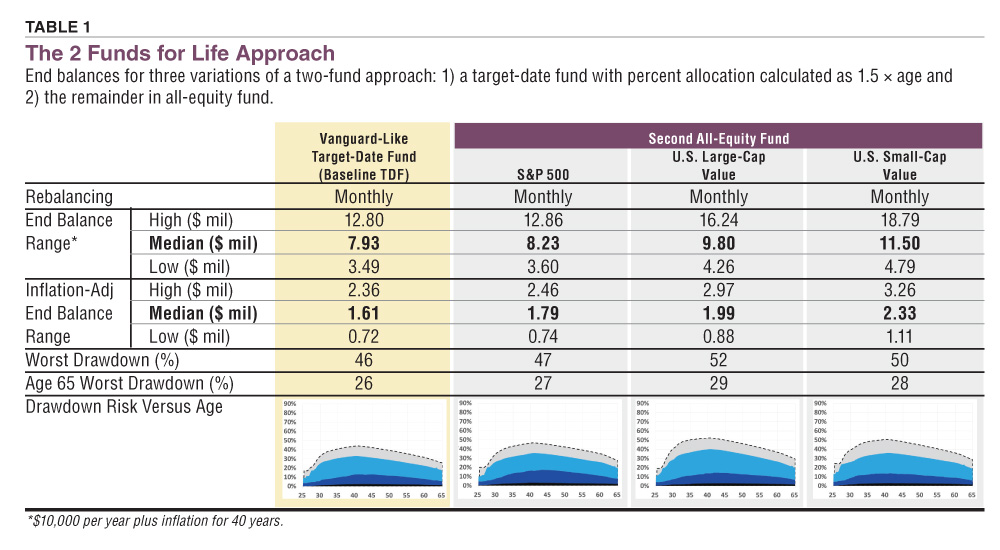
Not surprisingly, taking some additional risk in a second equity fund increased median (bold numbers) and high-end balances. If there is a surprise, it’s that the added risk in terms of account balance drawdowns is only one to six percentage points, while the end-balance increases are between $300,000 and $2.5 million. Moreover, the smallest end balances actually go up. For many young investors, that’s likely to be an appealing bargain.
The 1.5 times multiplier was chosen because 1.5 × 65 is approximately 100 so you end up with 100% in the target-date fund around retirement. If you plan to retire at some age other than 65, it doesn’t work. So, how do we adjust for early retirees?
The answer is simple. Instead of using 1.5 times your age to determine the percentage you would invest in the target-date fund, you turn it around and use 1.5 times the years left to retirement to determine the amount you would invest in the second fund. So, if you are 30 years old, and plan to save aggressively to retire at age 50, you would be 20 years from retirement, and 1.5 × 20 = 30, so you’d invest 30% in the second fund and 70% in the target-date fund.
How does that change the numbers? It depends. Because there are so many variations on the early retirement approach, it’s not practical to summarize them in a single table. It would take a series of tables like the one above where each table considered different savings rates and years to retirement. Will it still help? There are no guarantees, but the same principles that make this strategy work for age 65 retirees should help early retirees too. The 2 Funds for Life strategy will still mitigate the overly conservative approach of target-date funds in the early years, increasing likely returns with only slight increases in drawdown risk and ramping that risk down approaching retirement.
If you’re at or in retirement, you might feel left out. If age times 1.5 equals 100 or more, does that mean I should just be 100% in the target-date fund?
It depends on whether you’ve under-saved, over-saved or saved just enough. One way to figure this out is to calculate how much of your nest egg you’ll need to spend every year to meet your expenses. This is your withdrawal rate.
Say you have $1 million saved and invested and you can live on $50,000 per year. That would be a 5% withdrawal rate ($50,000 ÷ $1,000,000). But let’s say you also get $10,000 per year in Social Security and pension benefits. Now, you only need to spend $40,000 from your nest egg, or a lower 4% per year withdrawal rate.
There’s been a lot of research done to suggest that a fixed 4% withdrawal rate is a safe target. Fixed withdrawal means you calculate how much you will withdraw annually at your initial year of retirement, then you increase the withdrawal amount by inflation every year until you die. Keep in mind that the 4% withdrawal rate was tested for a traditional retirement age. If you plan to retire much earlier than age 65, you may need to have a lower withdrawal rate to make your money last.
So, if you plan to retire around age 65 and need more than a 4% withdrawal rate, we could say you’ve under-saved. On the other hand, if you need less than 4%, we could say you’ve over-saved. And right around the 4% rate, we’d call just right.
There will be a path forward, but it’s more likely to require some creativity and less likely to fit a boilerplate answer. It may involve working for more years, lowering expenses, increasing savings rates, changing investment portfolios or other approaches. A good financial planner should be able to help.
First, congratulations! Second, the 2 Funds for Life approach is fairly easy to extend into retirement for someone who has saved just enough because that’s pretty much what the target-date fund managers plan for. Sticking with a 100% allocation to the target-date fund in retirement is simple and prudent. It may err on the conservative side, but this may be what’s needed by retirees transitioning from regular paychecks to living off their investments.
Once retirees are comfortable living off of their investments, it may make sense to shift back to a two-fund approach if they can live with and persist through a little more volatility. Testing with the financial goals Monte Carlo Simulation tool at www.portfoliovisualizer.com suggests that allocating 10%–25% away from a Vanguard-like target-date fund toward low-cost, all-equity index funds could increase returns significantly without increasing the likelihood of running out of money.
You’ve got options. The simple way to think about your options is to think that you have two buckets. The first bucket is the part of your portfolio that you need to live on in retirement. This is the portion required to enable a 4% withdrawal rate. So, if you need to withdraw $40,000 per year to meet expenses, $1 million of your investments would be invested as your retirement portfolio ($40,000 ÷ 4%, or 25 × $40,000). Investing this portion in a target-date fund is again simple and prudent. Whatever you have beyond that can be invested more aggressively since it will likely be passed on to children and charities when you die. If you want to stick with a two-fund solution, you could invest the “extra” in any one of the second fund choices modeled in the 2 Funds for Life analysis.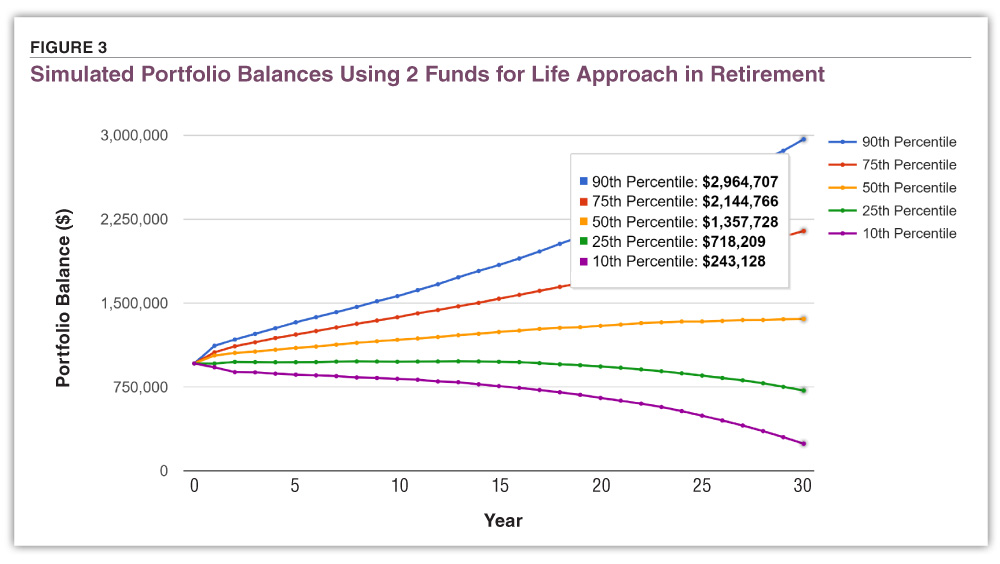
So, how much difference will it make? The example in Figure 3 is modeled using the free Portfolio Visualizer Financial Goals tool. We’ve assumed a $1 million nest egg invested in a Vanguard-like target-date fund over 30 years of retirement with a 4% fixed withdrawal rate. Here’s a link to the webpage calculation: https://bit.ly/2ImdiUi.
The tool produces a series of lines representing very bad luck (bottom line, 10th percentile), bad luck (25th percentile), average luck (50th percentile), good luck (75th percentile) and very good luck (top line, 90th percentile), and can be useful to help set expectations about how much you might expect your portfolio to go up and down over time. Though it’s not shown on the graph, the simulation also tells us that there was a 95% success rate, meaning 5% of the simulations ran out of money before reaching 30 years. Any risk sounds bad, but there’s probably a much greater risk that most of us run out of life before reaching the age of 95.
Table 2 tells us what we might expect from the 2 Funds for Life strategy in retirement with different fixed withdrawal rates and allocations, all starting with $1 million minus the first year’s withdrawal.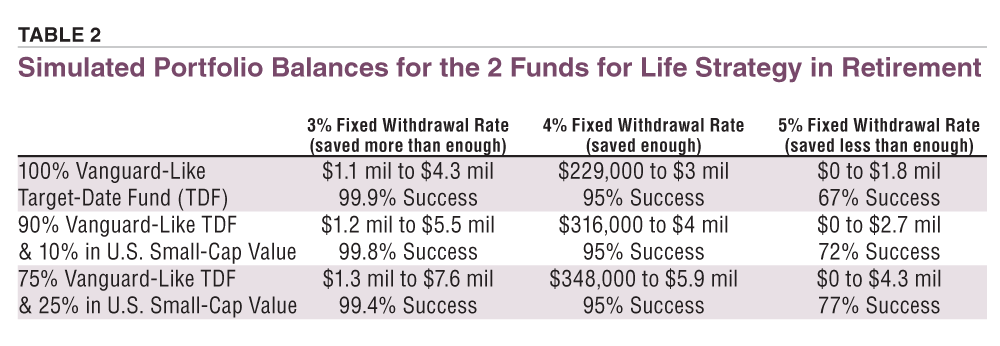
Let’s start by looking at the 5% withdrawal rate. Though adding equities to the Vanguard-like target-date fund asset allocation helps, the success rates still only go from 67% to 77%. That means there’s about a one-in-three to one-in-four chance you’ll run out of money, which is why we suggest working with a financial planner if you’ve under-saved and need a 5% withdrawal rate to meet expenses.
For those who’ve saved just enough and for over-savers, the chart shows that worst- and best-case scenario end balances increase with practically no change in success rates when we shift a portion of the portfolio away from the target-date fund and toward equities.
I hear some readers saying, “This looks too good to be true—what’s the catch?” The answer is that, much like younger investors, you have to tolerate a bumpier ride in the form of some increased fluctuations in your nest egg balance to earn these better returns. This is one of the reasons I suggest that people who have saved just enough consider sticking with the 100% target-date allocation when they’re just entering retirement. For many people, this is a stressful time where there’s more anxiety and less ability to calmly ignore the ups and downs of the market. Even though all of the return histories suggest that taking more risk will be rewarded, they all assume you stay invested to get the reward. Right sizing your risk is personal and can vary with circumstance as much as age.
Finally, if investing in small-cap value sounds too risky, you could invest in large-cap value or the S&P 500. The expected impact is not as great and ironically comes with slight decreases in the smallest end balances, but the return histories say it’s still likely to help.
The 2 Funds for Life strategy is fairly easy to apply in a wide range of circumstances, including early retirement, nearing retirement and in retirement. The places where a second fund helps the most are early in an investor’s life where target-date funds tend to be overly conservative, and late in an investor’s life if they’ve over-saved. In both cases, augmenting a target-date fund with a second all-equity fund seems likely to significantly improve long-term returns with only small increases in drawdown risks and little to no increase in the likelihood of running out of money. Though the approach is simple, it provides worldwide diversification across thousands of companies, with dynamic age-related portfolio risk management, and does it all at a very low cost.
When we first published our 2 Funds for Life strategy in the fall of 2018, our most ambitious hope was that fund providers would pick up on the observations and increase equity allocations in target-date funds, especially in the early years. In February of this year, T. Rowe Price announced, based on extensive research of their own, that they would be increasing equity allocations in the early and later years of their newly enhanced glide paths. We take no credit for this change, but optimistically hope that other fund providers will follow since it appears likely it will serve investors well.
We think you’d like this related webinar! AAII Wednesday Webinar with author Chris Pedersen: Simple & Effective Balanced Portfolios for Lifetime Investing Success
Portfolio Strategies
Related
Insights on Using the 4% Withdrawal Rule From Its Creator
Related
Related



David L from UT posted over 6 years ago:
Dennis L from MN posted over 6 years ago:
Chris Pedersen from California posted over 6 years ago:
Alec Clerihew from New Jersey posted over 6 years ago:
Chris Pedersen from CA posted over 6 years ago:
David L from UT posted over 6 years ago:
Ignacio from MA posted over 6 years ago:
Joe Gordon from North Carolina posted over 6 years ago:
Jim C from PA posted over 6 years ago:
You need to log in as a registered AAII user before commenting.
Log InCreate an account