


Many investors trust their investments to professionals, but before entrusting your portfolio to an individual adviser or brokerage firm, it is important to research their background. Here we list internet tools that are designed to help.
General Online Search
The first step should be to do a Google search on the broker or adviser in question. The top search results will probably lead you to marketing or profile information that the individual or firm posts, so you will need to dig further. Try adding their name plus “complaints” or “fraud.” Multiple searches can help you discover what the adviser may not want you to see at first glance.
You’re not just looking for complaints with these searches, you’re looking for information that conflicts with the impression or profile that the adviser is presenting. For example, an adviser who claims to have 20 years of experience managing portfolios but upon further research is found to have graduated from college a few months ago is a definite red flag.
 If you find information about the adviser that is different from how they present themselves, ask them why, and if you’re not satisfied with their answers or if it seems suspicious, trust your instincts and seek out a different adviser or firm.
FINRA’s BrokerCheck and the SEC’s IAPD Database
Beyond this, you should also use the Financial Industry Regulatory Authority’s (FINRA) BrokerCheck, a free database containing summaries of brokers’ employment histories, certifications and licenses, history of regulatory actions taken and/or complaints filed against individuals or their investment firm, including violations, complaints and related criminal felonies. BrokerCheck works in tandem with the U.S. Securities and Exchange Commission’s (SEC) Investment Adviser Public Disclosure (IAPD) website. The IAPD website handles SEC- and state-registered investment advisers and individuals associated with them, while BrokerCheck covers individual brokers or brokerage firms, but the two databases cross-reference each other. Between the two, you can review information on more than 1.2 million financial professionals, including 625,000 active individuals.
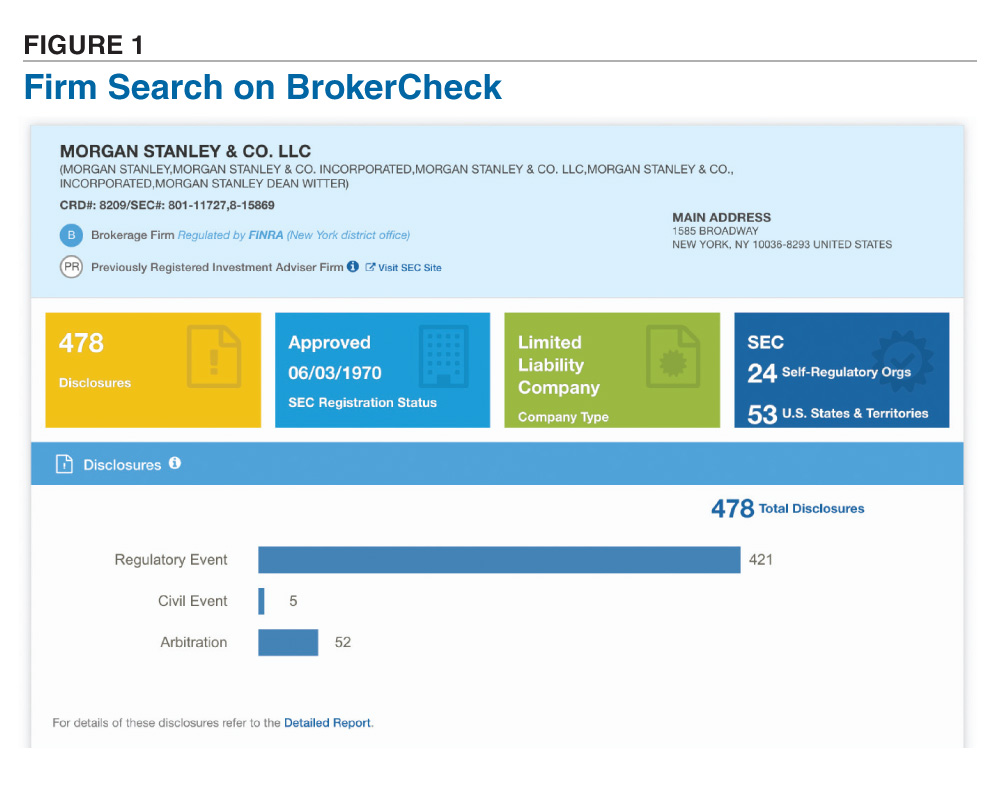
BrokerCheck lets you know when the individual was registered with FINRA and state securities regulators and if they have filed any disclosures, including how many and what type of disclosures. Disclosure information includes: criminal charges and convictions; regulatory actions; personal bankruptcies and unpaid liens; customer disputes, including allegations, damages requested and granted and any additional comments; how many exams they have passed; how many years of experience and firms they have worked at; current employment; which states and territories they have licenses for; broker registration history; and contact information for the firm where they currently operate. For firms, information about types of business also appears, as well as who the direct owners and executive officers are of the company. In addition, detailed reports on both individuals and firms are available in PDF form.
Disclosures do not necessarily indicate wrongdoing, as complaints can be dismissed by arbitrators. However, multiple disclosures along the same lines could be part of a pattern. It is important to consider the allegations, the amounts involved and any comments that may reveal the nature of the claims being made or the conduct of the adviser. For firm-level disclosures, BrokerCheck includes PDFs of regulatory activity, arbitration award history and other company information.
It should be noted that these tools, though designed to help investors, may not tell the full story behind a broker’s or firm’s past. FINRA allows individuals and firms to dispute the BrokerCheck record, which would be addressed in an arbitration forum. Claims that are found to be unfounded may be expunged from the record. BrokerCheck is updated daily and, while the data is available to the public, control of it remains tightly in FINRA’s hands. The terms of use ban firms from using the data for commercial benefit.
Keep in mind that a record with a lot of disclosures does not necessarily imply misconduct. And similarly, a clean record does not imply a perfect background check.
BrokerCheck also does not contain information on civil litigation not involving investments, or criminal records other than felonies or investment-related misdemeanors, such as theft or “breach of trust” data.
Two Additional Resources
Another resource is your state securities regulator, located through the North American Securities Administrators Association (NASAA). These regulators keep records on the investment professionals licensed in their state and may yield more information than what is searchable on BrokerCheck or IAPD.
Lastly, the SEC’s website also tracks registered investment advisers and exempt reporting advisers month to month, dating back to 2006 (www.sec.gov/help/foiadocsinvafoiahtm.html). For those interested in this data, this spreadsheet contains the information submitted on Form ADV, which all investment advisers must file with the SEC and their respective state securities regulator.
Conclusion
While not foolproof, using these resources will help you make a more informed choice when hiring an investment adviser or brokerage firm. A little due diligence goes a long way to protecting your investments from unsavory scams and schemes.

Related

Financial Planning
Advice on Evaluating an Adviser From an Industry Veteran
Related

Financial Planning
Why Your Financial Adviser Should Be a Fiduciary
Discussion
FREE REPORT

Get your free copy of our special
report analyzing the tech stocks
most likely to outperform the
market.
Barry Estell from California posted over 6 years ago:
Arnie Lamb from California posted over 6 years ago:
Ted from Calif. posted over 6 years ago:
Beaufort Lancaster from Texas posted over 6 years ago:
MICHAEL S from CA posted over 5 years ago:
BARRY J from TX posted over 5 years ago:
You need to log in as a registered AAII user before commenting.
Log InCreate an account