

AAII Survey: How the CARES Act Is Affecting Members’ Withdrawal Strategies
by AAII Staff | April 21, 2020

The Coronavirus Aid, Relief and Economic Security (CARES) Act, recently enacted in response to the coronavirus pandemic, includes a number of measures designed to stimulate the economy. One provision allows retirees to forgo taking required minimum distributions (RMDs) from IRAs or 401(k)-type plans this year. The CARES Act essentially suspended RMDs for 2020 across the board. It is important to remember that the CARES Act is a relief bill, and by suspending 2020 RMDs, the government is giving up short-term tax revenue to provide relief to retirees. Additionally, markets have been very volatile, and suspending RMDs gives many Americans the ability to leave their investment portfolios alone to recover over the next year. In addition to the relief these RMD provisions provide, it also opens up some planning opportunities. We wanted to hear how AAII members are taking the CARES Act into consideration when it comes to their withdrawal strategy.
We asked our members about their top issues with the following question:
The CARES Act suspends required minimum distributions (RMDs) for 2020. If you are retired, will this impact your withdrawal strategy?
Here are the results: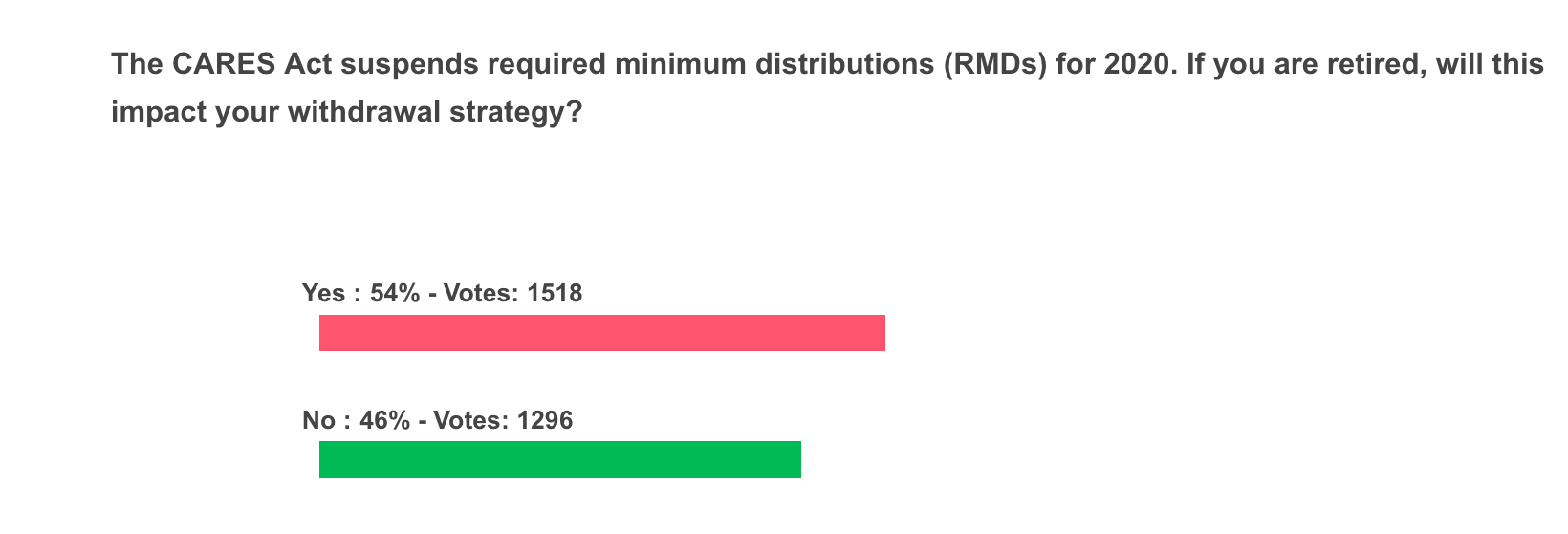
Over 2,800 members participated in this survey.
Of the 2,814 responses we received, a majority of respondents (54%) stated that the CARES Act provision will impact their withdrawal strategy in some way. This compares to 46% of respondents who stated that the provision would not impact their strategy.
Follow-Up Special Question
Before the CARES Act was passed, individuals over the age of 70½ (for those born prior to July 1, 1949) or 72 (for those born after July 1, 1949) were required to take a minimum distribution from their tax-deferred retirement accounts each year. In addition to retirees, most non-spousal heirs who inherited tax-deferred accounts, no matter their age, were also required to take an annual RMD. The changes to the rules governing tax-advantaged retirement accounts are an unusual response to an extraordinary situation. The rules have been altered and relaxed in order to give financial flexibility to people when they need it most; however, it’s still prudent to tread carefully. We aimed to explore in further detail how AAII members are adjusting their withdrawal strategy in response to the CARES Act.
We followed up our poll with:
If yes, how will your withdrawal strategy be impacted?
Of the 730 responses we received, a majority stated that they would be reducing or eliminating their distribution this year. However, the rationale among these respondents varied. Fifty-one percent of respondents said that they were reducing their distribution in response to the CARES Act because they wanted to lower their taxable income. Notably, many in this group cited lowering their Medicare premiums as the primary reason for lowering their 2020 distribution amount. This compares to the 32% percent of respondents who stated that they are planning to reduce their distribution in 2020 so that they can convert to a Roth IRA. Additionally, 17% of respondents stated that they were opting to reduce or eliminate their withdrawals because they want to give their retirement account more time to recover losses.
Here is a sampling of the responses we received to the follow-up special question:
-
“By reducing (or even eliminating) my 2020 RMD, I will reduce my income tax bracket, eliminate Obamacare tax, and reduce Medicare costs in 2022. If one can afford the reduction in 2020 cash flow, this change is a wonderful opportunity. Everyone should review their own situation to determine if taking advantage of this change makes sense for them.”
- “Allows me to keep making money, not a mandate. This requirement should be removed on a permanent basis!”
- “My withdrawal strategy is normally to take the RMD and reinvest it, as it is not needed for current needs. Suspension is good since the amount of RMD is based on December 2019 balance, which was much higher than it is currently. Also, would have resulted in a larger income tax. I would hope that the balance will increase when the economy recovers.”
- “Rather than take quarterly withdrawals, I will wait until the end of the year. At that time, I will make a decision based on my tax situation.”
- “No withdrawal for 2020. Why pay ordinary income tax rates on withdrawals when assets in non-tax-advantaged accounts, which most likely have reduced unrealized gains, can be withdrawn if necessary? I have plenty of emergency cash set aside for situations such as this to avoid any asset sales.”
Discussion
Ron from CO posted over 6 years ago:
Given, I always wait to 4Q (usually late Dec) to do the RMD, having accumulated the required cash or identified the appropriate "in-kind" securities to transfer during 3Q & 4Q, here is a plan for 2020: (Tax laws can always change during the year ... ;-) ) And, this probably works best in the early years of RMDs when the withdrawal percentages are smaller and tax losses have longer time to be re-gained. Seems to me that taking a one-time non-RMD partial IRA withdrawal in 2020, of any amount, paying all of the taxes due by with-holding in Dec (manageable by the withdrawer) and reinvesting the net withdrawal into a Roth is the way to go. (A partial IRA to Roth conversion.) Since there will be no "minimum", or ("maximum"?) IRA withdrawal required, tax impacts can be managed based on the individual's personal situation. And unlike reinvesting the withdrawal in a Taxable (Non Qualified) account as usual with RMDs in other years, the Roth then grows tax free (Divs, CGs) *and* future withdrawals are also tax free, unlike if the funds were just kept in the original IRA this year. And the withdrawal tax has to be paid in any case, if taken. So, pay the tax now and avoid it all later? Or, no withdrawals in 2020, keep it all in the IRA, grow it and pay (more?) taxes later? Anyone see any flaws in this strategy? Perhaps AAII could modify the rothconvert.xls calculator to highlight the *partial* IRA to Roth conversion opportunity in 2020. And/or calculating a "break-even" period to make the conversion worthwhile based on the other parameters. Since we are in RMD mode, the distribution period is important while still trying to get some accumulation. Since similar securities could be used in either the IRA or the Roth, the issue is whether the tax loss at conversion could be made up for over a future period with the cash gains due to non taxability of future Roth withdrawals. Thanks much - /r.
Lou Barth from PA posted over 6 years ago:
The CARES Act allows those individuals who took/take their RMD payments between Feb 1 to May 31 to repay their respective accounts (only 1 per 365 days) but for those who took it out between Jan 1-31 cannot. Why and will the IRS correct this injustice? Thank you.
John from CA posted over 6 years ago:
Re: CARES Act: I took a Required Minimum Distribution from my beneficiary IRA before the RMD waiver was put in place. My broker will not let me put it back because they state, a beneficiary IRA only permits withdrawals. I believe that is not the intention of the waiver which was to suspend RMDs for 2020. I find myself now forced to keep an RMD that was made not necessary by the CARES Act IRA RMD waiver. Have others had this problem? How has your broker handled it? Is there hope that Congress will remedy the problem?
Ray from WA posted over 6 years ago:
I too have a beneficiary IRA (with UBS), and was permitted to return my RMD this year, in accordance with the CARES Act.
ROHIT S from CA posted over 6 years ago:
With recent provision of CARES act, conversion is an attractive option, I am wondering if anyone has analysed using AAII"rothconvert.xls" calculator spreadsheet with modification of either partial conversion and or an impact of moving up into higher TAX bracket? How can this be done using this spreadsheet?
You need to log in as a registered AAII user before commenting.
Create an account