


Emerging research on cognitive aging as well as many financial studies have found declines in financial capability and concurrent lower investment performance among older individuals.
This is concerning due to the shift from defined-benefit pensions to defined-contribution plans, such as 401(k) plans, which places the welfare of retirees increasingly on their ability to make sound financial decisions.
Investors age 75 and above experience “much lower returns than younger investors.” The relationship between age and risk-adjusted investment performance shows the pattern of returns being lower among young investors, improving up to age 42 where it peaks and then declining after age 70 sharply.
Investors older than 75 on average experience investment returns that are 3% lower than those of middle-age investors. This return disparity rises to 5% among older investors with greater wealth. A mix of overconfidence and reduced abilities explained the subpar investment choices made by older subjects. Notably, in the study, financial literacy scores declined by about 1% each year after age 60, but subjects’ confidence in their own decision-making did not decline with age.
The authors of the study also noted that older workers are far more likely than younger workers to exhibit risk-tolerant investment preferences following a rising stock market, and risk-averse preferences following a decline in the market. By preferring risky assets after stocks rise in value and safe assets after stocks have declined in value, older investors exhibit poor market timing.
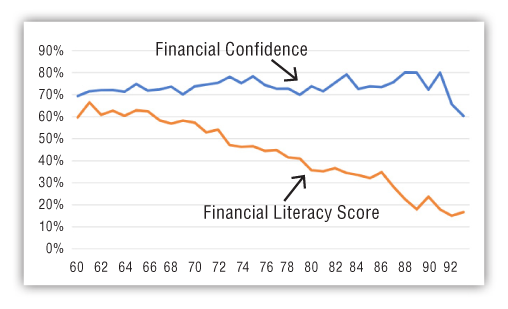
One explanation for these behaviors was that lower-quality decisions arise when either probabilities or outcomes are far from reality. Aging may compromise both an investor’s ability to process information in order to form accurate estimates of either investment probabilities or outcomes as well as the emotional response to an anticipated or realized loss.
The study’s authors conclude that “in the absence of widespread use of investment defaults, the observed underperformance of older investors in equity markets raises the possibility that stocks should be underweighted in the portfolios of self-directed retirees. The emotional response to a significant wealth decline from a stock market crash can impact retirees beyond the loss of their financial resources.”
Source: “Old Age and the Decline in Investment Performance,” by Michael S. Finke and Sandra J. Huston; Max Planck Institute and Bank of Italy Behavioral Financial Regulation and Policy Workshop, May 2020.
Related

Financial Planning
Steps to Smoothly Transfer Control of Your Family's Finances
Related

Retired Investor
Aging’s Adverse Impact on Decision Making
Discussion
FREE REPORT

Get your free copy of our special
report analyzing the tech stocks
most likely to outperform the
market.
Bob M from MA posted over 6 years ago:
THOMAS S from MN posted over 6 years ago:
HAROLD S from VA posted over 6 years ago:
You need to log in as a registered AAII user before commenting.
Log InCreate an account