



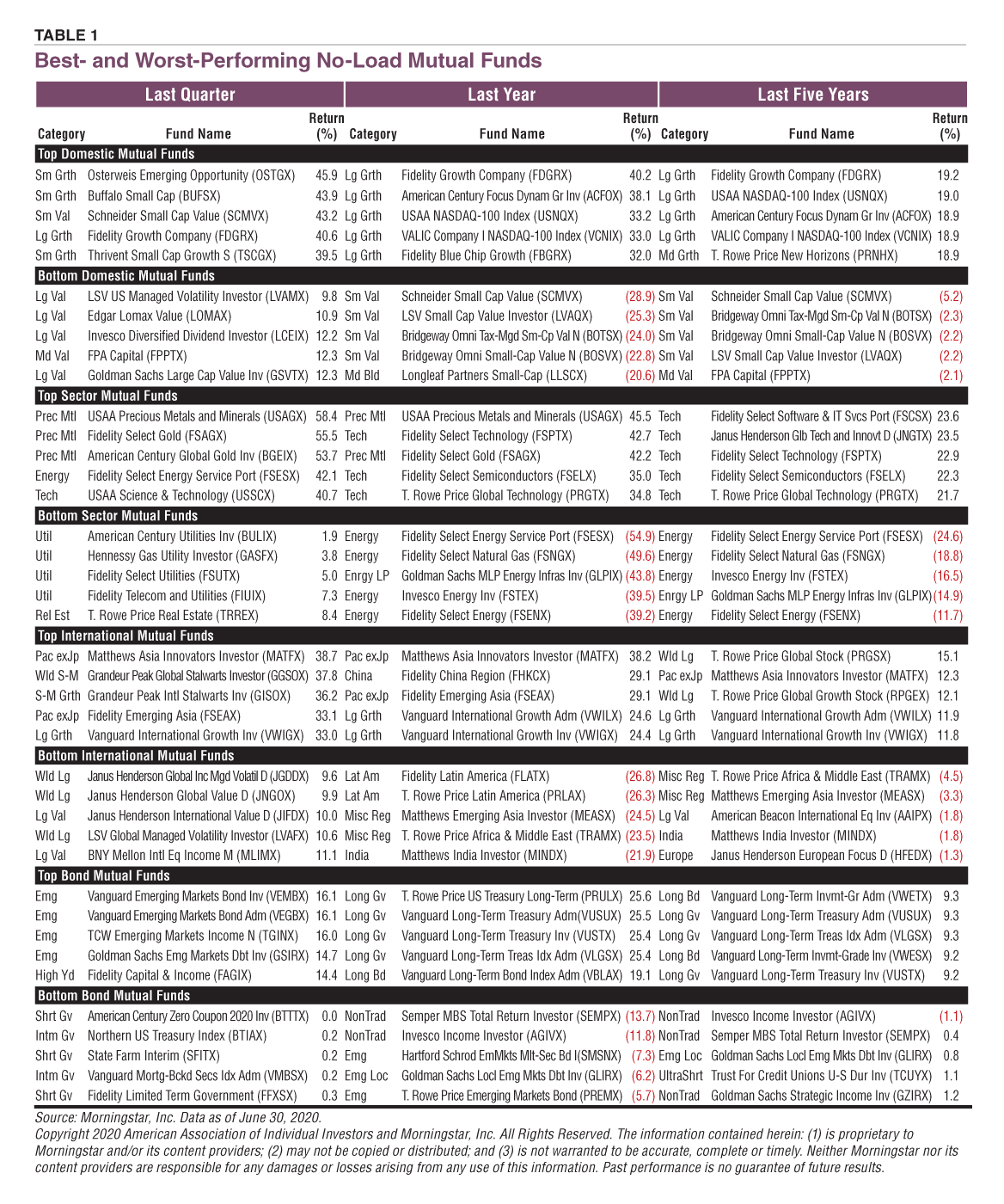
If the first quarter of 2020 was a sharp inhale, the second quarter was a sharp exhale. None of the funds featured in the Quarterly Mutual Fund Update as top and bottom performers recorded negative returns for the three months between April and June. In the first quarter, the only funds with positive returns were bond funds.
Whereas the first quarter captured the transition into a bear market and a recession, the second quarter captured the volatility of record-breaking upswings in the financial markets as investors reacted to the latest pandemic news and economic data.
Sector Funds
The top three sector funds for the second quarter belonged to the precious metals category. USAA Precious Metals and Minerals  (USAGX) was up 58.4% for the quarter, followed by Fidelity Select Gold (FSAGX) and American Century Global Gold Investors (BGEIX), up 55.5% and 53.7%, respectively. Gold prices traded at their highest levels since 2011, propelled by the decline in global economies as the commodity is widely viewed as a hedge against rising prices and currency debasement.
Of note among the top five sector funds is the Fidelity Select Energy Service Portfolio (FSESX), up 42.1% for the second quarter. The fund led the bottom-performing sector funds just three months ago by falling 66.3%. Confirming its volatility, the fund has a Category Risk Grade of F (implying a top quintile level of volatility). West Texas Intermediate, the North American crude oil benchmark, briefly hit negative prices in April before recovering to some stability in June around $40 per barrel. The current price is still low compared to the trend in prices over the last few years.
The majority of the bottom-performing sector funds were in the utilities category, with American Century Utilities (BULIX) recording the lowest performance, ending the quarter up just 1.9%. The fund’s largest holdings are in U.S. energy providers such as Dominion Energy Inc. (D) and Duke Energy Corp. (DUK).
International Funds
Matthews Asia Innovators Investor (MATFX) led international funds for the second quarter, up 38.7%. It also led international funds at the end of the first quarter. Representing developed and emerging markets in Asia (except Japan), the fund’s largest holdings are in prominent Chinese companies and the South Korean company Samsung Electronics. Category peer Fidelity Emerging Asia (FSEAX) was also among the top five international funds, up 33.1%.
Developed economies have managed to contain their outbreaks of the coronavirus. During the second quarter, their manufacturing sectors worked through order backlogs that built up during shutdowns in the preceding quarter. New orders haven’t exactly poured in, due to the remaining global economic uncertainty. However, electronics manufacturing, and chip manufacturers specifically, are expected to benefit from the worldwide adoption of 5G wireless technology over the coming decade.
The bottom-performing international funds for the second quarter focus on large-cap companies. Janus Henderson Global Income Managed Volatility D (JGDDX) had the lowest performance, up 9.6%. The fund seeks smaller drawdowns (a peak-to-trough decline during a specific period) and “a smoother ride over time,” aiming for up to 40% less volatility than the Russell 1000 index. As such, the fund’s Category Risk Grade is A (implying a bottom quintile level of volatility).
Domestic Funds
The top- and bottom-performing domestic fund categories for the second quarter seem to have swapped fortunes with the first quarter’s top and bottom lists. Funds in the small-cap category made up the majority of top performers in the second quarter after being the majority of bottom performers three months ago. The small-cap growth funds Osterweis Emerging Opportunity (OSTGX), up 45.9%, and Buffalo Small Cap (BUFSX), up 43.9%, led the group.
Funds in the large-cap value category made up four of the five bottom performers for the quarter. LSV US Managed Volatility Investor (LVAMX) had the lowest performance, up 9.8%. Large-cap funds weathered the first quarter better than small-cap funds and therefore had less performance to make up during the upswing of the second quarter. Quarter-to-quarter volatility like this doesn’t favor a fund such as the LSV US Managed Volatility Investor because it tries to select stocks whose total returns are expected to fluctuate less than those of the equity markets as a whole.
About the Quarterly Mutual Fund Update
The Quarterly Mutual Fund Update highlights the best- and worst-performing no-load mutual funds. Previously a premium AAII product, it is now a regular member benefit in the AAII Journal. The mutual funds covered are required to have at least $5 million in assets, a minimum initial purchase of $50,000 or less and an expense ratio ranking in the bottom half of their respective categories. Institutional funds and alternative share classes are excluded. ▪
Discussion
FREE REPORT

MICHAEL M from NC posted over 6 years ago:
CHARLES R from IL posted over 6 years ago:
You need to log in as a registered AAII user before commenting.
Log InCreate an account