

Charles Rotblut leads a class in AAII's new Essential Investing Video Course. Go to https://www.aaii.com/ves for more information and to subscribe.

The second quarter of 2020 proved to be inverse of the first quarter. The global financial markets rebounded as economies worldwide reopened and the number of new coronavirus cases fell in many countries. Out of the nearly 2,300 exchange-traded funds (ETFs) with returns for the full April–June period, all but 199 rose in value.
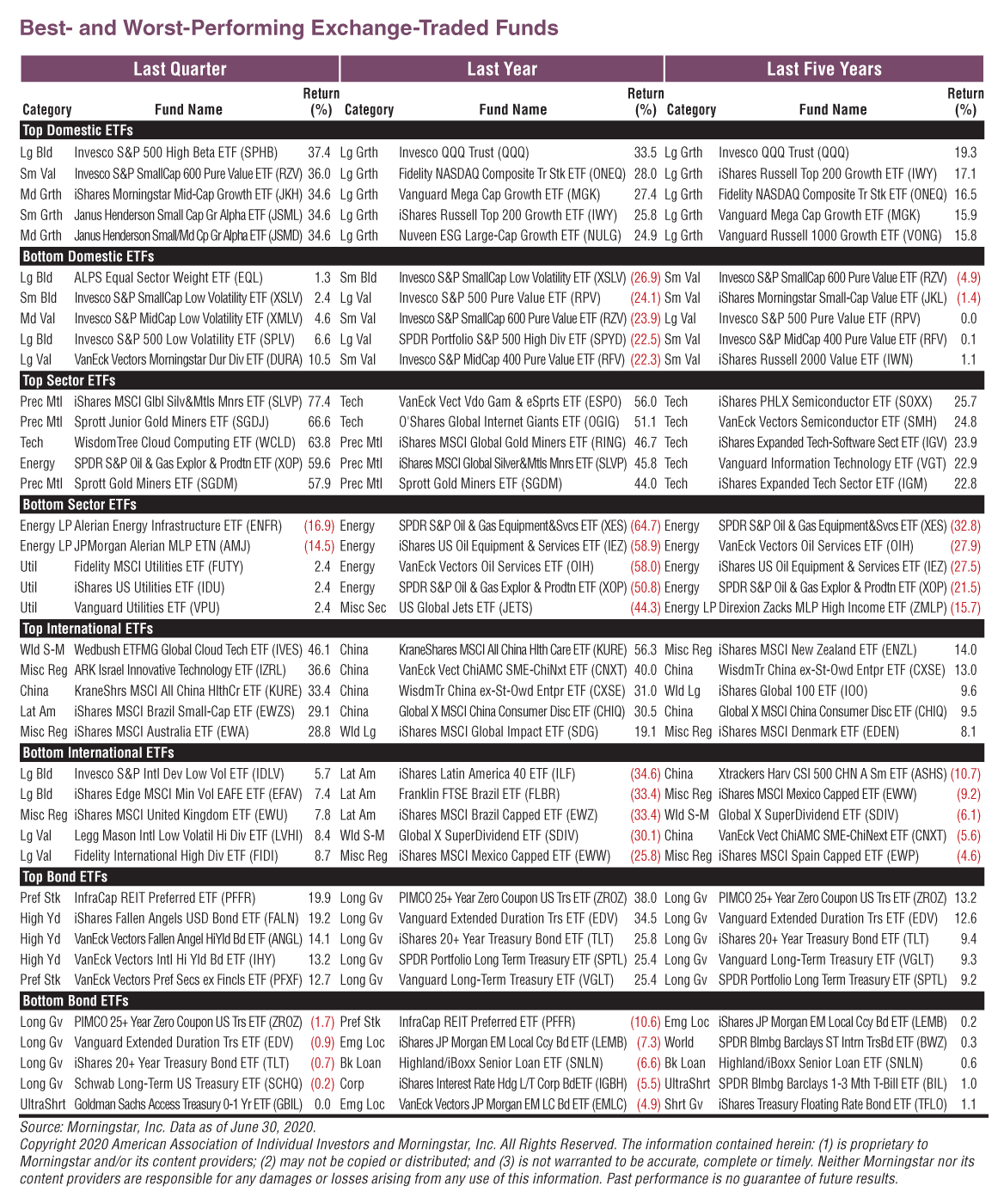
The table shows the data for the ETFs matching the criteria for inclusion in this quarterly update. The big percentage moves realized last quarter by equity-focused ETFs followed massive drops in the first quarter. This is partially why most of the quarter’s best-performing ETFs are different than the ones appearing in the Last Year column.
All That Glitters Is Gold
Three of the five best-performing ETFs last quarter invested in precious metal miners: iShares MSCI Global Silver & Metals Miners ETF  (SLVP), Sprott Junior Gold Miners ETF (SGDJ) and Sprott Gold Miners ETF (SGDM). These funds gained 77.4%, 66.6% and 57.9%, respectively.
Gold prices ended the second quarter at $1,800 per ounce, the highest price in approximately nine years. Precious metal mining stocks—and the funds that target them—are very sensitive to the price of gold, silver and other precious metals. As such, they are highly volatile and have historically experienced both big gains and big losses.
Looking Up at the Cloud
Joining the mining ETFs as one of the quarter’s best performers was WisdomTree Cloud Computing ETF (WCLD). This fund gained 63.8%. WisdomTree is marketing the ETF as a way to invest in the trend of working from home. It invests in companies involved with cloud storage and video conferencing. Zoom Video Communications Inc. (ZM) was the fund’s second-largest holding as of June 30, 2020, with a 3.6% weighting.
The cloud computing theme carried over to the international ETFs as well. The Wedbush ETFMG Global Cloud Tech ETF (IVES) gained 46.1% last quarter. Investors should note that this fund only recently started tracking cloud computing companies. Prior to April 6, it was named ETFMG Drone Economy Strategy with a ticker symbol of IFLY. The fund also followed a different index. So while last quarter’s returns were good, the ETF’s pre-April 2020 record of returns is not representative of future returns.
Domestically, More Volatile ETFs Fared Better
The top domestic exchange-traded funds for the second quarter mostly had higher category risk scores than their peers. These higher scores imply that these funds have historically incurred an above-average level of price volatility. This can be beneficial during periods when the market is rebounding strongly.
The Invesco S&P 500 High Beta ETF (SPHB) and Invesco S&P SmallCap 600 Pure Value ETF (RZV) have Category Risk Grades of F. The Janus Henderson Small Cap Growth Alpha ETF (JSML) and the Janus Henderson Small/Mid Cap Growth Alpha ETF (JSMD) have Category Risk Grades of D. These grades imply that the ETFs’ risk scores rank in the top 60% and top 80% in terms of volatility. Holding a fund with a higher category risk score can be justified if the returns are high enough to justify the extra price volatility. The four funds returned 37.4%, 36.0%, 34.6% and 34.6%, respectively, last quarter.
MLP ETFs Spring a Leak
The two worst performers in the ETF universe for the second quarter invest in master limited partnerships (MLPs): Alerian Energy Infrastructure ETF (ENFR) and JPMorgan Alerian MLP ETN (AMJ). Note the difference in the product designations. Alerian Energy Infrastructure is an exchange-traded fund whereas JPMorgan Alerian MLP is an exchange-traded note (ETN), which is a debt instrument.
JPMorgan Alerian MLP pays a quarterly coupon tied to the cash distributions paid by the MLPs it tracks. The ETN has a maturity date of May 24, 2024. At maturity, a payment will be made based on the value of the volume-weighted level of the index tracked less a tracking fee.
About the Quarterly ETF Update
Started earlier this year, the Quarterly ETF Update highlights the best- and worst-performing exchange-traded funds. Its goal is to provide an overview of the ETFs that are currently outperforming and those that are underperforming.
The ETFs covered are based on the same global asset classes and fund groups used for mutual funds: U.S. equity, sector equity, international equity and fixed income. All ETFs covered are required to have a minimum of $25 million in assets, a minimum trading volume of 5,000 shares per day and an expense ratio ranking in the bottom half of their respective categories. All return information is based on changes in net asset value (NAV) to allow for a more direct comparison with similar mutual funds. ▪
Discussion
FREE REPORT

No comments have been added yet. Add your thoughts to the discussion!
You need to log in as a registered AAII user before commenting.
Log InCreate an account