

Investment Expense Tracking Worksheet
by Charles Rotblut | August 06, 2020
Charles Rotblut recently spoke at the AAII Investor Conference 360. Video replays of all sessions are available for purchase. Go to www.aaii.com/investorconference for more details.

While investors cannot control how their investments will perform, they can exert control on how much of their portfolio’s return is forfeited to expenses and costs. The first step in controlling costs is to identify how much you are paying.
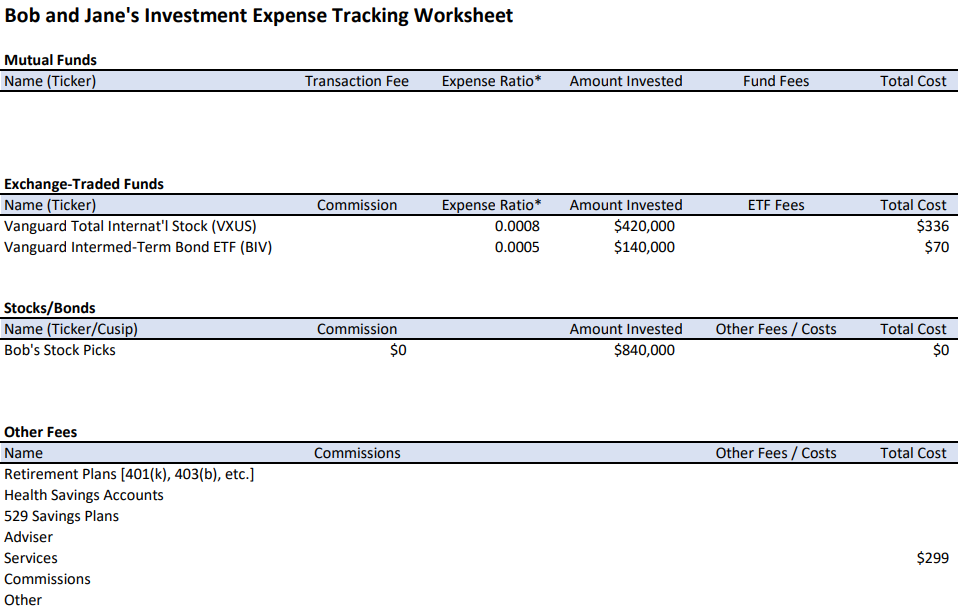
This worksheet will help you identify and quantify how much you are paying out in expenses, commissions, fees and other costs. First, it breaks down the fees you may incur by owning and/or holding certain types of investments. The other fees section, located lower on the spreadsheet, covers various expenses you may also incur such as administrative costs for your 401(k), amounts charged by an adviser and costs you may be incurring for certain other services.

View the PDF.

New! Excel worksheet now available for download.
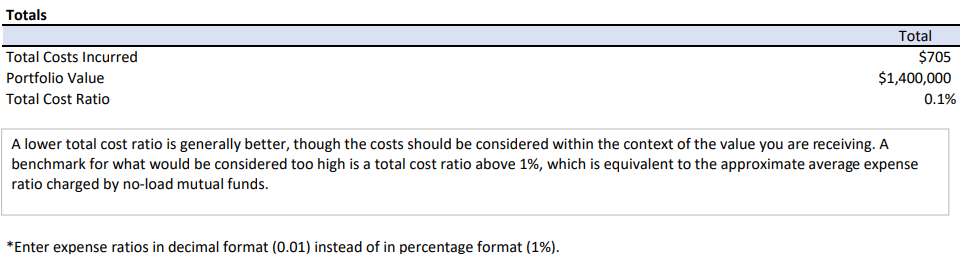
The resulting total cost ratio is the percentage you are paying out in various costs relative to the size of your portfolio. (On a percentage basis, flat costs—such as the price of a subscription product—are inversely related to portfolio size. Expenses charged on a flat percentage basis—such as a management fee—stay proportionate to portfolio size.) A lower total cost ratio is generally better, though the costs should be considered within the context of the value you are receiving. An adviser who helps you stay on track to reach your goals, or a service that provides useful ideas or information, can be well worth the cost. A mutual fund whose expense ratio is above the average for its category is often not worth the higher expense.
For those seeking a benchmark, the average expense ratio for no-load mutual funds is 1% or less (depending on category). This is a reasonable ceiling for your total cost ratio. An individual investor who solely uses index funds could have a significantly lower total cost ratio. These are just guidelines and, again, costs should be considered in the context of the value you are receiving.
These benchmarks are exclusive of taxes paid. While taxes are a cost, they were excluded from the total cost ratio because the realization of capital gains can be episodic and because taxes should not be the key determinant of investment decisions. Rather, taxes should be considered in the context of asset location. Less tax-friendly investments [real estate investment trusts (REITs), corporate bonds, funds with a high tax-cost ratio, etc.] and strategies more likely to have short-term gains should be held in tax-preferred accounts such as IRAs and Roth IRAs when possible.
Example: Combining Stocks and ETFs
Bob is a fully hands-on investor while Jane is an index investor. Their portfolio is composed of individual stocks and exchange-traded funds (ETFs). They are lifetime AAII members and Bob uses Stock Investor Pro to find stock ideas and monitor the fundamentals for his holdings. They have $1.4 million in investable assets, plus another $100,000 held in savings and checking accounts (the latter of which they choose to exclude from the worksheet since they don’t consider it to be “investable assets”). Thanks to combination of low expense ratios and no commissions being charged on trades, their total cost ratio is very low.
Discussion
ANTONIO L from MD posted over 6 years ago:
investor 10382419 YOU WORK AND GREAT NEW IDEAS ARE GREAT TO DO OUR INVESTMENT LIFE PLEASENT THANK YOU. HAVE A FANTASTIC DAY. ANTONIO LEON.
LEWIS C from PA posted over 6 years ago:
I suggest you change the % columns to an actual % field and set it for 2 decimals. The expense ratio is presented as .20% and I highly doubt someone will know to put in .002 in the field.
You need to log in as a registered AAII user before commenting.
Create an account