

Related

AAII InvestoGraphic
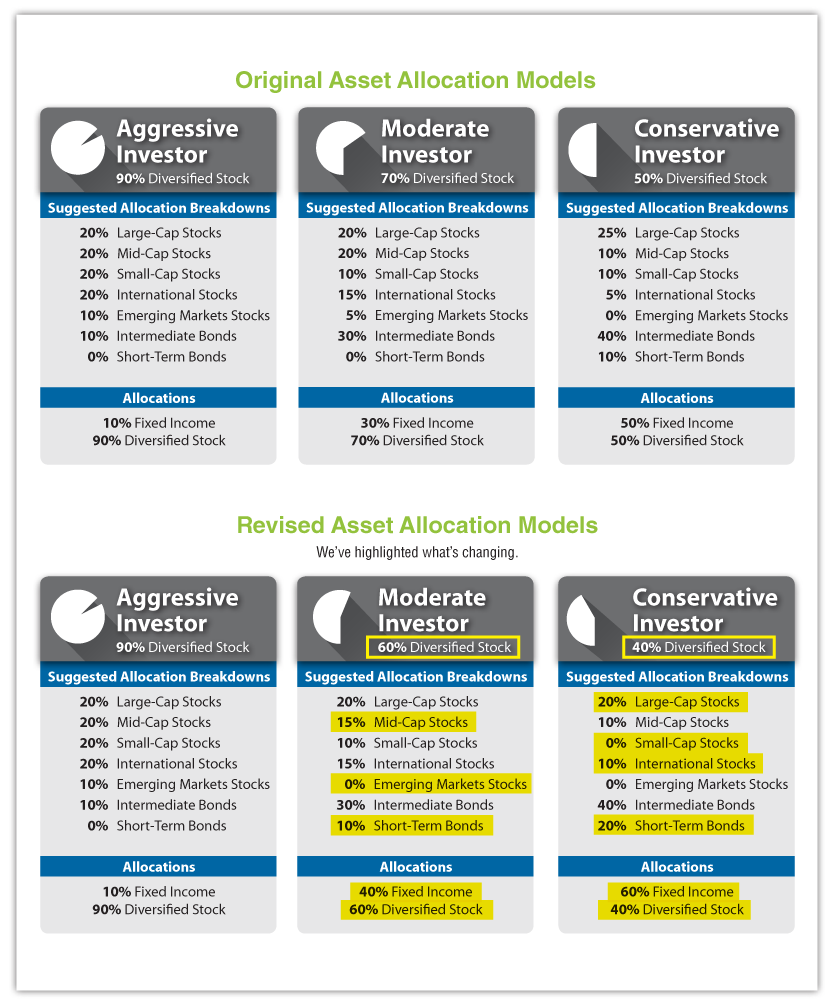
The AAII Asset Allocation Models serve as guidelines individual investors can use to construct appropriate portfolios. We updated two of the models.

Charles Rotblut leads a class in AAII's new Essential Investing Video Course. Go to https://www.aaii.com/ves for more information and to subscribe.
A key part of any investment plan is allocation. How you allocate will significantly affect your ability to reach your goals. It will also influence your ability to stick with a given strategy. Follow an allocation with too much volatility and you may abandon it during a market downturn. Favor investments less prone to bigger price swings and you may end up with too little growth to achieve your long-term goals.
This is why we started the project we’ve code-named “The AAII Way” by asking you to list your goals and assess your tolerance for risk. Without defining these two first, determining the right asset allocation is a guessing game. If you haven’t filled out the first two worksheets, I encourage you to do so. You can find them in the July and August 2020 issues of the AAII Journal or online at www.aaii.com/AAIIWay. [Update: This project became the PRISM Wealth-Building Process.]
Once you have stated your goals and defined your tolerance for risk, you can use them to identify an appropriate allocation strategy. The AAII Asset Allocation Models have long served as guidelines that individual investors can use to help construct appropriate portfolios. As part of The AAII Way, we are in the process of revising the moderate and conservative investor allocation models to improve the trade-off between risk and return.
The aggressive investor allocation model calls for a 90% allocation to stocks and a 10% allocation to cash; this model is staying unchanged. The suggested breakdown is 20% large-cap stocks, 20% mid-cap stocks, 20% small-cap stocks, 20% international stocks, 10% emerging market stocks and 10% intermediate bonds.
An alternative would be to use AAII founder James Cloonan’s Level3 approach or one or more of AAII’s model portfolios (Model Shadow Stock Portfolio, Dividend Investing, Stock Superstars Report and VMQ Stocks) for the stock portion. The bond portion is essentially a proxy for a low-volatility buffer. It could be substituted for cash-like assets to fund near-term goals and cash flow needs. Cloonan, for instance, suggested that retirees keep two to four years of planned withdrawals in cash or cash equivalents.
The Moderate Investor Model is changing from a 70% diversified stock weighting to a 60% diversified stock weighting. The bond weighting is increasing from 30% to 40%. This change brings the moderate investor model’s equity/bond exposure in line with the well-established 60/40 allocation benchmark. The revised mixture is 20% domestic large-cap stocks, 15% domestic mid-cap stocks, 10% domestic small-cap stocks, 15% international stocks, 30% intermediate-term bonds and 10% short-term bonds. The bonds can be Treasuries, investment-grade corporate bonds or municipal bonds.
There are a few reasons for the change. The 60/40 allocation is a well-established benchmark. It has held up well against a variety of more complex allocation strategies. For retirees, the 60/40 allocation tends to work well with the long-established 4% withdrawal rule. Even at retirement periods of 40 years in length, portfolios using the simplified version of 60/40 did not run out of money 87% of the time. A variety of investment models and strategies center around the 60/40 approach.
The 60/40 allocation is also easier to follow. This is important because one of the reasons investors bail on their investment strategy is because the level of volatility is too high. While we can make the argument of volatility being the price of higher returns, psychological and financial tolerances vary. Not all investors can tolerate higher levels of volatility to realize higher returns. Just tweaking the equity and fixed-income weightings of AAII’s moderate investor allocation resulted in a better risk/return trade-off for many investors (a 20-year annualized return of 6.1% with a standard deviation of 10.1% versus a 6.6% annualized return and a standard deviation of 12.4%).
The conservative investor model is also being made less volatile. It is currently 50% stocks/50% bonds. The mix is being lowered to 40% stocks/60% bonds. The new suggested weighting is 20% large-cap stocks, 10% mid-cap stocks, 10% international stocks, 40% intermediate-term Treasuries and 20% short-term Treasuries.
The small-cap stock exposure was removed to reduce volatility, large- and mid-cap international equity exposure was increased for diversification purposes and the exposure to short-term bonds was doubled. A basic 40/60 mix held up well for retirees following the 4% rule, with the portfolio lasting for a full 35-year period 86% of the time.
AAII InvestoGraphic

Trading Strategies


G L from IL posted over 6 years ago:
Narayana S from VA posted over 6 years ago:
CHARLES L from FL posted over 2 years ago:
You need to log in as a registered AAII user before commenting.
Log InCreate an account