


Trading in odd-lot increments (meaning in counts other than a multiple of 100 shares) has increased in recent years. In 2019, such trades accounted for nearly two-thirds of the market in trades.
The larger amount of odd-lot trading correlates to increases in nominal stock prices, lower commissions and more algorithmic trading. Additionally, on higher-priced stocks, a higher percentage of odd-lot trades have had transaction prices within the National Best Bid and Offer (NBBO), which is a U.S. Securities and Exchange Commission (SEC) regulation requiring brokers to execute customer trades at the best available (lowest) ask price when buying securities, and the best available (highest) bid price when selling securities.
Researchers identified these trends after looking at literature as well as data in the NYSE Trade and Quote (TAQ) database from January 1, 2014, to December 31, 2019, and from the SEC’s Market Information Data Analytics System (MIDAS).
For individual investors, commissions on trades for less than 100 shares had been proportionately higher than they were for trades of a round lot (100 shares). This is because, traditionally, most brokerage firms charged a fixed minimum commission level to execute trades. Online trading platforms and lower commissions have made it easier and cheaper for investors to trade in odd lots. For institutional and professional investors, algorithm and high-frequency trading have increased the practice of splitting orders into smaller numbers of shares.
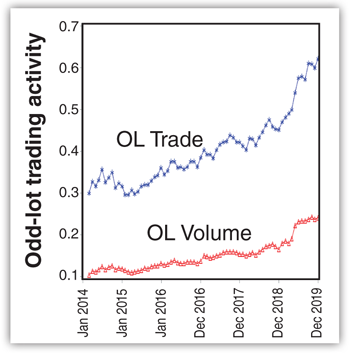
Both groups are sensitive to the high nominal price of some stocks. Wealth constraints limit the number of shares individual investors can purchase. Institutional investors face the prospect of moving a stock’s price if they try to transact in too many shares at once.
Notably, lower-priced stocks also experienced more odd-lot trades both by percentage of trades and trading volume. The researchers attributed this finding to the use of algorithmic trading, which submits odd-lot orders as an optimal investing strategy.
Researchers also found that, consistent with wealth constraints and concerns, the average size of odd-lot trades decreases with price level. Furthermore, the percentage of odd-lot trades with transaction prices strictly within NBBOs is larger than round-lot or mixed-lot (blend of round- and odd-lot) trades.
Source: “Odd-Lot Trading Activity and Nominal Stock Price,” by Kalok Chan and Jinming Xie; SSRN, July 2020.
Discussion
FREE REPORT

No comments have been added yet. Add your thoughts to the discussion!
You need to log in as a registered AAII user before commenting.
Log InCreate an account