Older adults who are unaware that they have experienced a decline in their cognitive abilities are more likely to incur losses of wealth, relative to those who don’t incur such cognitive declines or are aware of their impairments. These losses are more substantial among wealthier individuals that were previously active investors in the stock market.
Using data from the Health and Retirement Study (HRS), an ongoing study of elderly adults in the U.S., researchers analyzed the relationship between individuals’ perception of their memory performance and changes in wealth. The HRS data included the results of cognitive tests given to respondents. The analysis covered nearly 20,000 households. The majority of these households were composed of individuals between 50 and 80 years old.
The financial consequences are far more severe when the financial decision-maker of a household is unaware of their cognitive decline. The occurrence of a cognitive decline for the financial decision-maker of a household leads to roughly a $20,000 drop in wealth, while the occurrence of cognitive decline for nonfinancial respondents leads to about a $6,500 drop in wealth. Wealthier respondents with a lack of awareness of cognitive deficiencies, on average, experience a $22,000 drop in the net value of stocks, mutual funds and investment trusts owned.
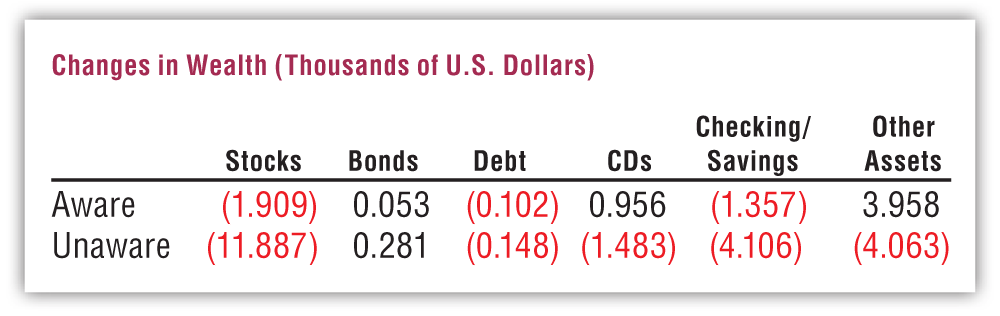
The paper’s authors assert, “respondents who experienced a severe memory loss show better cognitive performance at the baseline and were therefore likely to be more confident about their ability … losses in financial wealth are mainly observed among unaware respondents who reported to be active in the financial markets in the last two years.” Being unaware does not affect the probability of being in the stock market, but it does cause people “to perform worse on familiar tasks.”
Individuals unaware of a cognitive decline who were previously active investors incurred roughly 16% in financial wealth losses, while unaware individuals who were inactive investors experienced about 6% in financial losses. More than half of the average loss is attributable to a decrease in value of stocks, mutual funds and investment trusts.
Source: “Are Older People Aware of Their Cognitive Decline? Misperception and Financial Decision Making,” by Fabrizio Mazzonna and Franco Peracchi; IZA Institute of Labor Economics, September 2020.







No comments have been added yet. Add your thoughts to the discussion!
You need to log in as a registered AAII user before commenting.
Log InCreate an account