



Related

First Cut Stocks
Stock splits help to make shares more affordable to smaller investors and provide greater marketability and liquidity in the market.

Derek Hageman leads a class in AAII's new Essential Investing Video Course. Go to https://www.aaii.com/ves for more information and to subscribe.
Stock splits and stock dividends are often announced with great fanfare and strong press coverage. A stock split is a decision by a company’s board of directors to reduce the prevailing stock price by increasing the number of shares that are outstanding.
After a split, the stock price is reduced (since the number of shares outstanding has increased). So, although the number of outstanding shares increases and the price of each share proportionately decreases, the company’s market capitalization remains unchanged. (Market cap is the stock’s price times total number of shares outstanding.)
The accounting treatment of stock dividends and splits is slightly different, but for the investor stock dividends and stock splits are identical except in magnitude.
Stock dividends are distributions of additional shares of stock to shareholders instead of cash. For an investor holding 100 shares of stock, a 5% stock dividend would entitle the investor to another five shares of stock. When stock dividends are over 25%, they are typically called splits.
A positive stock split or dividend partitions the outstanding shares of a corporation into a larger number of shares accompanied with a proportionate decrease in share price, without affecting the overall shareholder’s equity or the total market value. For example, if you own 100 shares of a company that trades at $90 per share for a total value of $9,000 and it declares a 3-for-2 stock split (a split ratio of 1.5), you will own a total of 150 shares at $60 per share for the same total value of $9,000 after the split. Positive stock splits are the most common kind.
Why do companies split their shares—and why should you care? While stocks normally get a small boost from announcing a split, splits usually follow a period of strong price performance.
Many companies generally like to keep their stock’s price per share within a certain range. When a company’s share price increases to levels that it believes are too high, it may decide to do a stock split. The reason for this is that a stock split can make shares seem more affordable to small investors (even though the underlying market value of the company has not changed). This also has the practical effect of increasing liquidity in the stock.
When a stock splits, it can result in a share price increase—even though there may be a decrease immediately after the stock split. Small investors may perceive the stock as being more affordable and buy the stock. This effectively boosts demand for the stock and drives up its price.
Another possible reason for a price increase is that a stock split provides a signal to investors—particularly future potential buyers of the stock—that the company’s share price has been increasing. People may assume this growth will continue in the future, thereby further boosting demand and prices for the stock.
A stock split announcement represents a vote of confidence from the board of directors that acknowledges a company’s stock performance and signals that the board feels that performance is going to continue.
When a company announces a stock split, it provides three important dates for shareholders, a record date, a split date and an ex-date. The record date determines which shareholders are entitled to receive additional shares due to the split. On the split date, shareholders receive the split shares after the close of business. The ex-date is the date when a company’s shares will trade at the new split-adjusted price.
You must hold the stock at the close of business on the record date to be eligible for the split, while the actual split itself and the adjustment to the number of shares in your account take place on the ex-date.
On April 1, 2021, Sherwin-Williams Co.  (SHW)—a leading producer of paints, coatings and related products to professional, industrial, commercial and retail customers—split its stock 3-for-1. In a press release issued on February 3, Sherwin-Williams said the board of directors approved and declared a 3-for-1 stock split in the form of a stock dividend “to make the stock more accessible to employees and a broader base of investors.”
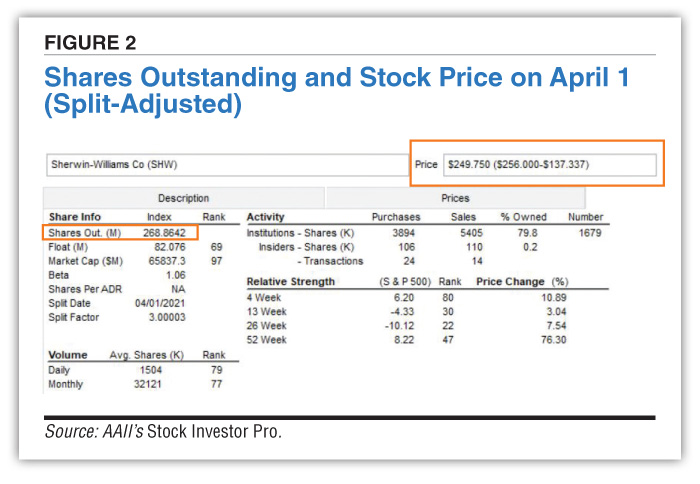
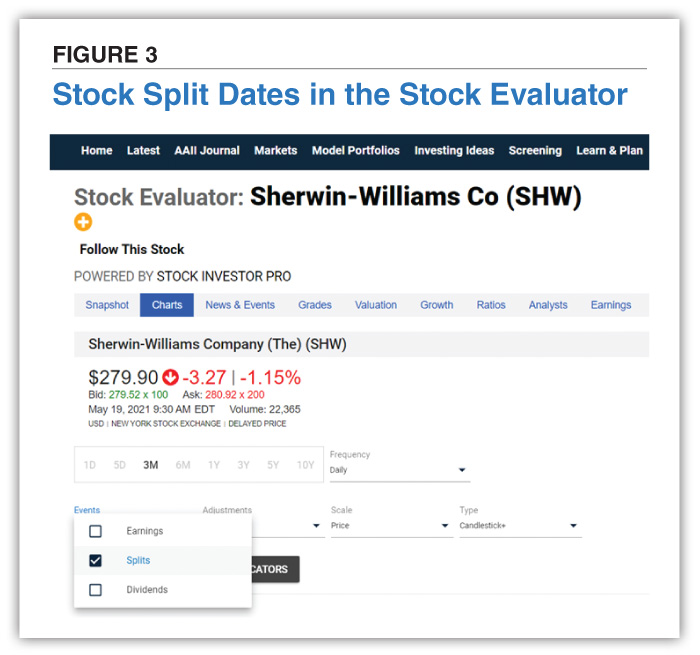
To illustrate how the mechanics of a stock split work, we use AAII’s Stock Investor Pro fundamental stock screening and research database. Figure 1 shows the share statistics subtab in the overview section with data as of March 31 (pre-split). Figure 2 shows the same tab with data as of April 1 (split-adjusted). AAII members who do not subscribe to Stock Investor Pro can see stock split dates and ratios on the Charts tab of the Stock Evaluator by choosing Splits from the Events drop-down menu (Figure 3), just above the chart.
If you held shares of Sherwin-Williams before the market open on April 1, you now own three shares for every share you held, and the stock price was reduced to one-third of its value at the start of trading on April 1. Sherwin-Williams shares closed on March 31 at $738.01 (pre-split), which translates into a split-adjusted price of $246.00. On April 1, Sherwin-Williams shares closed at $249.75.
If you sold Sherwin-Williams shares on or after the record date (March 23) but before the open on the ex-date, April 1, you sold them at the pre-split price. You were not entitled to the split shares. Following the split, the new owner of the shares will be entitled to the additional shares resulting from the stock split.
If you bought Sherwin-Williams shares on or after the record date but before the ex-date, April 1, you purchased shares at the pre-split price and received the shares purchased. Following the split, you received the additional shares resulting from the stock split. The stock split does not change your proportionate ownership interest in Sherwin-Williams. The total value of your holdings is not directly affected by the split; only price fluctuations in the stock’s price will impact the total value of your holdings.
When it comes to stock splits, this is perhaps the most straightforward question to answer, because most of the time investors should do nothing at all.
With a regular split, there isn’t much more to do besides standing pat. Historically, there is a good chance that immediately following both the announcement and the ex-date, the stock will get a small boost, so if you were thinking of selling just before an announcement, you might want to hold off a little before doing so.
There is no taxable income as a result of Sherwin-Williams’ stock split for U.S. federal income tax purposes. The tax basis of each share owned after the stock split will be one-third of the amount it was before the split. For example, if you owned 100 shares before the split with a tax basis of $300 per share, after the split you would own 300 shares of stock with a tax basis of $100 per share.
A stock split is used primarily by companies that have seen their share prices increase substantially. Although the number of outstanding shares increases and the price per share decreases, the market cap (and the value of the company) does not change. As a result, stock splits help to make shares more affordable to smaller investors and provide greater marketability and liquidity in the market.
Stock splits are much more common than most investors think, although their impact is minor. The most important thing to keep in mind, though, is that they don’t change the value of your holdings, although they may have some influence on the stock’s performance for a while after they happen.
Keep in mind that a stock dividend, split or announcement is not a reason to buy a stock but serves as a pointer to recently successful stocks that may be attractive if the fundamental factors that fueled the performance remain.
We think you’d like this related webinar! Individual Investor Show: Stock Splits, Robo Advisers and How to Use My Screens
First Cut Stocks

Computerized Investing


No comments have been added yet. Add your thoughts to the discussion!
You need to log in as a registered AAII user before commenting.
Log InCreate an account