

Related


Portfolio Strategies
A worker’s income, education level, marital status, level of debt and employment status have been found to have a major impact in determining what they do with their 401(k) and other defined-contribution (DC) retirement accounts.
by AAII Staff | July 2021

A worker’s income, education level, marital status, level of debt and employment status have been found to have a major impact in determining what they do with their 401(k) and other defined-contribution (DC) retirement accounts.
Using data captured by University of Michigan’s Health and Retirement Study (HRS) for the 2014–2016 period, Pew Charitable Trusts analyzed how 159,726 workers and retirees aged 50 or older moved their retirement savings when faced with various work transitions such as job changes or retirement.
One of the most significant findings was that low-income households of under $25,000 were more than three times as likely to withdraw all of their savings as opposed to households with income of $100,000 or more a year. Pew notes that this may be due to “rules allowing employers to cash out or force a transfer of small accounts when an employee leaves a company because of the administrative cost of maintaining such accounts.”
Additional factors that may contribute to the withdrawal of all savings include a high level of uncollateralized debt and marital status. Pew notes that “some single respondents may have faced the increased financial pressures that can be associated with living on one income.” Lower levels of both education and amounts in accounts also contributed to high rates of withdrawal.
Conversely, individuals with debt ratios of 40% or more were more likely to not withdraw their savings. This debt “may include personal loans or student loans at relatively low interest rates, and individuals may be less inclined to use retirement savings.” Higher education levels are also correlated with keeping funds in defined-contribution accounts.
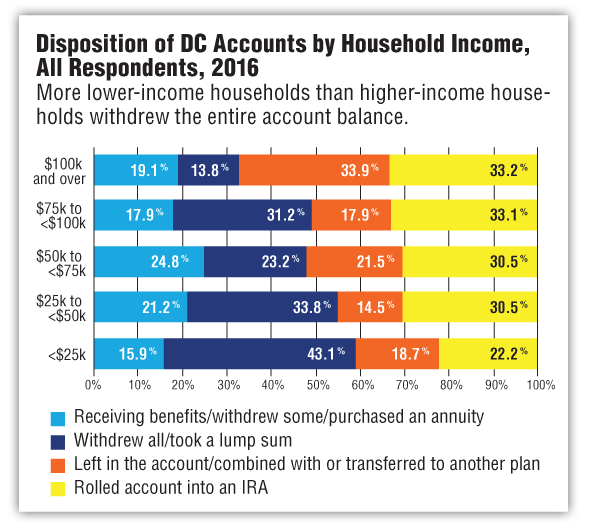
Pew concluded that those who previously owned an existing individual retirement account (IRA) were more likely to rollover their 401(k) account into another IRA. From 2014–2016, 41% of IRA rollovers were done by someone who already had an IRA in 2014. This is compared to the 17.5% of rollovers that were made by those who didn’t have an IRA set up by 2014.
Source: How Employees Handle Their Retirement Savings During Work Transitions; The Pew Charitable Trusts, May 2021.
Portfolio Strategies


No comments have been added yet. Add your thoughts to the discussion!
You need to log in as a registered AAII user before commenting.
Log InCreate an account