

Related

First Cut ETFs
Almost half (45%) of Financial Times Stock Exchange 100 index (FTSE 100) companies have some form of environmental, social and governance ESG measures within their executive pay.
by AAII Staff | August 2021

Almost half (45%) of Financial Times Stock Exchange 100 index (FTSE 100) companies have some form of environmental, social and governance (ESG) measures within their executive pay.
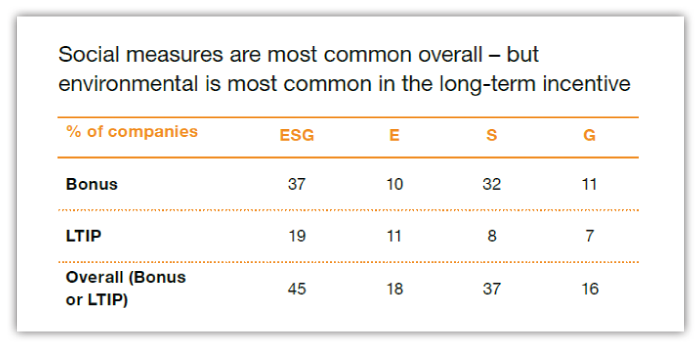
Of these companies, 37% include ESG measures in bonuses and 19% made them part of their long-term incentive plans (LTIPs). The use of ESG measures in compensation plans comes as companies are increasingly recognizing their importance in terms of both long-term goals and how they operate.
These findings were part of a study conducted by PWC and the Centre for Corporate Governance at the London Business School. The study examines executive pay methods in relation to ESG goals for FTSE 100 companies.
The report makes key distinctions between old and new ESG measurements. “Old” ESG was defined as measures relating to risk, employee engagement and employee health & safety. Old measures were regulatory requirements or risk-related issues that connected directly to shareholder value.
Conversely, “new” ESG measures include communities, decarbonization, diversity, plastic reduction and other sustainability goals. The study states that these newer ESG measurements “represent a company’s obligations to a wider range of stakeholders,” conveying corporate responsibility to other people and entities besides shareholders. The table here summarizes the percentage of companies in the study incorporating each component of ESG.
The report also explores how these metrics should be used in practice and takes a deeper look at two opposing schools of thought. The Alignment View sees ESG as a necessity that can discipline short-term-oriented executives and believes that “ESG supports shareholder value.” In contrast, the Trade-off View sees ESG metrics as something that can detract from shareholder value or require a trade-off that comes “in conflict with shareholder value.”
These two opposing ideas convey that incorporating ESG into pay is difficult and can be an impactful decision. The study’s authors cite guidance from The Investment Association (a U.K. trade group) on including ESG metrics, stating that measures should be “material to the business and quantifiable.” This highlights that companies should employ ESG metrics that are relative to their products or industry as a motivator for executives to foster healthy relationships with their respective stakeholders.
Source: “Paying well by paying for good,” PWC, London Business School, Centre for Corporate Governance; July 2021.
First Cut ETFs

First Cut Mutual Funds

Portfolio Strategies

No comments have been added yet. Add your thoughts to the discussion!
You need to log in as a registered AAII user before commenting.
Log InCreate an account