Can a Roth IRA Conversion Save You Money?

Moving assets from a traditional IRA to a Roth IRA is most compelling when you pay tax on the converted amount at a relatively low rate.
Since 2010, all investors have been allowed to convert assets from a traditional individual retirement account (IRA) to a Roth IRA. Because conversions are not subject to income restrictions, people at any income level can take advantage of the Roth’s key benefit: tax-free qualified distributions. (A qualified distribution is tax-free if taken at least five years after the year of your first Roth contribution AND you’ve reached age 59 1/2, become totally disabled, died or met the requirements for first-time home purchase. If the distribution from your Roth IRA is not qualified, the earnings may be taxable. Additional taxes may apply for early withdrawals.)

A Roth conversion provides you with tax diversification in your retirement years. In addition, Roth IRAs do not have required minimum distributions (RMDs) for the original owner, whereas traditional IRAs are subject to RMDs in the year you reach age 72 (or age 70½, if you reached age 70½ on or before December 31, 2019). These positives need to be weighed against the tax you pay on the amount converted.

Deciding whether a Roth conversion makes sense in your situation depends on several factors, including:

  • Your current and future tax rates,
  • Your mix of assets and
  • Possibly your heirs’ future tax rates.

Before you execute a Roth conversion, you’ll also want to consider:

  • How you will pay the taxes on the distribution,
  • Timing of the conversion in relation to your retirement horizon and
  • Whether you are (1) planning to use the money yourself or (2) planning for it to be used by your heirs.

Advantages of Converting to a Roth

You can benefit from a Roth conversion by paying taxes now at a lower rate if your tax rate is likely to be higher when you take distributions. The strategy should be considered in a number of situations, if you are able to pay the taxes (preferably from a nonretirement account):

  • Your current income is unusually low.
  • You plan to leave the assets to heirs whose tax rates will be higher than yours.
  • Your assets are primarily in tax-deferred accounts, and you want more tax flexibility.
  • You want more opportunity to optimize asset location—holding different types of assets in different accounts.
  • You want a hedge against higher statutory tax rates. (For example, following the tax cuts passed in late 2017, you might believe that tax rates are unlikely to be any lower during your lifetime.)
  • You won’t need your RMDs for retirement expenses. As we will discuss further, even if your tax rate stays flat or decreases in retirement (despite the RMDs), a Roth conversion could be beneficial if you pay the taxes from an account that isn’t highly tax-efficient.

Disadvantages of Converting to a Roth

The key disadvantage of a Roth conversion is taxes due on the converted value. There are a number of reasons your tax rate may be lower when you (or your heirs) take distributions:

  • Many people have lower income in retirement.
  • When you take retirement distributions, they may represent a large portion of your income and straddle tax brackets, resulting in a lower average tax rate. (In contrast, the conversion probably adds to the income taxed primarily at your marginal, or highest, rate.)
  • Some states don’t tax retirement distributions or have no income taxes at all, which is important to consider if you might relocate.

There are also factors to consider specifically for the year of conversion. Higher taxable income that year could have one or more of these negative effects:

  • A higher tax bracket,
  • A higher portion of Social Security benefits subject to tax,
  • Higher Medicare premiums and
  • Less eligibility for student financial aid.

Strategies for Paying Taxes on a Conversion

In general, a conversion works best if you can pay taxes from a taxable account. Selling assets in a taxable account may be all or partly a return of your principal (cost basis) and, therefore, may not be a taxable gain. Realized gains from those sales may be taxed at the long-term capital gains rate, which is typically lower than your marginal ordinary income tax rate. If you’re considering this approach, make sure that you still have an adequate emergency fund and that this doesn’t inordinately reduce your financial flexibility.

You could also pay the tax using distributions from the traditional IRA or from existing Roth assets. In both cases, you could pay a penalty on the distributions if you’re under the age of 59½. Funding the tax from a traditional IRA would incur ordinary income tax on that distribution, so unless you’re in a low tax bracket, that’s not ideal. Using an existing Roth to pay the taxes doesn’t result in ordinary income tax, but this approach essentially reduces the amount and the value of the conversion.

When Is the Right Time to Convert Assets?

A Roth conversion is most compelling when you pay the tax on the amount converted at a low rate. So if your income is irregular, consider Roth conversions in low- income years. Or you could consider a conversion in a year when you’ve been unemployed. Unfortunately, those years may coincide with cash flow challenges, making extra tax payments impractical. But if you have lined up new employment without falling below a prudent cash level, a conversion could make sense.

Another common example is converting assets early in retirement before you face RMDs. As noted above, be careful about triggering higher taxes on Social Security benefits or higher Medicare premiums in the conversion year. However, reducing your RMDs could have a favorable impact on Social Security taxation or Medicare premiums later. Ideally, you should coordinate your Social Security claiming strategy and retirement income strategy, including the account drawdown order and possible Roth conversions.

The Setting Every Community Up for Retirement Enhancement Act of 2019 (SECURE Act), passed in late 2019, may make Roth conversions more attractive for some people. Under the SECURE Act, most IRAs inherited by beneficiaries [other than spouses, disabled or chronically ill individuals, or those less than 10 years younger than the IRA owner (or other exceptions)] will need to be fully distributed within 10 years of the original owner’s death. That income could push some beneficiaries into higher tax brackets. Therefore, a Roth conversion could be attractive if those beneficiaries’ tax rates are higher than the rate upon conversion. In addition, the starting age for RMDs has been pushed out from 70½ to 72, which may allow more time to execute a conversion strategy. (This change in age is only available for individuals who did not reach age 70½ on or before December 31, 2019.)

Running the Numbers: Evaluating Different Scenarios

We analyzed a situation in which a Roth conversion might make sense: Traditional IRA assets that won’t be needed for retirement income are available, and a taxable account exists to pay the tax upon conversion. In this situation, the assets are intended to pass to heirs (in the next generation, as opposed to between spouses). A person in this position can use a series of annual Roth conversions to reduce unwanted RMDs. (This analysis builds upon T. Rowe Price’s analysis by Judith Ward, CFP, republished in the March 2015 AAII Journal, “Converting to a Roth IRA Can Minimize RMDs.”) Within this framework, we evaluated scenarios with a focus on three key parameters:

  • Tax characteristics of the taxable account used to pay taxes on a conversion,
  • Tax rate during working years versus in retirement and
  • Potential tax rate of your heirs.

The first of these parameters merits some explanation. Returns in a taxable account can generally be treated in one of three ways for federal income tax: ordinary income (e.g., interest received), capital gains (profits from the sale of securities) and tax-free (e.g., interest for certain municipal bonds). In addition, if you hold appreciated securities until death, your heirs can benefit from a “step-up” in cost basis. That means that they don’t pay capital gains taxes on appreciation through the date of your death, so those gains are also essentially tax-free.

For each combination of these parameters, we measured the results of three strategies:

  • No Roth conversion,
  • Roth conversions each year from age 55 to age 72 and
  • Roth conversions each year from age 65 (retirement) to age 72.

Each strategy is measured by the total aftertax asset value received by heirs upon the owner’s death (assumed to be at age 95). This value assumes that traditional IRA assets are taxed upon death at the heirs’ ordinary tax rate. (Roth and taxable accounts are assumed to pass to heirs’ income tax-free.)

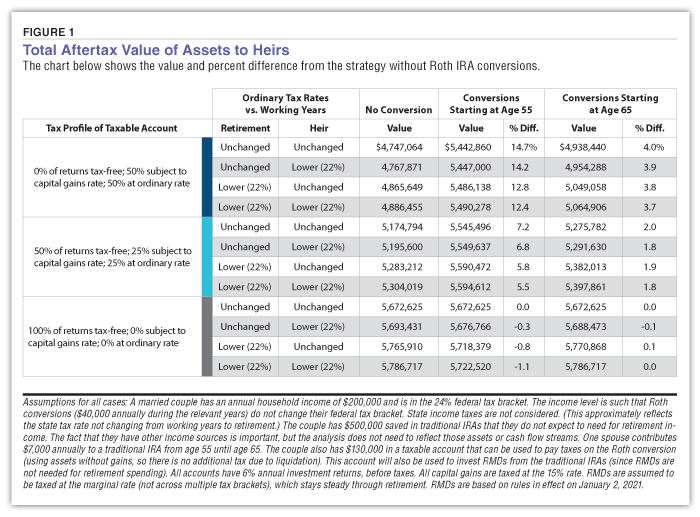
We evaluated 12 combinations of assumptions for the three key parameters. Other assumptions were held constant for all scenarios (as explained in Figure 1). We didn’t analyze situations where the worker’s tax rate increases during retirement because those are generally advantageous for Roth conversions. Again, the idea was to depict a situation in which Roth conversion is plausible but not a “slam dunk.”

Key Findings

  1. In this broad situation (in which the IRA assets aren’t needed for retirement spending), the benefit of a Roth conversion is driven largely by the profile of the taxable account being used to pay taxes on the conversion. If the taxable account is primarily generating ordinary income or even capital gains, Roth conversions are usually beneficial in the general situation we studied. (See dark blue and bright blue rows in Figure 1.)
  2. There are situations in which a Roth conversion doesn’t add value. (See dark gray rows in Figure 1.) This occurs if the taxable account generates tax-free returns and the person’s tax rate in retirement (and/or the heirs’ tax rate) is lower than during working years.
  3. If converting makes sense, you generally get much more benefit by starting sooner (and, therefore, converting more). Alternatively, you could convert the same total amount over fewer years, but you’d be more likely to jump into a higher tax bracket.

FIGURE 1 Total Aftertax Value of Assets to Heirs

The importance of the taxable account profile may seem counterintuitive. After all, the conversion is from a traditional IRA (pretax) to a Roth, and the taxable account seems like a secondary factor. In general, however, traditional and Roth IRAs have equivalent results if a person’s tax rates stay constant. (See “Investment Performance Comparison Between Roth and Traditional Individual Retirement Accounts,” by George Kutner et al. in the February 2001 issue of the Journal of Applied Business Research.)

You can think of a Roth conversion more as a shift of assets from a taxable account (the conversion tax paid) to a tax-advantaged one. This explains why the ninth row of Figure 1 shows no difference between converting and not converting if tax rates stay constant and the taxable account is all tax-free.

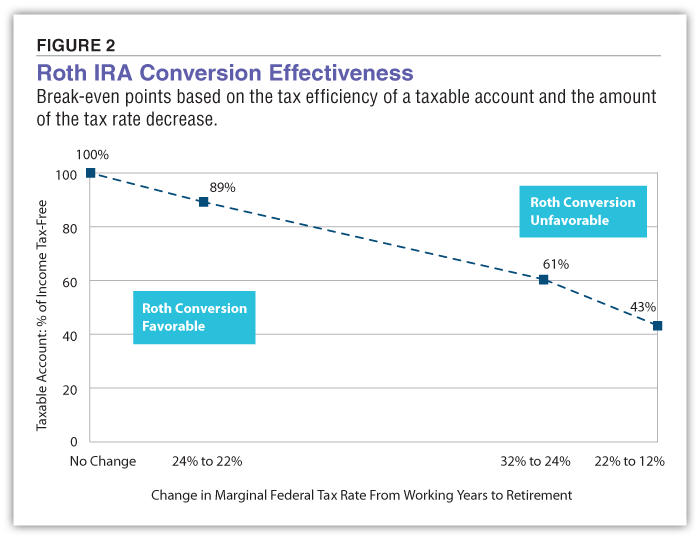
It may also be surprising that the benefit of this shift from taxable to tax-advantaged can even outweigh a tax rate reduction in retirement. So we dug a little deeper to analyze the impact of taxable account profiles for different levels of tax rate reduction (see Figure 2).

FIGURE 2 Roth IRA Conversion Effectiveness

This analysis assumes the taxable account generates only earnings at 0% or capital gains rates, not at ordinary rates. (This reflects a person who carefully manages assets across account types.) It also assumes the heirs’ tax rate is the same as the person’s tax rate during retirement. Starting amounts in the accounts, as well as the amount of annual conversions, are adjusted proportionally based on approximate income levels for the starting tax brackets. The analysis is based on starting conversions at age 55. Other assumptions are consistent with the analysis summarized in Figure 1.

For example, if a couple’s tax rate falls from 24% in working years to 22% in retirement, converting is favorable unless more than 89% of earnings in the taxable account are tax-free. For someone whose rate falls from 22% to 12%, converting becomes unfavorable when more than 43% of the taxable account earnings are tax-free. Again, these numbers rely on the specific situation evaluated in which someone doesn’t need RMDs for expenses in retirement, among other assumptions.

Conclusion

People approaching retirement age or who recently retired should at least consider a Roth conversion strategy. Many of those people will correctly conclude that it’s not practical or advantageous due to upfront taxes on the conversion.

However, our analysis paints a picture of people who could benefit significantly. These people have saved diligently in all of their pretax retirement accounts. They probably don’t have significant Roth assets, because Roth contributions were unavailable or unattractive at their income level. They have taxable account assets, perhaps from windfalls or because they were able to save beyond retirement contribution limits. They may have a pension or other income sources that give them confidence they will leave assets to their heirs.

For these investors, a Roth conversion reduces unwanted RMDs. It is especially attractive if their taxable income is low in their early retirement years. However, even if their tax rate stays flat or decreases in retirement, they may benefit from a Roth conversion if they are using a relatively tax-inefficient taxable account to pay the taxes on the conversion. Because there are many interrelated factors in this decision, you may want to consult with a financial planner to evaluate your specific circumstances. 

Can a Roth IRA Conversion Save You Money? Video

We think you’d like this related webinar! Individual Investor Show: Convert to Roth IRA?, Small-Cap Value Funds, PRISM on Choosing Bonds


Discussion

R L from TX posted over 4 years ago:

A couple of other considerations for a Roth conversion, are the expiration of the Federal tax cut in 2026. This will raise the income tax percentages from 22% to 25%, 24% to 28%, 32% to 33%, 35% to 35%, and 37% to 39.6%. A taxable income after deductions of $100,000 would pay an additional $3,000 in federal tax, $200,000 an additional $8,000 and a $300,000 an additional $12,000 in federal taxes. (Assumes filing jointly.) Another consideration for a Roth conversion is if you are married and file a joint return; sooner or later one spouse will die and the surviving spouse will file as a single tax payer. The surviving spouse could easily go from a incremental federal tax bracket of 22% to 32% or higher.


JOHN M from VA posted over 4 years ago:

One other idea not mentioned is the advantage of converting when the market drops. This allows you to shelter more stock as prices have declined. Unfortunately, the “ do over “ option to reverse a conversion is no longer available, but on a drop in values ,it still can make more sense.


EL S from IL posted over 4 years ago:

Another thing not mentioned is the "Qualified Charitable Distribution" (QCD). If you donate to qualified charities then by donating directly from an IRA the money is not considered taxable income even though it is part of your RMD. We don't have enough other tax deductions to cover the standard deduction such that the donations I do make would be 100% deductible. This way I get our full standard tax deduction plus the full charitable donations aren't taxed. Since it isn't considered income then based on the state you live in a QCD might also not be taxed.


RICHARD O from CA posted over 4 years ago:

This analysis is overly simple, though it is illustrative. Why stop making ROTH conversions at age 72? Age 72 appears to be arbitrary based on current RMD rules. Admittedly, the earlier one takes ROTH conversions the better, since that allows more money to be accumulated in the ROTH. One may want to tap one's ROTH account later in life to manage one's TAX rate, say in the event of a Medical or other emergency requiring additional funds that would normally raise one's taxes coming out of a retirement account, such as an IRA or 401K. What are the considerations that need to be taken into account in this case? What about the potential tax consequences that may limit the size of a ROTH Conversion one may want to take? Such as exceeding the Modified AGI limit that if exceeded triggers additional Medicare taxes, and those that can negatively affect those of us who are already retired by increasing our Part B premiums. What about the case where the ROTH conversion taxes are paid from the normal RMD that a retired person is taking? Why not continue making incremental ROTH conversions until the MAGI Medicare limit would be exceeded? A previous AAII article pointed out the ROTH conversions can lower future RMDs thereby potentially lowering our taxes in the future. Isn't money in a ROTH account always preferential to money in a taxable account? Aren't we told to use our taxable money first? This is a much more complex and nuanced situation than presented and it is disappointing that it has not helped those of us who are struggling with doing ROTH conversions to assure we have considered all the factors that need to be considered. Perhaps in a future article?


Dan D from LA posted over 4 years ago:

Richard O from CA: very good points. This article appears to be an incomplete look at Roth conversions.


DAVID M from NC posted over 4 years ago:

It is my belief there is no one correct answer or move in this financial game; just as there is no “silver bullet” to load in a firearm. The correct answer is dependent upon an individual or couple’s present and anticipated future circumstances. Circumstances including age, health, dependents, heirs, assets, residency, future residency and anticipated inheritance, et al. This particular retired, married-filing jointly, no children [ever] couple has assets it's managing in these buckets: Taxable Accounts, Traditional Ira Account, Roth Accounts, Home Equity and SSA Annual Income. Although we previously converted 2 traditional IRA’s to Roth in our early 60’s, we have no intention to convert our remaining Traditional IRA to a Roth. We try to employ the “KISS” approach to our money management believing chasing du jour strategies is like playing a costly game of “Whack-A-Mole” or trying to see the future through a rotating kaleidoscope. The best advice, in my opinion, is still save, save early, invest, stay invested and when the market drops be like Admiral David Farragut and say to yourself “Damn the torpedoes, full speed ahead"!


Frederick M from FL posted over 4 years ago:

What are the pluses and Minuses for a Roth SDIRA?


Carter W from NV posted over 4 years ago:

My biggest concern stems from the observation by several Democrats (who don't want anyone to be wealthy except themselves) about Peter Theil's Roth Conversions that have resulted in his Roth IRAs have values in the multi-millions or more. They are talking about instituting some limits on Roth values, after which they would be taxed.


MARTIN V from CT posted over 4 years ago:

I have been doing incremental Roth conversions for four years now. Mostly with an eye towards the increased Medicare premiums that the RMDs would push us into. We have been doing these conversions without any tax withholding and making estimated payments with after tax money. The biggest headache that I have encountered has been with the IRS. They generally assume that your income is received evenly throughout the tax year. For conversions that are performed late in the year, they have issued penalties for underpayment of taxes in earlier quarters. These penalties have been resolved by filing the relatively complicated Form 2210 with Appendix A completed. This form is no picnic to complete yourself and I would guess that a professional tax preparer would charge heavily for completing one.


GILBERT L from TX posted over 4 years ago:

Can a Roth IRA conversion save you money. AAII September 2021 This article should really have a preface: For those 30/40 year olds with little in their tax deferred accounts (IRA). Individuals with 30+ years of work will have upwards of $1 million. To convert such to a Roth would not be wise. The Fed tax would be 40+%. A person would never get an equal return for such a shortfall. Paying for the tax from a taxable account, savings too just goes from one pocket to the other with no gain. Roth conversion benefits the financial companies not the investor. An of course the Fed upfront with tax collection. One more omen, the congress will eventually tax the gains, no matter what is said today. No Roth except when young and small amount of money in the IRA to rollover. GK Lamb Bellville, TX 77418


DAVE G from WA posted over 4 years ago:

This article covers a number of good points in the analysis of Roth Conversions when near to or in retirement, but it doesn't look more broadly at the question of "how much of my earnings are involved to get this money to the Roth." In other words, to correctly answer the question of should I put my hard-earned salary into a Roth at any point in time you need to compare just that - your pre-tax earnings to the after-tax result that ends up in the Roth. When you do that everything else falls out just due to the properties of math and you are left with a comparison of tax rates on the front end to tax rates in retirement. Adding a taxable account to the mix only confuses the equation and makes it less efficient and not more efficient. This article explains the details; https://seekingalpha.com/article/4417323-common-cents-roth-conversions It is also untrue that the price you convert your stocks or portfolio at makes a difference. If you are on the wrong side of the tax equation it just compounds your error in a bad way.


JAMES M from MT posted over 4 years ago:

The graph showing when Roth conversions are favorable versus unfavorable is quite confusing to me. I wonder if someone other than the author can give simple minded investor a better explanation of what is going on here. Thank you


KEVIN V from NC posted over 4 years ago:

The article fails to mention one of the biggest advantages to doing conversions for married people. As RL noted, one spouse will eventually die - perhaps years ahead of the second spouse. Converting a much higher percentage of tradition money to Roth money makes sense for marrieds as there will almost certainly be a point where retirement taxes are higher than now.


CHRISTOPHER B from CA posted over 4 years ago:

I read your article with interest. My investment advisor is always pushing me to consider Roth conversion. I understand the points in your paper but to me you miss one key consideration ( as does he). The amount of money incurred in taxes, say 30% to 40% with state taxes (Ca) , is a lot of money that could be earning investment returns over another 20-30 years prior to having to pay taxes at whatever tax rate. This investment return on money paid in taxes currently could far exceed the taxes paid later. To me, keeping the maximum amount of capital invested (even if pretax) far exceeds potential future tax consequences. Delaying taxes is usually better. I don’t want to lose 30-40% of my investment capital for the rest of my lifetime just because I chose to pay taxes now instead of in 2050.


RONALD K from IN posted over 4 years ago:

A key to the Roth conversion is the line " In general, however, traditional and Roth IRAs have equivalent results if a person’s tax rates stay constant." What this indicates is that if you strictly consider the Roth conversion, using money from the IRA to pay the taxes, after age 59.5, assuming the same tax bracket now as when you withdraw the money, you end up with the same amount of money, after taxes, when you withdraw it with either the conventional IRA or the Roth. In the California case above, you may payout 40% of the money to taxes when you make out the conversion, earnings grow tax free, and you have only have 60% of the gross amount when you withdraw it some years later. If you leave it in the conventional IRA, you have 100% of the gross, but pay 40% in taxes and end up with 60% of the gross. The same amount! Hence, it is all about the tax rate when you convert vs. when you withdraw the money. As for the government taxing the Roth, since it has no inherent value over a conventional IRA, that would be based on a lack of understanding of the math. It would be better to educate your representatives of the mathematical beauty of the Roth. It is not a free lunch, but rather equivalent to a conventional IRA, assuming similar tax rates. The only difference is the Federal government gets their tax dollars today with a Roth, at you present conversion value, rather than waiting decades to get their tax dollars at an (hopefully) inflated rate. As such, taxing the Roth earnings, or getting rid of the Roth all together, makes no sense what so ever. (And yes, I understand it is beyond many in Congress to understand basic math.)


Hugh P from WA posted over 4 years ago:

Thanks to DAVE G from WA for profitable link to SA article, which links to a nice summary version at https://seekingalpha.com/instablog/3752451-financialdave/4845086-roth-vs-non-roth-401k-403b-457-etc-time-value-of-money The first article, in particular, includes the case of market timing alluded to by JOHN M from VA, showing it makes no real difference to your final wealth, just the number of dollars/timing of paying the tax. I agree with JAMES M from MT that digesting Figure 2 is a challenge. Thinking of a Roth conversion as a shift of assets from a taxable account to a tax-advantaged one, there is a tension between tax paid at conversion vs tax paid at withdrawal. If the two tax rates are equal, conversion simply moves money from taxed to not-taxed. The advantage is to convert all ("no change : 100%" at left of Figure 2) and avoid tax on gains in the taxable account. If you encounter the other three choices ("24% to 22%", etc), upfront conversion tax at the higher rate is compared to tax on gains in the taxable account (based on some assumption about gains tax: "This analysis assumes the taxable account generates only earnings at 0% or capital gains rates, not at ordinary rates."), Figure 2 shows the break-even point for various tax ratios.


DAVE G from WA posted over 4 years ago:

Thanks to Hugh P for some kind words. One important point about Figure 2 is that it is not based on the math I talk about in all my articles. Once you understand the basics that if your tax rate in retirement is lower then your traditional IRA funds always win. The fact is that in figure 2 everything in the chart has the tax rate in retirement either equal to or less than the working tax rate. That favors keeping the traditional IRA funds, not doing conversions, and just spending some of that $40k saved on conversion to make the taxable account more efficient. The author makes a grave mistake with a blanket statement "It also assumes the heirs’ tax rate is the same as the person’s tax rate during retirement." This seals the fate of this math exercise because if the heir's rate is always lower that favors inheriting a bigger traditional IRA. The author Roger Young makes a traditional mistake that frankly many authors make and that is he starts in the middle of a person's life to decide whether a Roth or Traditional IRA is more favorable. We already know a taxable account is not favorable, but it can be made at least equal to a Roth, at least on the day of inheritance by simply shifting some assets. If we do that it simplifies the thinking greatly and we see what I have been pointing out for many years - The traditional IRA wins in retirement if tax rates are lower. It is as simple as that. Maybe Roger will read my comment and visit my articles, as my most recent article discusses exactly this topic of how to sort out what is really going on when people throw the taxable account into the mix just to make the math more complex.


PAUL V from MD posted over 4 years ago:

No one has mentioned the Roth advantage of tax free GROWTH! I've made conversions into Roth accounts and seen them grow very nicely in the past few years. I will owe no tax on that growth. On the other hand, if I had left the money in my Traditional IRA, I'd be paying tax on the growth at individual income tax rates when I take it out. Obviously growth is not guaranteed (unlike taxation!!), but most of us have seen significant growth in our retirement accounts in the past 50 years. The 22% federal income tax I pay today on my Roth conversion is pretty much repaid (to me) over the next 3-4 years, From then on, the growth (like the principal) is totally tax free, unlike the money that stays in the T-IRA and gets withdrawn with taxes due on the entire sum. (Does this make sense?)


DAVE G from TX posted over 3 years ago:

Paul V, If you read all the comments above, in particular the one by Ronald K, you may understand that "tax-free growth" on 60% of your money (in the case of 40% conversion tax) is not tax-free growth at all. The money you paid in tax, is now compounding in a negative way as money you won't be able to spend. Don't know if that makes it easier to see but there is no free lunch, the IRS always gets their cut whether your investments compound or not.


DAVE G from TX posted over 3 years ago:

One item I don't see is some kind of rule of thumb for what is considered a "low tax rate" for contributions to a Roth or Roth conversions. I have done some work on this that suggests 12-15% is an area where you can't go wrong too far in either direction. If you want more proof here is a well thought out article in the Bogleheads wiki: https://www.bogleheads.org/wiki/Traditional_versus_Roth it suggests "There is one notable shortcut: If you can contribute to Roth accounts today at 12% or less, it is usually a good idea as this is a historically low tax rate." It also has a wealth of information and examples for almost every side trip you can take in this analysis. Good luck.


CHARLES L from TX posted about 1 year ago:

If one has enough money in a traditional IRA that RMDs will kick you into a higher tax bracket (with implications for higher IRMA or tax on social security income), you might be better off doing the conversion and paying more income tax today. The savings on a lifetime of IRMA is rarely considered in the calculation. If the tax bracket is the same when you convert as when you would take the distribution later if not converted and you pay the taxes from the money coverted, then it is a wash from income taxes. If you were in the 22% tax bracket and converted $1000 from a traditional IRA to a Roth, you would have $780 that now grows tax free. If some time later when the funds have doubled, you would have $1560 in the Roth as compared to $2000 in the traditional IRA. However, if you withdraw the $2000, you would need to pay $440 of income tax, so you would be left with the same $1560 after tax. f you can pay the tax on the conversion with non-tax-advantaged funds, you are effectively sheltering additional funds from taxation (and tax-free rather than tax deferred). In the above example, if you could pay the $220 with non-tax-advantaged funds, you have gone from having $1000 of tax-deferred funds to having $1000 of tax-free funds.


You need to log in as a registered AAII user before commenting.
Create an account

Log In

Get your free copy of our special report analyzing the tech stocks most likely to outperform the market.

Download the FREE Report Here: