

Related

AAII InvestoGraphic
Though inflation erodes purchasing power—the ability to buy goods and services with a set amount of money—it is not as damaging to investment returns, a study finds.
by Adam Scheg | September 2021

Though inflation erodes purchasing power—the ability to buy goods and services with a set amount of money—it is not as damaging to investment returns, a study finds.
Over both the past approximately 90 years (1927–2020) and the more recent 30-year period (1991–2020), most asset classes were found by the researchers to have positive average real (inflation-adjusted) returns. Positive real returns were realized during both low- and high-inflation years.
Inflation is a concern to savers. Over the past 30 years, the value of $1 has decreased to $0.51. For investors who are both concerned about inflation and desire to limit systemic (market) risk, Treasury inflation-protected securities (TIPS) can be an option.
Investors who are willing to accept a higher level of risk can allocate to assets with high expected real returns. The value factor (favoring stocks with lower valuations) has realized positive real returns in both low- and high-inflation periods. Since 1990, the size factor (favoring small-cap stocks) has also realized a positive real return during both low- and high-inflation periods.
Energy stocks and commodities were observed to have had higher real returns in inflationary periods. Their ability to be an effective hedge against inflation is tempered by their volatility. Over the last 20 years, the volatility of these assets’ returns has been 20 times that of inflation.
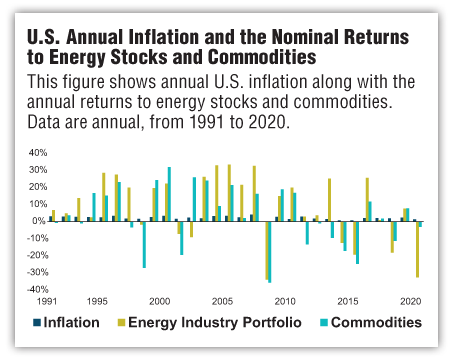
Overall, the study’s authors arrived at two key takeaways. First, that most of the assets analyzed—U.S. and international bonds; domestic stocks as well as sector, style (value and growth) and factor (size, value and profitability) stocks; foreign stocks; real estate investment trusts (REITs); and commodities—were able to outpace inflation in the long term. “Return premiums associated with the size, value, and profitability factors have also been mostly positive, with no reliable differences depending on the level of inflation,” observe the researchers.
Second, “inflation—whether contemporaneous, lagged, expected, or unexpected—is not a major driver of nominal asset returns and factor premiums.” Even in the case of energy stocks and commodities, “more than half” of the volatility in nominal returns was “unrelated to inflation.” (Nominal returns are those not adjusted for inflation.) For most assets, inflation was just one of several factors influencing returns.
“US Inflation and Global Asset Returns,” Wei Dai and Mamdouh Medhat; SSRN, July 2021.
AAII InvestoGraphic

Investor Professor

Portfolio Strategies

ED C from CA posted over 4 years ago:
You need to log in as a registered AAII user before commenting.
Log InCreate an account