


Charles Rotblut leads a class in AAII's new Essential Investing Video Course. Go to https://www.aaii.com/ves for more information and to subscribe.
Chris Pedersen is a financial analyst and writer at The Merriman Financial Education Foundation. We spoke about the importance of “meaningful diversification” and how it can reduce risk.
—Charles Robtlut, CFA
You make an argument in the book “2 Funds for Life” (The Merriman Financial Education Foundation, 2021) about why investors should diversify instead of holding a concentrated portfolio. Could you share a summarized version?
Sure. Diversification has been described as the only free lunch in investing. The reason you get seemingly something for nothing is that there are parts of the market that tend to move at different times.
If you combine two things that have positive expected returns and they move up and down at different times or they don’t move in a coordinated way, you effectively get a less bumpy ride. And that less bumpy ride means lower drawdowns and less volatility in your portfolio without having to give up expected returns.
The real trick is making that diversification meaningful. Many investors think they have a broadly diversified portfolio, when in fact what they have is a bunch of different similar funds. It’s this mishmash of stuff, but when you add it all together, it still looks like the whole market. As an example, when some of my friends will come to me for a portfolio analysis, I’ll look at their distribution of assets. Often, I find that they could basically do the same thing with an S&P 500 index fund.
So, the trick is to have meaningful diversification. You need to have different parts of the portfolio that genuinely have different performance characteristics or deliver their outperformance at different times in the market cycle.
The academic research into factors suggests what those things would be. The small-cap part of the market tends to behave differently from the large-cap part of the market. The value part of the market tends to behave differently from the growth part of the market. If you have a portfolio that disproportionately weights some of those factors, you start to get meaningful diversification. You also start to get the benefit of less volatility while still preserving the same kind of returns.
The challenge is that nobody can tell you when each part is going to outperform. So, you have to be willing to tolerate performance that’s different. If you want a different return and you want a different behavior, you have to be willing to be different. For example, over the past several years, the S&P 500 and growth stocks have outperformed; those who diversified into other parts of the market underperformed. But patient investors who are willing to tolerate the shorter-term underperformance should expect to be rewarded in the future. It is reasonable to expect less volatility and a better return.
Well, that leads to a good question. In the case of small-cap value, it underperformed for several years until this year. How do you convince people who are looking at, say, five-year performance to stick with the strategy?
I think it’s really important that you are able to invest with conviction. To invest with conviction, you need to understand the history. You need to understand the historical behavior of the asset classes that you’re investing in. If you go back to the 1920s, there are periods of eight, 10, 15, even up to 20 years where the performance of small-cap value stocks was comparable to, or below, the S&P 500. So, it takes a lot of patience.
Somebody who’s going to tilt a part of their portfolio to small and value, or just small or just value, needs to understand that. They need to recognize that that part of the portfolio might lag for a very long time. They need to be able to look at periods of underperformance and say, “It’s not different this time.” That’s a tough thing to do because during those periods of underperformance, there will be countless articles written saying, “It is different this time. This factor has really gone away. It’s never coming back.”
So, you have to decide what you genuinely believe in as an investor. If you believe in almost 100 years of history and you can invest with conviction and confidence, history suggests you’ll be rewarded by sticking with it and persisting to the end.
In some ways, it’s like a game of chicken though, you’re up against other investors. If you can outlast them in your conviction and belief, you’ll do better. That’s what history suggests. Nobody knows the future. It could be different. But for me, when I’m deciding where I’m going to invest with conviction, I’ve got nothing better than history to guide my choice.
When I look at the historical performance, I feel quite confident that these riskier, smaller companies, value companies that you can buy at a lower cost, are effectively on sale. I think they’ve got a better chance of outperforming the market than companies that everybody’s fawning over today. Those are likely to fall out of grace at some point in the future. Combining some of both gives me meaningful differentiation and the chance to celebrate when either are outperforming.
Many investors believe they get enough international diversification by holding U.S.-based multinationals, but you argue that they really need to invest in companies domiciled in other countries outside the U.S.
This may be a little bit controversial, but I go back to the early 1900s and think about what unfolded across the last century (Figure 1). Would anybody have predicted that the Chinese market would have grown, be basically wiped out and then grown again? Would anybody have predicted that the U.S. would have dominated the last century after only being barely into the double-digits of the total worldwide gross domestic product (GDP) in the 1900s? Would anybody have predicted that Germany would have gone through the tough times it did with hyperinflation and nearly wiping out its stock market?
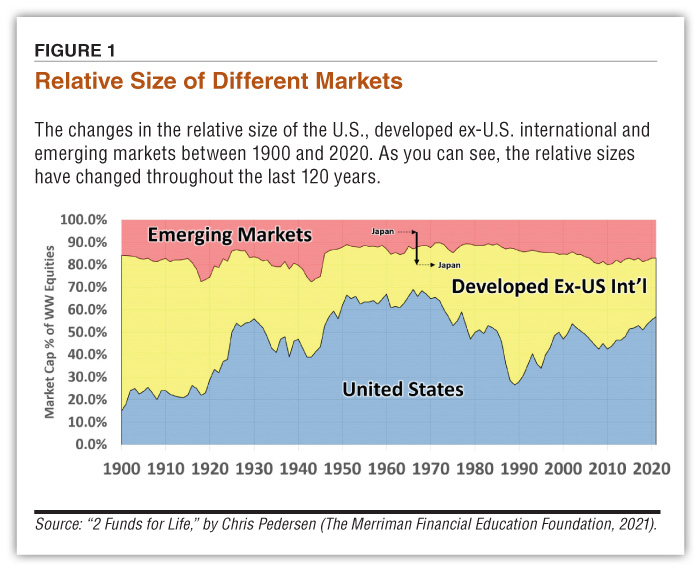
If we look forward to a lifetime, which is almost 100 years for an increasing number of people, who’s to say what will happen to the U.S. market over a 100-year period? It’s hard to predict.
History suggests that about one in 20 of the developed countries failed over a lifetime of investing. Are you willing to take the risk that your country is never going to run into that kind of a problem? If you are, then that argument that U.S. companies have a lot of their revenue from international sales makes sense. But if the U.S. economy were to fall onto dire times, holding shares in those companies won’t protect you.
Historically, if you diversify internationally, it hasn’t boosted or hurt returns or volatility by much. In terms of safe withdrawal rates, diversifying internationally leads to a slight improvement because you’re rebalancing back and forth between regions that thrive at different points in time.
The record suggests that diversifying internationally is very cheap insurance. That’s the way I would think of it. You have to decide what you’re comfortable with, but I would be very surprised if most people can’t tolerate having 10%, 20% or 30% of their portfolio in international securities. That protection seems well worth it.
In terms of the optimal number of mutual funds or exchange-traded funds (ETFs) to hold, you found that holding 10 funds versus holding two or three doesn’t necessarily give an advantage in terms of diversification. You found that holding fewer funds actually had a little bit more benefit, beyond simplicity.
That’s correct. To use a cooking analogy, think about making a spicy dish that you want to add a lot of flavor to. You have five different spice mixes, and they all rely on two key ingredients, let’s say it’s onions and peppers, to add flavor. Some of them are very spicy and some of them aren’t.
You can get the same result in two different ways. One way is to add a little bit of all of the different spice mixes, some of the light ones and some of the really strong ones. The other is to just add a little bit more of the really spicy one.
So, that’s basically what’s happening when you look at these portfolios. If you take a portfolio like my colleague Paul Merriman’s Ultimate Buy and Hold portfolio, it holds large-cap blend, large-cap value, small-cap blend and small-cap value funds. Effectively, you’re tilting a market portfolio toward small and value. The large value tilts a little bit toward value, the small blend tilts a little bit toward small and the small value tilts toward both small and value.
If instead you just took a small-cap value fund and you spiced a market portfolio with it, you can get similar tilts. You don’t actually need all four funds to get the same tilt.
The biggest reason I think people are drawn to a 10-fund solution is regret avoidance. If I own all of the asset classes and there’s a year where large-cap value just crushes it, life is good. If the next year, small-cap value crushes it, that’s great. If you go the other route and you just spice your market-like portfolio with a small-cap value fund, there are going to be years where large-cap value was the one that crushed it and you don’t own it. You’ll likely feel kind of bad, even though you got some benefit from owning the large blend market-like fund and you got some benefit from owning the small value.
So, I think that a 10-fund solution is perfectly fine. For a lot of people, it will be the portfolio they can stick with, but it is more complex to manage and a little bit harder to take care of along the way.
That makes sense. Let me move on to withdrawal rates. Regarding a 40-year withdrawal period, you found that a larger percentage of portfolio assets could be withdrawn annually if a barbell portfolio—which combines an aggressive allocation with a conservative allocation—was used. In particular, combining small-cap value and intermediate-term Treasury bonds. Could you share some insights about those findings?
I did an analysis where I looked at allocation mixes of intermediate-term Treasury notes and the S&P 500. Then I looked at allocation mixes of the S&P 500 and U.S. small-cap value and, finally, mixes of U.S. small-cap value and intermediate-term Treasury notes.
The highest 40-year safe withdrawal rate, if you use data going all the way back to 1928, was 4.29% for a 50/50 mix of small-cap value and intermediate-term Treasuries.
The mix of 60% S&P 500 and 40% small-cap value had a 40-year safe withdrawal rate of 3.62%—more than a half percentage point less.
If you look at the data only going back to 1970, it’s even more compelling. The 40-year safe withdrawal rate for the 50/50 mix of small-cap value and intermediate-term bonds was 4.63% versus 3.65% for the 60/40 mix of S&P 500 and the same bonds (Figure 2). That’s almost a full percentage point difference.
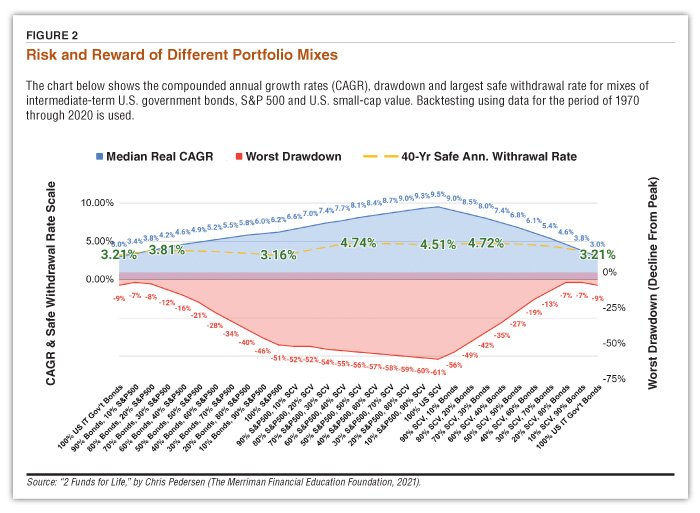
The barbell portfolios also had annual returns that were more than a full percentage point higher with worst-case drawdowns that were about the same as the S&P 500/bond portfolios.
This barbell strategy of mixing two very different asset classes—Treasury notes and small-cap value stocks—gives you a broad level of diversification with a small number of funds. With small-cap value, you’re getting exposure to small, value and market risk factors. With intermediate-term Treasury bonds, you’re getting exposure to term risk. The bonds tend to do well at different times than the stocks do. When you combine the two, you get a broadly diversified portfolio that’s simple to implement. The biggest thing it’s missing is geographic diversification, and you could get that by substituting a total global market fund for the S&P 500.
It’s pretty interesting. You’re taking a lot of risks with stocks while staying pretty conservative on the bond side.
Yes. Diversification is about combining things that are different, and these things could hardly be more different.
You used the term “nudge withdrawal” in your book. Can you explain to our members what this is?
Some of the 2 Funds for Life approaches maintain allocations to both a small-cap value and a target-date fund into retirement.
Once in retirement and taking withdrawals, you could rebalance the portfolio annually before taking withdrawals, but that’s a bit unnatural because you have to sell what’s been winning to buy what’s been losing. So, I wondered whether there might be something that was behaviorally more attractive. What I considered is whether someone could just look at their portfolio and say, “Which asset class is outsized? Which one is bigger than it’s supposed to be?” and take from it.
Let’s say you’ve decided to follow the aggressive 2 Funds for Life strategy I describe in the book, which maintains a 20% allocation to small-cap value in retirement. When it comes time to take your annual withdrawal, you’d start by looking at the share of your portfolio represented by the small-cap value fund. If it was over the 20% target allocation, you’d take the entire annual withdrawal from small-cap value. If it was under 20%, you’d take the entire annual withdrawal from the target-date fund. The result would be a “nudge” back toward the target asset allocation.
This makes rebalancing more natural because you just look at the fund that is doing comparatively better and you harvest some of your profits. You’re basically saying, “Well, I’m going to take a little bit off the table from this thing that is getting larger. In doing so, my portfolio is brought a little closer to my target allocation.”
The interesting thing is when I ran the backtests, nudge withdrawals perform very similar to annual rebalancing in terms of the expected returns and drawdowns. Plus, your withdrawal is easier to take. You just do one thing instead of rebalancing and then taking the withdrawal. I think for a lot of people, it’s a very practical approach.
Meaningful Diversification Can Lead to Higher Returns Video
We think you’d like this related webinar! Individual Investor Show: Inside the Investor Minds of Chris Pedersen and Robert Hagstrom

Related

Related

Portfolio Strategies
Revisiting the Risks of Retirement Spending Rules
Discussion
FREE REPORT

Get your free copy of our special
report analyzing the tech stocks
most likely to outperform the
market.
JOHN L from NJ posted over 4 years ago:
Karl E from TX posted over 4 years ago:
BARRY J from TX posted over 4 years ago:
VICTOR S from NC posted over 4 years ago:
RONALDO J from IL posted over 4 years ago:
SARVESH A from MI posted over 4 years ago:
Carol R from IN posted over 3 years ago:
You need to log in as a registered AAII user before commenting.
Log InCreate an account