

Related

AAII InvestoGraphic
A measure we follow to gauge expectations for monetary policy is the CME FedWatch Tool.
by AAII Staff | March 2022

As we went to press with this month’s issue, the Federal Open Market Committee (FOMC) was widely expected to raise interest rates at its March 15–16, 2022, meeting. This would be the first increase in the federal funds target rate since December 20, 2018.
A measure we follow to gauge expectations for monetary policy is the CME FedWatch Tool. The FedWatch Tool uses pricing data for 30-day federal funds futures to assess the possibility of interest rate targets being at certain levels following upcoming FOMC meetings. The futures market is a useful marker because it reflects the actual trades being made on expectations of future monetary policy decisions.
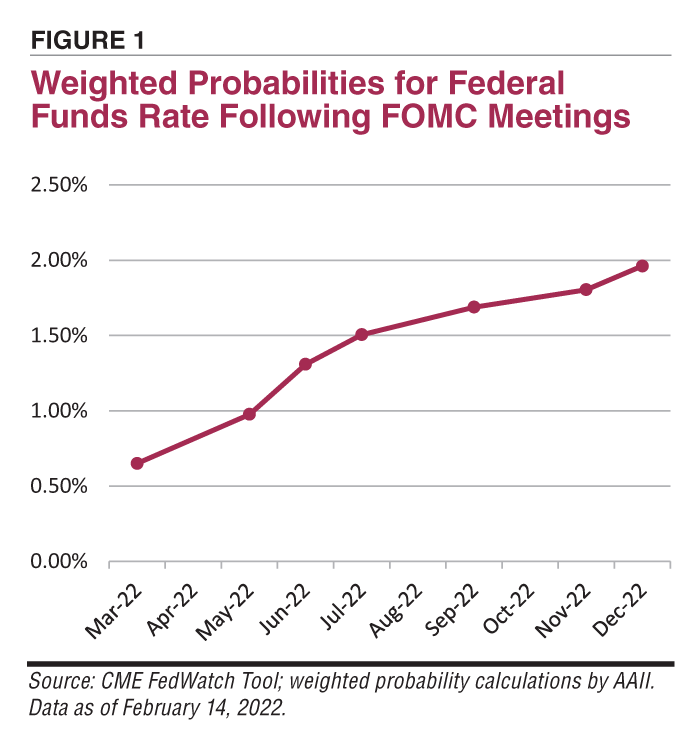
Currently, the futures market is pricing in several interest rate hikes to occur this year. Half-point (0.50%) increases are projected to be announced following the March 15–16 and September 20–21 meetings this year. Traders are pricing in the possibility of the federal funds target rate reaching 2% following the December 13–14, 2022, meeting. The target rate range at the start of this year was 0.00% to 0.25%. Figure 1 shows the projected trend of rate increases.
Not all traders are in agreement. Table 1 plots the dispersion of expectations for the federal funds rate to be at various levels following each FOMC meeting this year.
Just glancing at the table, you can see how the amount of dispersion in the forecasts widens as the forecasts go further out into the future. For the May 2022 FOMC meeting, traders are assigning a 27.9% chance of the target rate ranging between 0.50% and 0.75%, a 53.8% chance of the target rate being between 0.75% and 1.00% and an 18.3% chance of the target rate being between 1.00% and 1.25%.
Table 1. Probabilities of Different Target Rate Outcomes Following FOMC Meetings
A higher level of dispersion is to be expected for meetings scheduled further out into the future. The level of uncertainty, and therefore the range of outcomes, increases at longer stretches.
The probabilities given by the FedWatch Tool are not static. They constantly change as traders incorporate new data into their trading decisions. This makes the projections a useful real-time gauge for setting expectations about what might happen in the future.
Like any forecasting tool, FedWatch cannot guarantee what will happen. It only reflects current expectations. The FOMC has, on occasion, surprised the financial markets in the past and always has the possibility of doing so again in the future.
AAII InvestoGraphic



No comments have been added yet. Add your thoughts to the discussion!
You need to log in as a registered AAII user before commenting.
Log InCreate an account