


Stock screens play a major role in all of the model portfolios developed by AAII. The goal of using stock screens is to filter the massive universe of publicly traded companies to make investing simple and intuitive. Screens can also be used to capture the winning strategies developed by famous investors over the years.
Many of these strategies have track records of long-term success and market-beating returns. However, it is important to understand what these screens are, how to develop them and, ultimately, how to use them to build your own investing portfolios.
What Is a Stock Screen?
A stock screen is a tool that is used to sift through thousands of publicly traded companies to identify stocks with a common set of characteristics. Running a screen is an excellent starting point for building a portfolio based on an investment strategy. A stock screen enables an investor to use a consistent framework to decide which stocks to add or remove from a portfolio. Discipline is a common trait shared with the successful investors that we have studied. It is too easy to let emotions such as greed, fear and even pride take over the decision-making process and ignore the rational side of investing.
A common misconception about stock screens is that they create a “buy” list based on a particular set of rules. While a stock screen finds stocks with characteristics that are appealing, these stocks still need additional vetting before being added to a portfolio. Further research into a company is required to determine if the company aligns with your investment goals.
Another way to think of a stock screen is as a database filter. AAII’s proprietary Stock Investor Pro fundamental stock screening and research database program contains a wealth of data on all “active” publicly traded, U.S.-based companies, which can be used to analyze the fundamentals of companies. A stock screen is quantitatively based, meaning it relies on numerical datapoints within a set of ranges. Some screens have very complex criteria whereas others only have a few constraints.
There are different types of stock screens, such as the screens found in the Screening section of AAII.com available to all AAII members. The AAII guru stock screens are based on famous investors’ strategies. The AAII factor screens use fundamental attributes that identify stocks with the potential to realize higher returns. Some examples of investment factors include value, momentum, estimate revisions, quality and growth. All these screens analyze a company’s financial metrics to see if they pass the underlying screening filters.
Stock screens also let you identify companies you would otherwise overlook, either because they are lesser-known or are facing short-term issues that may scare away investors. However, adding qualifying filters can help uncover solid companies with strong long-term prospects that are trading at attractive valuations because the market has overly discounted them. You can exclude certain types of companies that you don’t want to end up in your portfolio, such as those with high debt or those that are bleeding cash.
It’s important for investors to understand that a passing companies list of a stock screener is not a buy list; it is a set of companies with the same base set of criteria that still require additional research.
Here are some important takeaways about stock screens to keep in mind:
- They are sets of variables/criteria/rules that you either set up or follow,
- They are screening engines that find companies that satisfy specific rules or variables and
- They include filtering tools that generate lists of stocks based on your criteria and preferences.
Stock screens exist for every type of investor; therefore, it’s crucial you understand what is available to you and what the differences are.
Pay Attention to Screening Criteria
All screens start with the process of identifying initial objectives (Figure 1). These should reflect an underlying investment philosophy as well as preferences for growth, dividends, momentum, etc. Clear, focused, narrowly defined objectives lead to the best screens. Before choosing a pre-built screen or building your own, your objectives should be further refined to reflect the specific type of stocks that you are seeking. After your objectives have been determined, you can work on developing specific screening criteria or choosing a screen that will identify the desired types of companies and stocks.
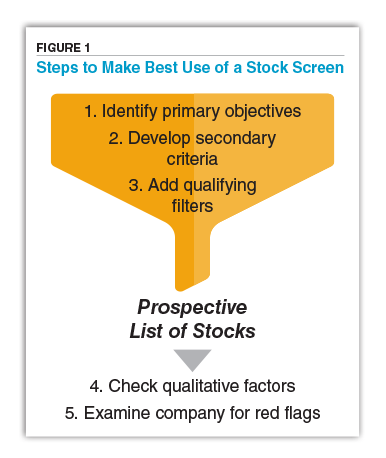
Quantitative screening filters primarily focus on fundamental criteria, though price-related criteria such as market capitalization and relative strength can also be included in screens. Criteria can be relative to other companies/industries or compared to a constant number. When developing a screen, the primary criteria should stem from the initial objectives that were laid out. This helps create a base for the screen, which can then be refined to find companies that fit the strategy.
When defining your primary criteria, you will need to decide if you wish to compare data on an absolute or relative basis. Relative conditions compare a company’s current financial situation to its historical level or to market, sector or industry benchmarks. For example, you may screen for companies with price-earnings (P/E) ratios less than that of a benchmark index, such as the S&P 500 index. Alternatively, some fundamentals should be compared to the company’s respective industry averages: Ratios such as profit margins, payout ratios and total liabilities to total assets will vary given a company’s line of business, so it is important to perform an “apples to apples” analysis by comparing companies to their peers.
One of the biggest mistakes in constructing stock screens is having a list of criteria that are reasonable individually, but when combined turn out to be contradictory.
For example, if you are looking for emerging high-growth companies in the early stages of their life cycle, then you should not combine a requirement for high earnings growth with that for a high dividend yield. Companies that are in a rapid growth phase typically need cash for their expansion and can’t afford to pay (high) dividends. Combining the criteria in this way will negate the objective of the screen, leaving you with a list of stocks that don’t fit with any strategy, if any stocks pass at all.
It is also a mistake to combine too many criteria filtering for the same types of companies. Making a screen too restrictive will lead to a small pool of potential candidates. Your screen is better off focusing on the criteria that indicate the type of companies you are seeking and on criteria that you understand well.
A common practice in the creation of screens is including criteria to avoid outliers. While the primary criteria will find companies of attractive value, strong growth, etc., secondary or qualifying criteria will filter the stocks that are worth looking at and eliminate those that aren’t. For example, the AAII stock screens commonly include criteria that eliminate or greatly reduce the chances of over-the-counter (OTC) stocks from passing. Likewise, requiring dividend-paying stocks to have reasonable payout ratios will increase the likelihood of future dividend increases.
Almost all primary and secondary criteria in stock screens are based on quantitative data, but there are still qualitative aspects to consider when selecting stocks from a screen. You must look for the qualities of a company that make it a good investment. This might be the management of a company, the economic position/trend or an innovative line of products. This is the reason why a screen by itself does not constitute a buy list. There is some level of additional research that needs to be done in order to make investment decisions.
If you decide to develop your own screening criteria, be sure to outline a clear objective that meets your investment strategy. Then, create primary criteria that follow this objective while avoiding any contradictory information. The results must be refined, so use secondary screening criteria to get a concise list of stocks to choose from. A screen is preliminary and does not represent a final portfolio; it is a tool to help you search for companies that follow a particular investment strategy.
Table 1 provides an overview of three of our screens that are based on some of the most successful investing gurus. Notice how each strategy has a set of quantitative and qualitative criteria associated with the screen.

Turning a Passing Companies List Into a Portfolio
AAII’s stock screens are our interpretations of the approaches used by investment gurus or are based on factors that academic research and real-world results have shown to beat the market. Stock screens are based on a practical set of rules and are used as preliminary research into building an investment portfolio. After generating a list of companies from the screen, further research on the companies is necessary to decide which ones are good investments. Remember, stock screens are used to find potential investments.
Constructing and managing a portfolio requires much more than simply following a winning stock screen. Screens don’t tell you how long to hold a stock nor do they tell you how many stocks to hold. Plus, they don’t tell you how to maintain diversification. Research into the companies generated from a screen may reveal outliers that numbers couldn’t catch. This may also present a learning opportunity for what other criteria needs to be considered before deciding to buy a passing stock. Finding screens that consistently generate passing stocks that align with your time horizon, investment objective and risk tolerance is the key to developing a sound portfolio.
Over time, a portfolio is built from repeating the process of running the appropriate screen for your objectives and preferences and conducting further research into candidates selected from the list of passing companies. Then, the other big step in portfolio management is to monitor and decide when to sell your holdings. Just as stock screens remove most of the emotions involved with identifying investment candidates, they can also be used to help develop rules for when to sell a stock.
A useful rule of thumb is to sell a stock when it no longer reflects the spirit of the strategy used to identify it. For example, the David Dreman screen looks for stocks with price-earnings ratios in the bottom 40% relative to all U.S.-listed stocks. Within AAII’s Stock Superstars Report portfolio, one of the deletion rules using the value-oriented Dreman strategy is to remove stocks whose price-earnings ratio rises to a level of 20% or higher than the median price-earnings ratio for S&P 500 companies.
The strategy of altering screen criteria for decision-making is employed by all of AAII’s model portfolios—Model Shadow Stock Portfolio, Dividend Investing, Stock Superstars Report and VMQ Stocks—since it allows making decisions based on clearly defined quantitative rules instead of emotion or intuition. You don’t want to let emotions trigger your sell decisions. Sometimes, people sell good stocks too quickly because they can’t deal with short-term declines or volatility. Other times, they become so attached to their picks that they hold on to a bad stock far longer than they should, hoping that it will rebound and justify their initial buy decision.
As with any of AAII’s strategies, analysis is not focused on a single datapoint, and your analysis shouldn’t be either. Take two or three of the criteria that align best with your outlined strategy to develop long-term rules for managing a portfolio. There are other things to consider such as the industry concentration of the portfolio. A good rule of thumb is to choose a maximum percentage that any industry cannot exceed. This provides diversification benefits beyond protection from industry downtrends as it removes another emotional response when selecting stocks from the screen.
To determine which screen may be appropriate for you, look at both long-term returns as well as recent performance. Understand that the stocks presented by the screens are computer-generated lists based on AAII’s interpretation of popular investment approaches as well as academic and industry research on the characteristics associated with higher returns. Screens following the approach of an investment guru do not represent their actual stock picks. The rules of each screen are defined by our interpretations of their respective investment approaches. It is important to remember that any screening strategy will have periods of both out- and underperformance. You should use a proven screen that makes intuitive sense to you so that you’ll be more likely to stick with it when the screen goes through a downtrend.
Conclusion
Stock screens are the most important offense we have when building and maintaining portfolios. They allow us to analyze thousands of stocks instantly to make educated investment decisions. As an AAII member, you have access to 60 prebuilt stock screens at AAII.com.
If you desire to build your own custom screen or modify an existing screen, A+ Investor offers the Custom Stock Screener. Stock Investor Pro offers even greater options for customization. Remember that just because a company passes your base set of criteria doesn’t necessarily make it a good investment. You must take a deeper dive into the company, its industry and its competitors to help you make an educated decision.
How to Best Use Stock Screens to Build a Portfolio Video
We think you’d like this related webinar! Identifying Promising Companies With AAII.com’s Stock Screens
Related

Related

Investing Gurus
Five Common Traits of Successful Value Screens
Discussion
FREE REPORT

FRANK H from MA posted over 4 years ago:
JEAN H from IL posted over 4 years ago:
JAMES M from SC posted 10 months ago:
You need to log in as a registered AAII user before commenting.
Log InCreate an account