




Related

ETFs and Mutual Funds
Short-term bonds can act as a buffer against volatility, preserving capital, and as such can be buckets to dip into when you want to buy riskier assets at a discount during down markets.

Income-seeking investors have had the opportunity this year to capture high yields through bonds, including short-term bonds. Yields on one-year Treasuries were at 2.88% in mid-June 2022 versus 0.40% at the start of the year. Three-year Treasury notes yielded 3.33% in mid-June versus 1.04% in January. These yields are at their highest level in over a decade, as are yields on many other bonds.
This rise in yields is occurring as the Federal Reserve is in the midst of hiking rates to rein in inflation.
In addition to providing a source of income, bonds—including bond funds—have traditionally been a counterpart to stocks for investors looking to diversify their portfolios with a less volatile asset that also provides income.
Investors often adjust their asset allocation strategy to move portfolio dollars from equities to bonds as their investment horizon decreases, whether they are approaching retirement or a separate goal for which they were preserving capital.
Mutual funds and exchange-traded funds (ETFs) remove some of the difficulty of selecting and maintaining an investment portfolio, which applies to bond funds as it applies to stock funds. Bond funds are useful if you don’t want to buy and manage individual bonds yourself or you lack the ability to easily buy a diversified set of bonds.
With yields up from their historic lows, it’s a good time to learn how bonds can make up a portion of your asset allocation through either mutual funds or ETFs and how to select bond funds to fulfill your allocation targets.
The obvious yet critical difference between owning bonds directly or indirectly through either a mutual fund or ETF is management.
Bonds have a defined maturity date at which the investor receives the principal the bond was issued for (typically $1,000 in the U.S.). Along the way to maturity, the investor receives regular interest payments as additional compensation for lending the principal to the bond issuer.
If you own bonds directly, you would receive all of the interest payments and the principal upon maturity unless you sell the bond early. You control the rate of return because it is known from purchase, outside of changes in price based on the market.
A traditional bond fund or ETF has no maturity date and is thus an ever-changing stream of assets as the manager buys and sells bonds to maintain the fund’s objectives.
As an investor in a bond fund, you do not control the rate of return; the fund manager decides what is held, what is removed and what is added to the fund’s portfolio. These decisions can have tax implications if the changes result in capital gains being realized and you don’t hold the fund shares in a tax-exempt account. In this case, you would have to sell your shares in the mutual fund or ETF to receive your “principal” (adjusted for any capital appreciation or loss).
Short-term bonds are present in two of AAII’s three asset allocation models, the moderate investor and the conservative investor. The model for an aggressive investor asset allocation features only intermediate bond representation.
Because our data comes from Morningstar, the short-term bonds in this article are based on Morningstar’s category definitions, which conform to general time-based term standards based on duration. Overall, there are three taxable bond categories that use “short” in their name. Two are the primary short-term bond categories: short-term bonds and short-term government bonds, called short government.
The short-term bond fund category includes funds with a major focus on corporate and investment-grade U.S. fixed-income issues that typically have durations of one to three-and-a-half years relative to the three-year average of the Morningstar Core Bond index.
The short-term government bond fund category follows the same duration logic but requires that at least 90% of the fund’s bond holdings are in bonds backed by the U.S. government or by a government-linked agency.
Short-term bonds are less sensitive to interest rates than those with longer durations, reducing their risk because investor dollars are committed for a shorter period of time. U.S.-government-backed bonds minimize credit risk further, making those bonds both safer in terms of default and with less exposure to ever-changing credit spreads.
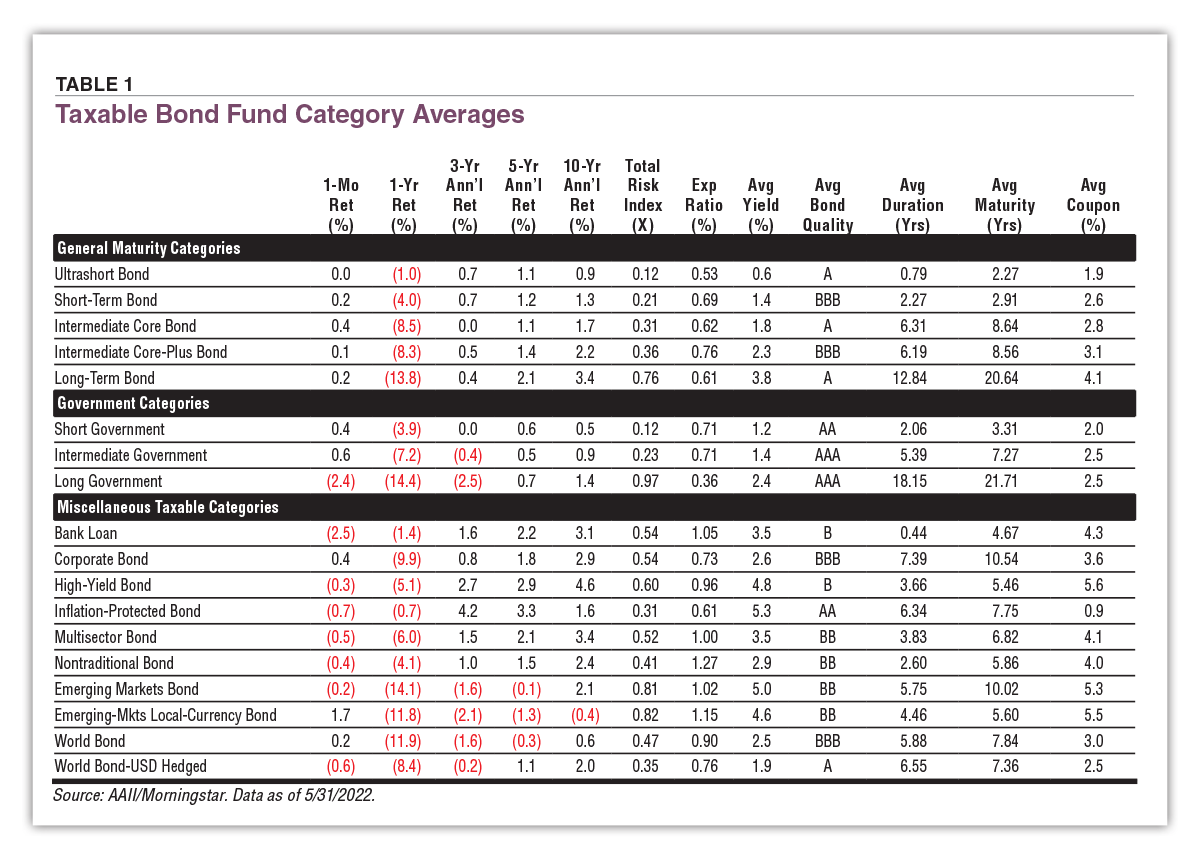
These relationships can be seen in Table 1, which compares the taxable bond categories in AAII’s dataset. Short-term categories have better one-year returns than the intermediate- and long-term categories.
Short-term bonds can act as a buffer against volatility, preserving capital, and as such can be buckets to dip into when you want to buy riskier assets at a discount during down markets.
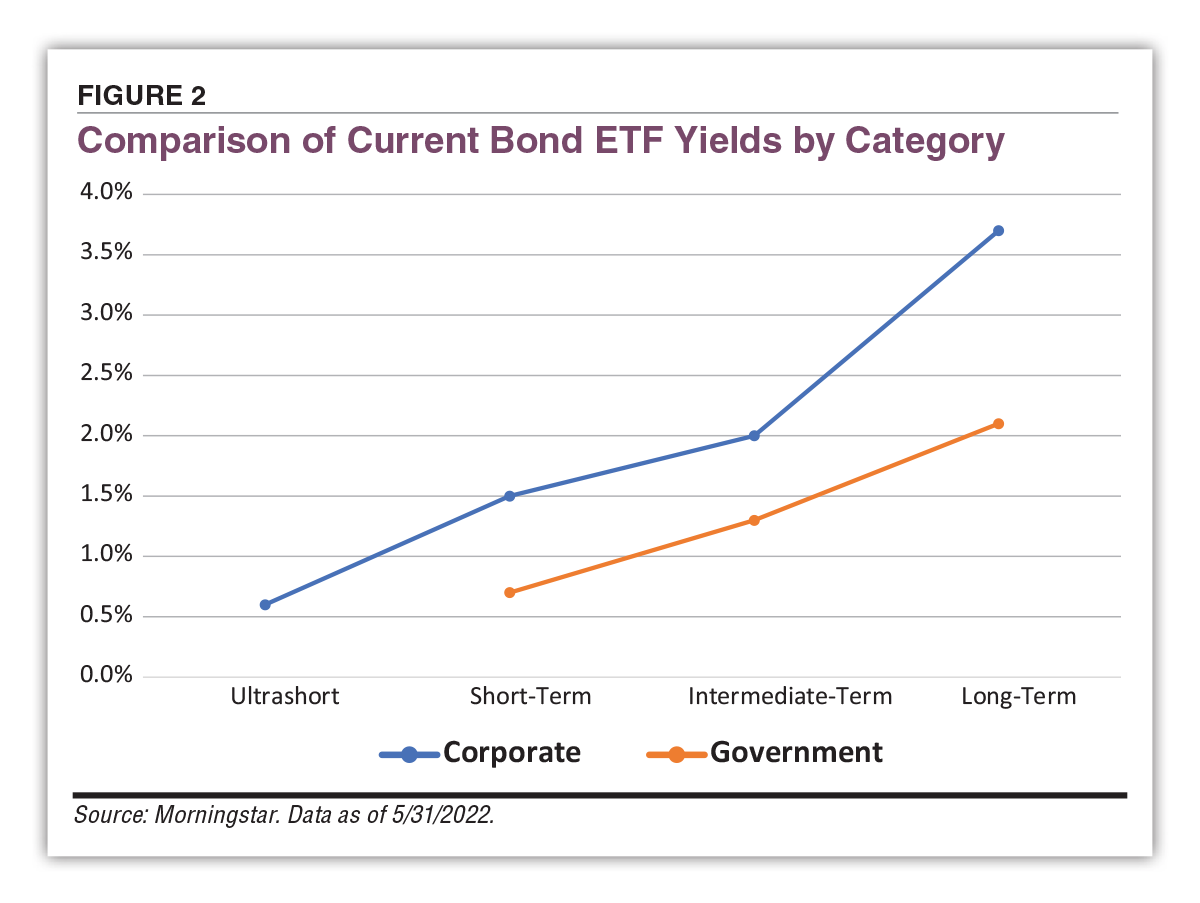
However, the short-term bond fund categories have lower yields (as shown in Figures 1 and 2, which plot category average yields for different bond fund and ETF categories) and less opportunity for capital gains appreciation than longer-term bond categories.
Bonds are typically sold with different times to maturity, such as less than one year, one year, three years, five years, 10 years, etc. Time to maturity simply refers to the number of years the bondholder will receive interest payments from the bond’s coupon and, ultimately, the wait for repayment of the principal.
Duration is a more precise measurement of a bond’s time to maturity, accounting additionally for the sensitivity of the bond’s coupon rate to changes in interest rates. Duration measures how long it takes in years for the bondholder to be repaid the bond’s price by the bond’s total cash flows, which includes its interest payments as denoted by its coupon.
This is important because interest rates and bond prices are inversely related. When interest rates go up, bond prices fall, and their yields rise. When interest rates go down, bond prices rise, and their yields fall. Presently, bond yields are rising as the Fed increases interest rates.
Ultrashort bond funds, the third taxable short bond category, invest primarily in investment-grade U.S. fixed-income issues and typically have durations of less than one year. They offer minimal interest-rate sensitivity and therefore low risk and total-return potential.
In general, the mutual funds with higher durations have lower one-year category return grades, in both short-term and short-government bond categories.
It is important to evaluate bond funds by their average maturity, duration, credit quality and yield. When doing so, compare a fund against its category peers.
When comparing bond funds of the same category, a fund’s expense ratio is also important because it sets a performance hurdle that management must regularly overcome. Differences in expense ratios can also indicate either a more active or passive approach to fund management.
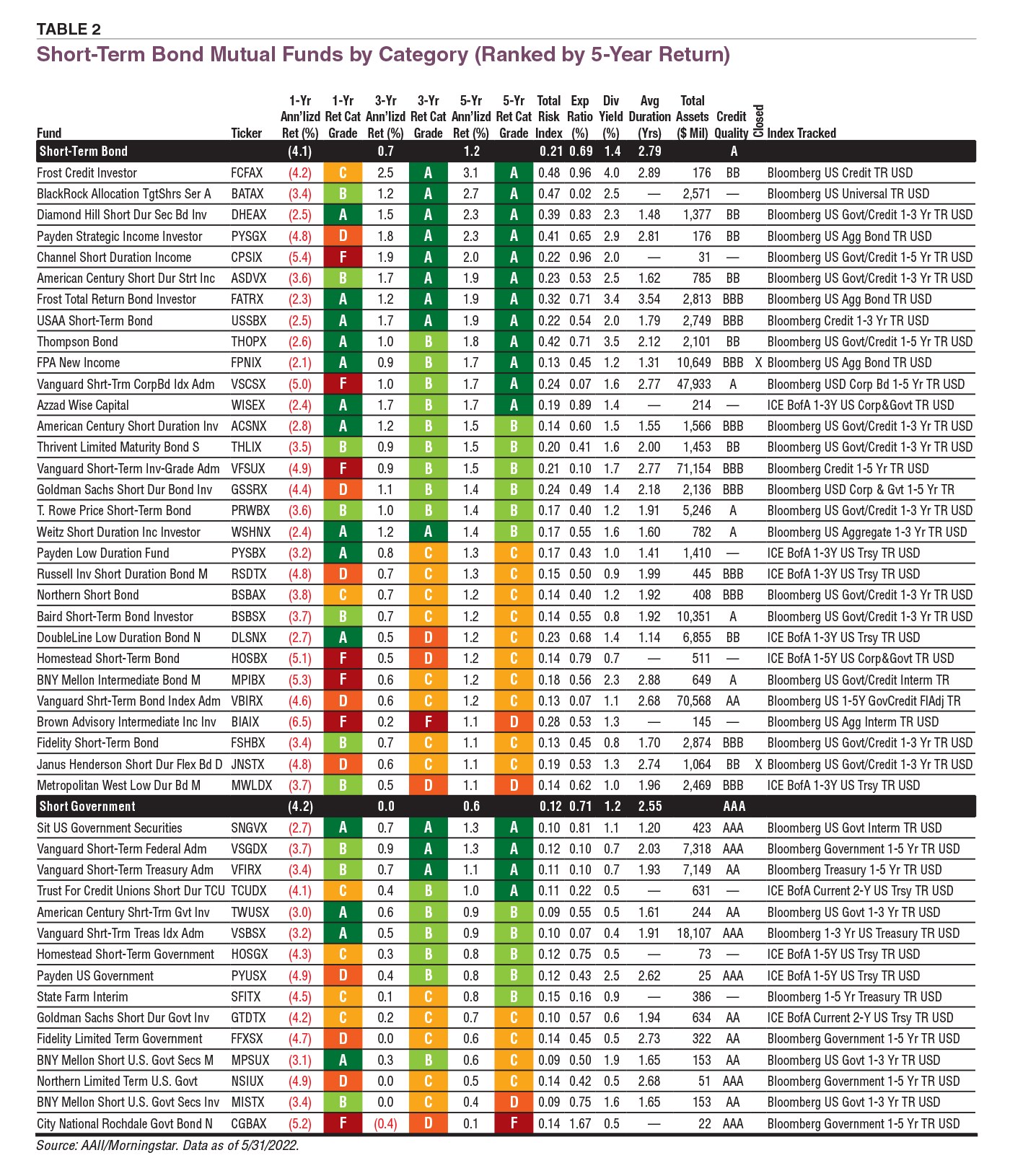
In the list of short-term bond mutual funds in Table 2, Vanguard’s Short-Term Corporate Bond Index fund  (VSCSX) has one of the lowest expense ratios at 0.07%. This compares to Frost Credit Investor’s (FCFAX) expense ratio of 0.96%, which is one of the highest on the list.
Download the Excel spreadsheet of this table.
The Vanguard fund’s expense ratio is below the short-term bond category’s average of 0.69%, while the Frost fund is above the category average.
In terms of expense ratios, ETFs are typically cheaper than mutual funds, due to their tendency to be passive index funds.
The majority of mutual funds and ETFs are focused on stock-based strategies. Investor options for bond ETFs are limited, even more so for short-term categories compared to categories with longer durations. The number of ETFs that fall within the short-term bond and short government categories is also much smaller than the number of mutual funds in the same categories.
In total, 67 mutual funds passed the basic screening criteria before we limited the group to those with the top five-year returns. Two-thirds are in the short-term bond category and one-third are in the short government category.
A total of 36 ETFs met basic screening requirements; only seven of these are in the short government category. Whereas many of the initially passing mutual funds are not included here, the ETFs shown in Table 3 represent the majority of the passing universe. The pickings are slim at best, and many of the short-term bond ETFs are so new that they do not have five-year return data.
Download the Excel spreadsheet of this table.
Considering the role of active management in determining bond fund performance, it makes sense that there would be a dearth of bond ETFs. Further considering that most ETFs are passively managed, there is a proportionately large number of ETFs in Table 3 that are not labeled index funds.
Three of these such ETFs are near the bottom of the short-term bond category in Table 3 because of their lack of five-year return data: Hartford Short Duration ETF (HSRT), Natixis Loomis Sayles Short Duration Income ETF (LSST) and VictoryShares USAA Core Short-Term Bond ETF (USTB). However, these three ETFs have top category return grades for both three-year and one-year returns.
Bond funds help investors balance the risks of stock funds in a diversified portfolio following an asset allocation model, especially as investors shift their portfolios toward a more conservative allocation when approaching goals such as retirement. Short-term bonds carry less interest rate risk than longer-duration categories but offer lower yields and less capital appreciation potential. However, higher yields are making bonds more attractive than in past years.
Funds offer an efficient way to access bonds for investors without the time or know-how to maintain individual bond holdings, and the fund will continuously replenish its holdings as its bonds mature. Compare a bond fund’s expense ratio, maturity, duration, credit quality and coupon against its competitors, in addition to considering long-term returns.
ETFs and Mutual Funds

Portfolio Strategies
Portfolio Strategies

PAUL S from OR posted over 4 years ago:
CHARLES R from IL posted over 4 years ago:
Jack J from IL posted over 4 years ago:
ROBERT A from NC posted over 4 years ago:
Robert G from MI posted over 4 years ago:
You need to log in as a registered AAII user before commenting.
Log InCreate an account