

Related

Investor Professor
Online Exclusive: Delving Into the Definition of the CAPE Ratio


Stock Strategies
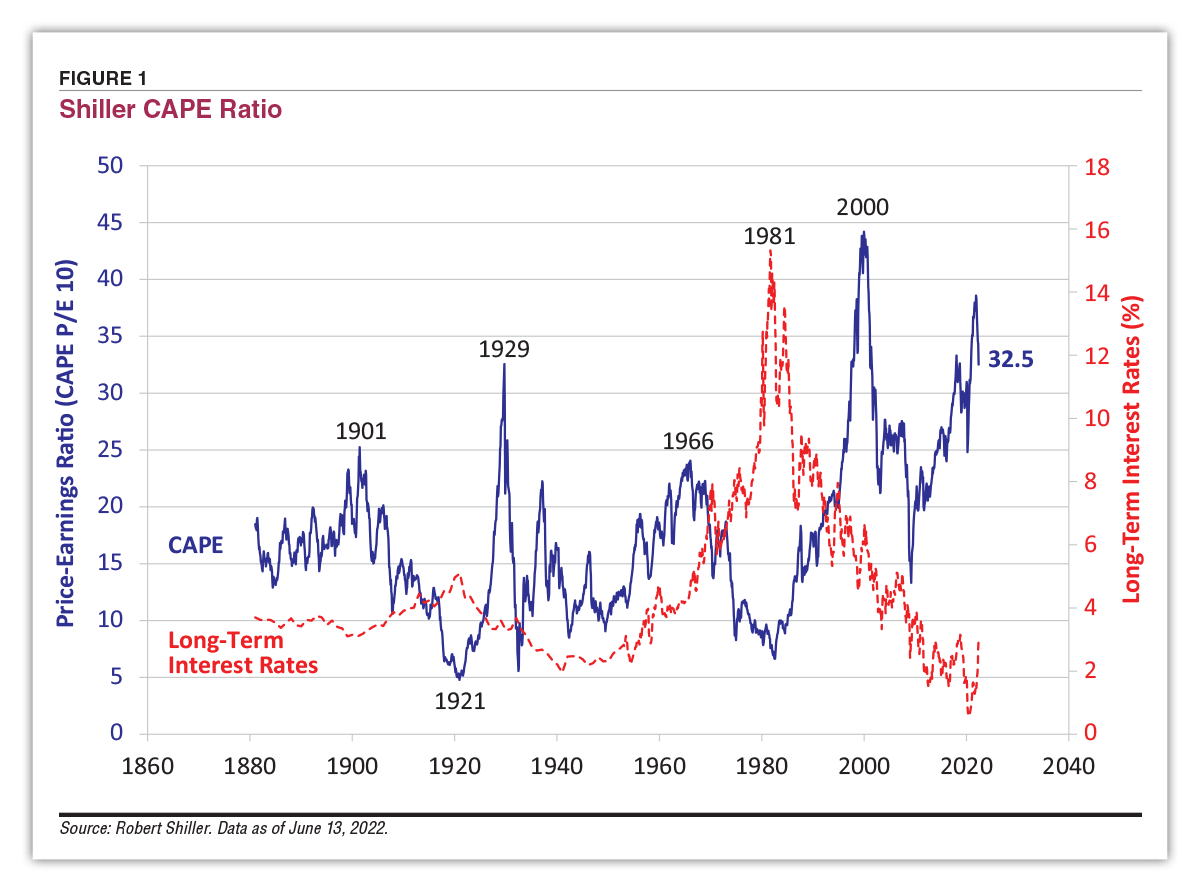
The cyclically adjusted price-earnings (CAPE) ratio is a widely followed, long-term measure of the stock market’s valuation.
by Charles Rotblut | July 2022

Charles Rotblut leads a class in AAII's new Essential Investing Video Course. Go to https://www.aaii.com/ves for more information and to subscribe.
The cyclically adjusted price-earnings (CAPE) ratio is a widely followed, long-term measure of the stock market’s valuation. Unlike traditional valuation measures, this price-earnings ratio uses 10 years of real (inflation-adjusted) earnings in its denominator. The numerator (price, or in this case, the value of the S&P 500 index) is also inflation-adjusted.
A look-back period of 10 years is used to smooth out volatility in earnings. This long look-back period helps to smooth out the volatility a single year can have on earnings and, thereby, valuations.
Since its creation by Nobel laureate Robert Shiller and John Campbell, the CAPE ratio has been used to gauge expected returns for the stock market over the next five to 10 years. As of mid-June, the CAPE ratio was 32.5. Though down from its recent (November 2021) peak of 38.6, it is still far above the post–World War II median of 18.7. The current CAPE ratio is also above its post-1981 long-term interest rate peak median of 23.7.
When we asked Shiller in 2013 what investors should do when the CAPE ratio is high, he responded by saying, “You have to compare the alternatives” to stocks. (The CAPE ratio was 23.3 at that time.) More recently (June 2022), WealthManagement.com quoted Shiller explaining that he was “not that alarmed by a CAPE ratio in the low 30s at this time” while speaking at the Wealth Management EDGE conference. Shiller then added, “I think the market is highly priced now—not super highly priced—but everything is highly priced, including real estate.”
For more on the CAPE ratio, see this month’s online exclusive Investor Professor column, “Delving Into the Definition of the CAPE Ratio.”
Investor Professor
Stock Strategies

No comments have been added yet. Add your thoughts to the discussion!
You need to log in as a registered AAII user before commenting.
Log InCreate an account