Volatility has certainly returned this year.
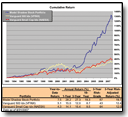
The Shadow Stock Portfolio has seen everywhere from a gain of 15% to a gain of only 2% over the past few months. It is now up by 7.5% for the year, compared to 5.1% for the S&P; 500 (as represented by the Vanguard 500 Index fund). The complete data is shown in Figure 1.
I never want to look a gift horse in the mouth, but it is important to keep in mind that the stock market—and the Shadow Stock Portfolio—does contain risk in the form of volatility, and that volatility will result one year in negative returns.
Figure 1.
Model Shadow Stock
Portfolio vs. Benchmarks
(Through 8/31/07)
|
|
CLICK ON IMAGE TO
SEE FULL SIZE.
|
|
A look at Table 1 will show that it has been a long time—the year 2000—since the portfolio has had a down year.
Although we still have several months to go before year-end, this has not been a typical pre-election year.
On the other hand, Congress is back in session, and there may be some more “spending for votes” before the year is over. I also feel the Federal Reserve will be a bit more accommodating and the sub-prime mortgage fiasco will pass by.
Where It Stands
Table 2 shows the current holdings of the Model Shadow Stock Portfolio and their status, Table 3 shows the latest portfolio rules and Table 4 summarizes the portfolio activity over the three months ended August 31, 2007.
Please note that we have raised the acceptable price-to-book-value ratio from 0.80 to 0.85 to accommodate current market conditions. I would have thought that the recent market pullback would have given us more qualifying stocks, but it has not.
In terms of changes, the Cronus Group (CRNS) was bought out by CRX Acquisition, a holding company, for $16.00 a share. In addition, Bonso Electronics (BNSO) violated its earnings probation and was sold during our activity period in the last week of August. We also added Golfsmith International Holdings (GOLF) and Johnson Outdoors (JOUT) to the portfolio. And, since P&F; Industries (PFIN) qualified as a buy and our holding was a bit below average, we used some cash to buy additional shares.
Screening on Your Own
For those of you who do your own screening using the Shadow Stock Portfolio rules, you may have uncovered International Shipholding (ISH) and NovaStar Financial Inc. (NFI). Why aren’t they in our own Model Shadow Stock Portfolio?
International Shipholding passed the screens in our own portfolio, but we sold it earlier this year because of negative earnings (this was unfortunate, since it almost doubled), and we don’t buy stocks recently sold.
NovaStar Financial, on the other hand, is a different story. NovaStar would be a value stock if you could believe the data—which we don’t because the value of outstanding loans is impossible to calculate. Down from $130 to $7.16, it was the classic sub-prime lender.
Once again there are stocks we could sell under the two-year rule if we needed the money for new purchases. However, there are not many qualifying stocks, so we don’t really need to raise cash.
As I mentioned earlier, I raised the acceptable price-to-book-value ratio to 0.85 this quarter, and I may raise it to 0.90 next quarter, but I don’t want to go higher than that. I may also raise the market-cap limit, particularly if the market rebound continues.
Portfolio Turnover
I was curious about the nature of the portfolio turnover in the Model Shadow Stock Portfolio, so we went back and examined the reasons we had sold holdings over the past four years.
Here’s what we found out. Out of the last 49 stocks sold:
- Twenty-four had violated the earnings requirements;
- Eight had exceeded the value restrictions because they went up too much;
- Fourteen were bought out at a premium;
- Three lost their listing (two voluntarily deregistered to avoid the costs of Sarbanes-Oxley regulations and one was permanently delisted by the exchange); and
- The majority of the sells were at a profit.
The two stocks that voluntarily withdrew registration have gone up significantly since we sold them. We have kept some stocks that fell into this category if we had assurances that they would continue to act like public companies. However, we have had a tendency to sell them for fear they wouldn’t make data public. We will look more carefully before selling the stock of companies that deregister voluntarily.
The Election Cycle
As I have mentioned in previous articles, this third year is usually the best year in the four-year election cycle. In fact, there has not been a negative return in the year before an election since the Great Depression, and the average return for the third year in the election cycle is an impressive 22.6%.
That 22.6% gain seems far away right now, but it is still possible. At the end of 2006, I suggested that the unusual run-up in the last quarter may have borrowed some steam from 2007.
In any event, the election year—2008—is a below-average year in the election cycle, but not the worst. The worst year is the first year of the new presidency, which comes in 2009.
However, all of this is “on average” and there is quite a bit of variation from year-to-year. Like the election itself, it ain’t over until it’s over.
| Table 4. Third-Quarter 2007 Transactions
|
| Company (Ticker) |
Reason |
| Tender |
| Cronos Group (CRNS) |
acquired by CRX Acquisition Ltd. |
| Sell |
| Bonso Electronics (BNSO) |
negative earnings |
| Buy |
| Golfsmith Int’l Holdings (GOLF) |
|
| Johnson Outdoors (JOUT) |
|
| P&F; Industries (PFIN) |
purchased additional shares with excess cash |






No comments have been added yet. Add your thoughts to the discussion!
You need to log in as a registered AAII user before commenting.
Log InCreate an account