

Related

Financial Planning
Open conversations help you and your loved ones become more financially healthy and prepared for future uncertainties.

Our personal finances and conversations with a partner about money can make us feel vulnerable and uncomfortable, regardless of our age, gender or stage of life. Historically, money has been a taboo topic—either impolite or better off avoided. In fact, a 2018 Merrill study found that 61% of women say they’d rather discuss details about their own death than talk about their money. But now, as we have finally acclimated to the “new normal” post-pandemic era, times have begun to change.
 The coronavirus pandemic has changed how we approach death, grieving and also how we receive support. The inevitability of death was, of course, not something new during the pandemic. Yet we had historically shied away from talking about it as a society, just like conversations about money, because it is uncomfortable and hard.
What has changed?
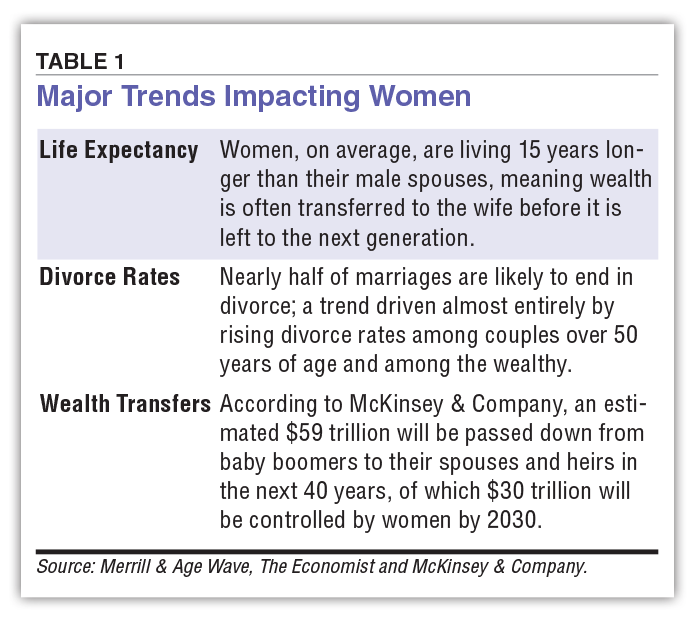
There are three major trends that are primarily (and profoundly) impacting women but are also equally important considerations for their partners. First, women are living significantly longer than their spouses. Second, the rising trend in divorce rates is driven by older and wealthy couples. Third, a generational transfer of wealth to women is occurring (Table 1).
And why does it matter to you?
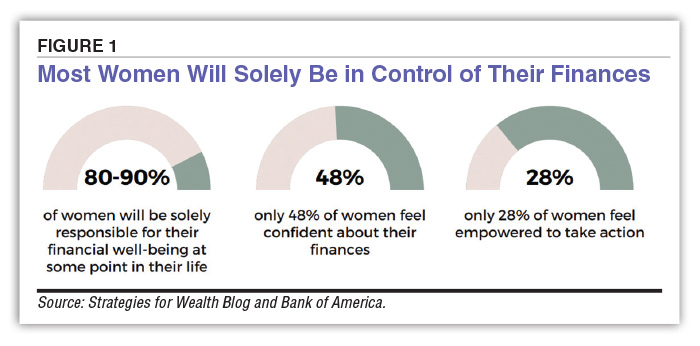
Studies show that these trends inevitably mean that eight out of 10 women will be solely responsible for their financial well-being at some point in their life, whether by widowhood, divorce or some other major life event. Despite this, a Bank of America study found that only about half of women (48%) feel confident about their finances and only 28% feel empowered to take action, as shown in Figure 1.
So, regardless of your gender or marital status, let’s discuss some financial planning best practices to help you and your partner prepare for your future together.
Going through a divorce is an emotionally draining process for everyone involved. Unfortunately, when paperwork and lawyers start to fill your days, things like working out and making healthy meals fall by the wayside. That’s why it’s integral to remember that you are your most important asset! Especially if you are also caring for your children or other loved ones, you must be healthy and strong to be able to be there for others.
As you begin the divorce process, here are six important actions you need to take to ensure your finances are in order.
Think through your goals and objectives so that you can build a path to achieving that outcome. Ask yourself questions such as:
Consider starting with a statement of your intentions or a description of how you want to remember your marriage and your divorce, then list the steps to get there.
One of the first things you and your spouse should do is complete a full inventory of your finances. It is critical that you have a strong understanding of how much your lives cost and what the family assets and income are. This is especially important for women who haven’t been involved in managing household finances.
Start by conducting a lifestyle analysis to understand your expenses and income. This should include compiling a list of income, debt, retirement accounts, bank account balances and property such as homes, vehicles and valuables for both yourself and your spouse. A spreadsheet with each item and its value will come in handy later.
Then, create a budget that is organized by your “need to haves,” “nice to haves” and “want to haves.” This can be your jumping-off point for creating and implementing a new financial plan during divorce and for post-divorce.
In addition to reviewing the basics of your insurance policies, it’s important to consider the impact a divorce settlement could have.
You will want to take stock of and update your beneficiaries (if needed). For example, it’s likely a good time to remove your soon-to-be ex from the list.
Many find having a trusted support team to be essential during a divorce. Relationships with friends and family may feel more strained during this time. It’s important to establish a supportive network with other allies such as therapists. While divorce attorneys are often the most referenced, having a financial life coach and/or financial adviser, in addition, can help bring a greater sense of security and stability to this uncertain process. Each specialist has their area of expertise and having a comprehensive team can help you cover all the bases.
It is important to remember that the emotions leading up to, during and after a divorce are often complex, challenging and conflicting. Therefore, it is important that you try to maintain a positive outlook, focus on what you can control and allow yourself time to grieve and heal.
Divorce represents the death of a marriage and all the hopes and dreams that went into it. And the death of a marriage, like any death, requires a grieving process for healing.
Dealing with the death of a spouse can feel impossible at times. While there are some similarities to the grieving process for divorce, grieving the death of a spouse is often more nuanced and requires time and support for healing and rebuilding to begin.
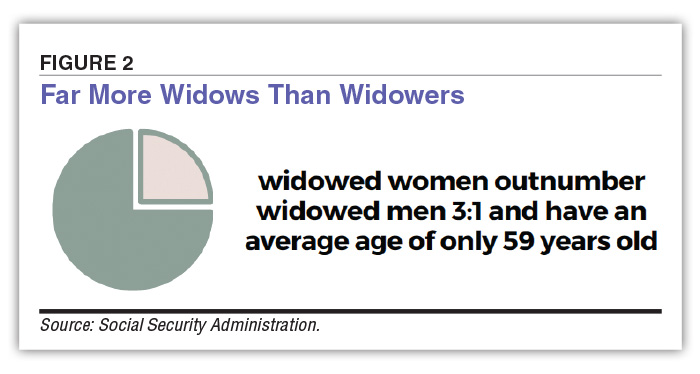
Widowed women outnumber widowed men by a ratio of 3-to-1 (Figure 2). According to the Social Security Administration, the average life expectancy for women in the U.S. is 81 years, compared to 76 years for men. According to the U.S. Census Bureau, the average age of a widow is 59.
For those of you who are recently widowed, or perhaps soon-to-be-widowed, we want to help you focus your decision-making on a few key tasks right now so you can get back to caring for your emotional health. That needs to take priority as you navigate this time of loss. Take it one hour at a time. Literally.
Grief doesn’t just affect feelings, it impacts our overall wellness—how we think, sleep and digest. With a difficult loss, you may not feel “whole” or “well” for a while and that’s okay. We believe that taking things one day at a time can help, but having a roadmap is very important. Here are four important considerations for new widows.
New Zealand academic Lucy Hone studied the power of resilience when her loved one was killed in an accident. She found herself taking a different approach to grief than the ones we have been talking about, which she calls “resilient grieving.” Hone suggests these strategies:
Time is necessary for healing, but often the hardest part becomes how you pass the time. Find healthy ways to deal with your grief. It is OK to scream, cry or curl up in a ball. None of these feelings will go away quickly, and it’s all right to accept survival mode as you think about what it will take to get through the next hour.
After the loss of your partner, it may feel like you have no one to rely on or go to for advice. Do not go it alone. Loneliness is inevitable, but you don’t have to reinforce it by choosing to be an island.
Finances may feel overwhelming, but the most important thing to remember is to not make big financial decisions that aren’t necessary when you are still processing your grief and loss. It may feel like you should sell your house or another investment and move away somewhere else, but you don’t want to make decisions when your judgment is clouded by your immense loss.
However, the reality is that some items unfortunately do need to be dealt with earlier than others. To make these items feel more manageable, organize and prioritize your to-do list. The most effective way to get through a long list is to break the big things into easier-to-manage small steps.
In the first six months to a year, you will want to:
There are also some financial complications that you and your spouse should be aware of if one of you were to die.
Dealing with these financial complications on top of grieving can be overwhelming. Therefore, it’s important to slowly build a trusted financial team to help you through the process. If you have a great relationship with a financial adviser, you can continue working with them or you may find that you would like to enlist a coach who is able to be your unbiased sounding board. You should slowly build a team that will help you figure out the legalities of an estate plan as well as help sort out your finances. Vet these people and inform them of your current emotional situation as well so they can help support you better. If the finances and legalities seem overwhelming, take a trusted friend or family member with you to these meetings.
While considering these issues is difficult at any time, initiating the conversations and plans before they’re absolutely necessary will help you and your loved ones feel more prepared for any scenario. Here are a couple of actions you should take as soon as possible.
If you manage your household’s finances, make sure your house is in order by doing the following:
If you aren’t currently involved in your family’s finances, start that conversation as soon as possible. Ask questions about each of the items above:
Planning your financial legacy will help you and your loved ones not just in the future should anything happen to you, but also now as you clarify and communicate what’s most important to you. A legacy often refers to a gift, such as an inheritance, a family business or property in a will. But it’s not always limited to tangible items. They can also include intangibles like:
One way you can start planning your legacy is by answering the following questions:
By reflecting on these questions, you can feel peace of mind that what you’re working toward today can have a lasting impact on those you care most about.
Legacy planning and talking to your loved ones about the potential of losing you is never easy! But remember: Legacy planning is an integral part of personal risk management. It protects what you have spent your life creating: your goals, dreams, wealth and well-being. While we can’t eliminate all risks, there are ways to avoid, minimize or protect yourself and your family. With clarity and planning, you can manage your risks, better prepare for unexpected life events, safeguard your financial status and protect your loved ones.
Open conversations with your partner, parents, siblings and children help you and your loved ones to become more financially healthy and prepared for future uncertainties. And the time to have these conversations is now. People who embrace these financial discussions are less likely to find themselves isolated and unprepared and are better able to achieve financial well-being and a secure future for both themselves and their loved ones.
Financial Planning
Financial Planning

Financial Planning

JOHN L from NJ posted over 4 years ago:
FERNANDO R from FL posted over 4 years ago:
BARRY J from TX posted over 4 years ago:
LAWRENCE T from OH posted over 3 years ago:
You need to log in as a registered AAII user before commenting.
Log InCreate an account