


Related

ETFs and Mutual Funds
A look at what’s on offer in the realm of diversified emerging markets mutual funds and ETFs.

Emerging markets offer the potential opportunity for investors to get exposure to stronger economic growth relative to developed markets. While emerging markets share at least some of the investment characteristics of developed markets, they have unique defining attributes.
Developed markets feature high per capita income, liquid equity and debt markets, accessibility by foreign investors, dependable regulatory systems and integration with global markets via trade and investments.
Generally, emerging markets are in a transition to becoming developed markets as their economies, financial market structure and regulatory frameworks grow. They tend to be in high-growth phases, often characterized by comparatively younger populations and an expanding middle class of consumers that drive an increase in demand across sectors. Growing political stability allows for regulated capital market processes, such as financial market trading and settlement procedures.
Investing in international equity and debt is tricky enough for individual investors who are considering opportunities in developed markets. Most individuals have neither the expertise nor the buying power of institutional investors, which can trade or buy in volumes necessary to reduce costs of investing internationally.
However, with risk comes the potential that emerging markets have for greater growth than with developed markets. As international investments, companies in emerging markets also offer diversification from domestic markets. Foreign markets are uncorrelated to some extent with the U.S. market, and this can be even more pronounced when it comes to emerging markets. In some cases, the low correlation between the U.S. economy and emerging markets may reduce a portfolio’s volatility.
Another benefit is that in terms of valuation, more risk is factored into the valuation of emerging market equities compared to equities in developed markets. Yet, at the same time, many emerging markets have exposure to growth sectors.
Risks in emerging markets cover many spectrums. Common risks are political instability, domestic infrastructure problems, currency volatility, illiquidity in equities with many state-owned or privately owned companies and a lack of sophisticated financial and regulatory institutions, which lowers market efficiency and slows the adoption of standard accounting practices.
Smaller than developed markets, emerging markets can also be more vulnerable to global political shifts, commodity price swings and changes in monetary policy, as a few further examples.
Despite the potential for growth from emerging markets, their risks don’t fit the profile of all investors. It’s best to invest in emerging markets over a long period of time, which can smooth out the year-to-year volatility. This is similar to investing in small- or micro-cap equities when these categories are compared to large-cap equities.
Of AAII’s three Asset Allocation Models, only the aggressive investor model includes an allocation to emerging markets. At 10% of the aggressive portfolio, emerging markets constitute one-third of this model’s direct international investments. The remainder is invested in large-cap foreign companies, typically in developed markets. The aggressive asset allocation model is suggested for investors who are very risk tolerant, with an investment horizon of at least 20 years. However, risk tolerance is ultimately a personal decision.
The easiest way for individual investors to access international companies is through mutual funds and exchange-traded funds (ETFs). As institutional investors, funds have the knowledge and capabilities to invest effectively in foreign markets, especially for emerging markets.
Emerging markets funds follow a variety of strategies, both active and passive. There is also much diversity through factor tilts—whether the fund is focused on a specific market capitalization, or a value or growth strategy.
AAII’s aggressive asset allocation model features the Vanguard Emerging Markets Stock Index Admiral Shares fund  (VEMAX) as a representative of emerging markets investments; its ETF equivalent is the Vanguard FTSE Emerging Markets Stock ETF (VWO).
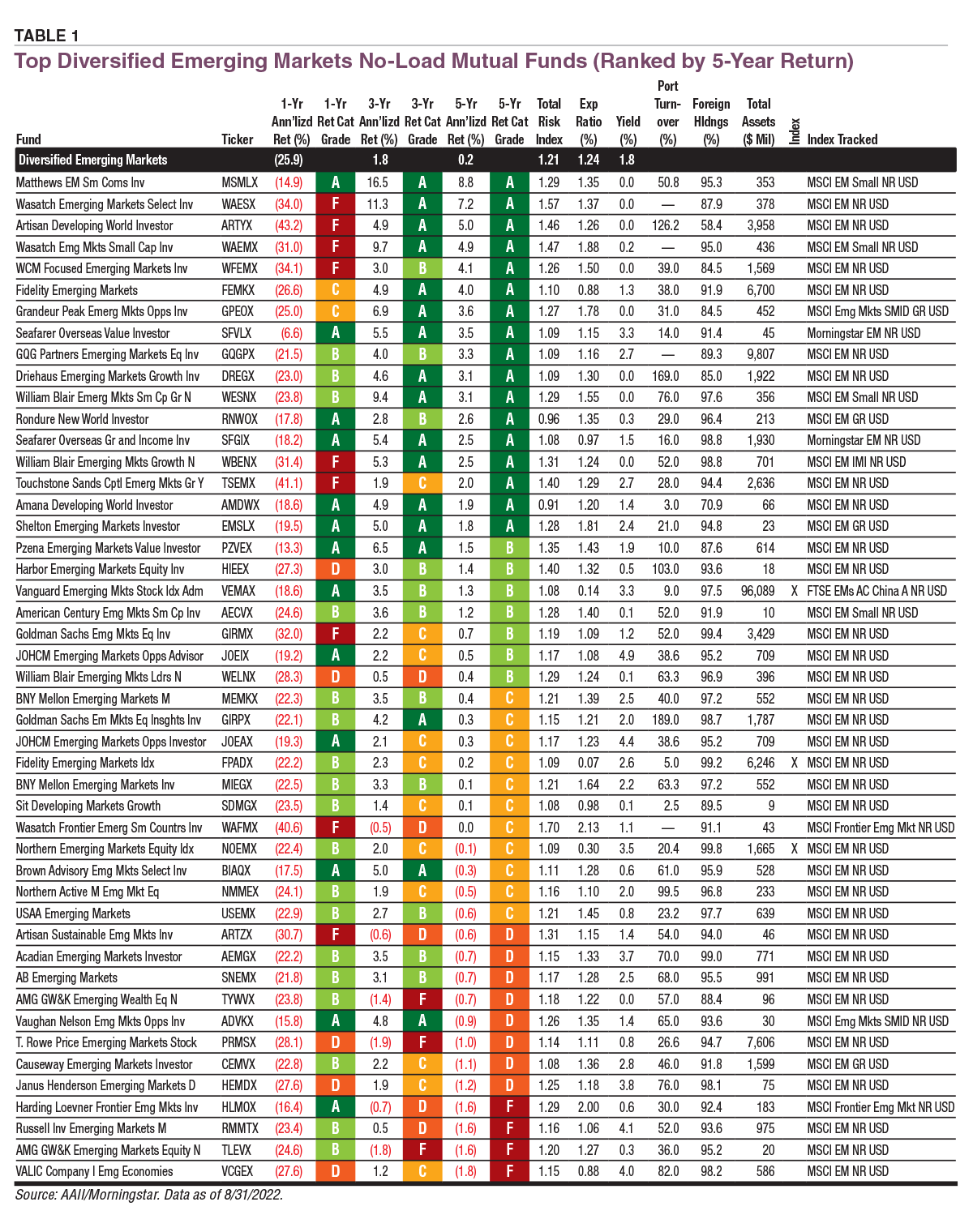
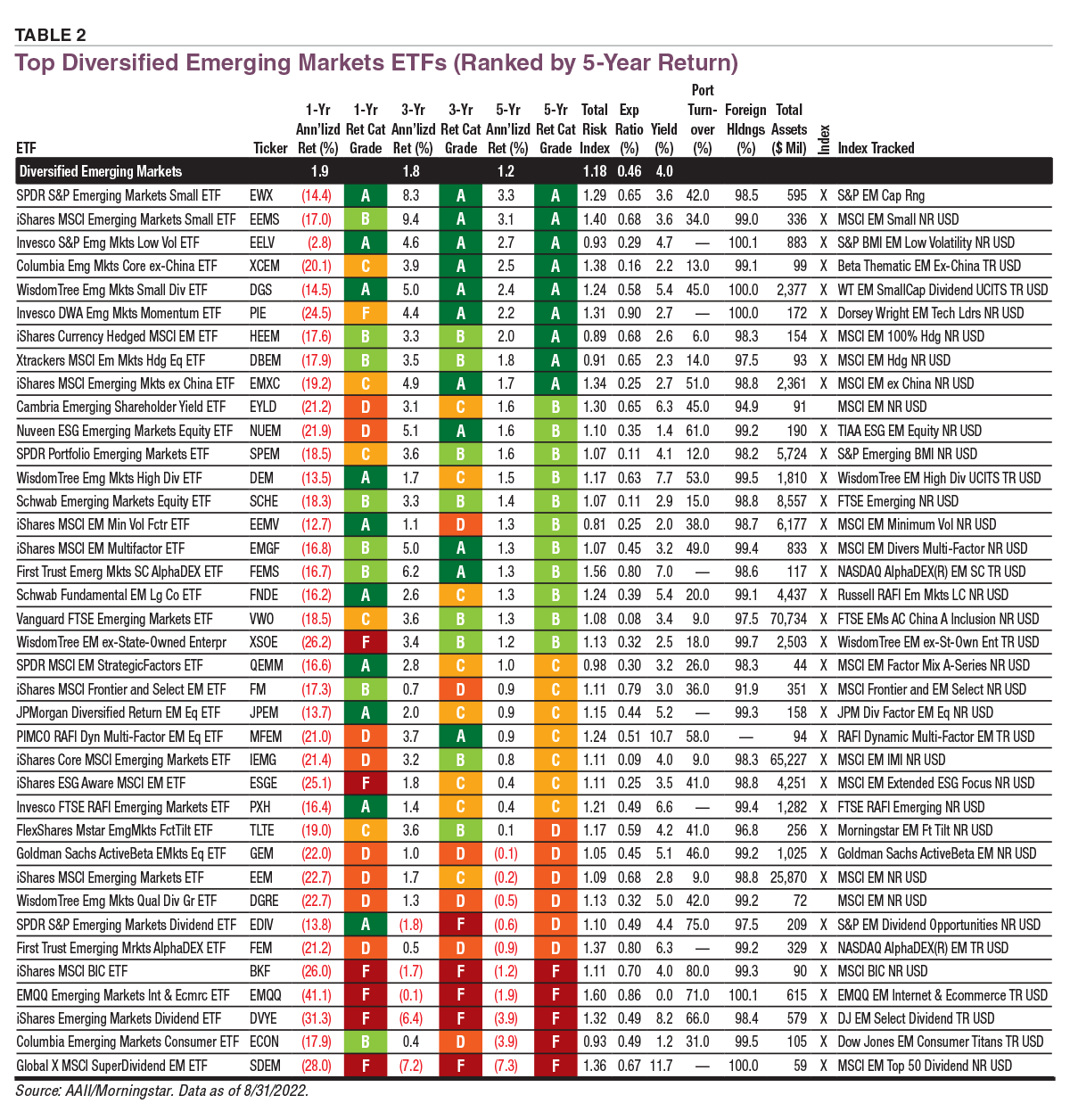
These Vanguard funds are diversified emerging markets funds, which means they are not focused on investing in a single region or country categorized as an emerging market. Table 1 and Table 2 show other top mutual funds and ETFs in the diversified emerging markets category.
Download the Excel spreadsheet for Table 1.
Morningstar defines diversified emerging markets funds as those that tend to divide their assets among 20 or more nations. However, the funds in this category tend to focus on the emerging markets of Asia and Latin America, rather than on those of Europe, Middle East or Africa (EMEA). The funds invest predominantly in emerging markets equities, but some also invest in fixed-income investments from emerging markets.
Download the Excel spreadsheet for Table 2.
The MSCI Emerging Markets index provides a useful standard for tracking emerging markets. The majority of the mutual funds in Table 1 follow the MSCI Emerging Markets index as their benchmark index, and iterations of MSCI’s Emerging Markets index make up the majority of the benchmark indexes for the ETFs in Table 2.
In Asia, MSCI considers China, India, Indonesia, Malaysia, the Philippines, South Korea, Taiwan and Thailand to be emerging markets; in the Americas, the category includes Brazil, Chile, Colombia, Mexico and Peru; in Europe, the Czech Republic, Greece, Hungary and Poland are labeled emerging markets; the Middle East includes Turkey, Egypt, Kuwait, Qatar, Saudi Arabia, United Arab Emirates; and in Africa, South Africa is considered an emerging market.
Traditionally, the four most commonly tracked emerging markets were Brazil, Russia, India and China, referred to by the acronym BRIC. Russia is now notably missing from this group. MSCI moved Russia into the category of “stand-alone market” in March 2022, following Russia’s invasion of Ukraine in February 2022 and the imposition of sanctions against its economy by Western countries.
According to MSCI, Russia’s prominence as an emerging market was already slipping from a 10% index weight in 2008 to 4% at the start of 2022 under pressure from currency deprecation and preceding economic sanctions.
As of August 31, 2022, China carries the largest weighting of any country in the MSCI Emerging Markets index, at 32.1%. Taiwan, India, South Korea and Brazil follow with weightings of 14.6%, 14.5%, 11.6% and 5.3%, respectively.
Financials is the most heavily represented sector for the index at 21.6%, followed by information technology at 19.4%, consumer discretionary at 14.2%, communications services at 10.1% and materials at 8.4%. Consumer staples, industrials, energy, health care, utilities and real estate make up the remaining portions in descending order.
Most of the diversified emerging markets mutual funds in Table 1 are actively managed. Vanguard Emerging Markets is the best-performing index mutual fund on the list of diversified emerging markets mutual funds ranked by five-year annualized return. It has a five-year return of 1.3% and a five-year return category grade of B. There are only two other index mutual funds on the list, Fidelity Emerging Markets Index (FPADX) and Northern Emerging Markets Equity Index (NOEMX).
There is a wide range in the levels of activity, with some of the featured mutual funds recording high percentage levels of portfolio turnover. This field measures the trading activity of the fund, which is computed by dividing the lesser of purchases or sales for the year by the monthly average value of the securities owned by the fund during the year. Securities with maturities of less than one year are excluded from the calculation. The result is expressed as a percentage, with 100% implying a complete portfolio turnover within one year.
Among the top 10 mutual funds on the list ranked by five-year annualized return, the Driehaus Emerging Markets Growth Investor fund (DREGX) has a portfolio turnover rate of 169%, one of the highest on the list. The fund manager is upfront about expecting the fund to have high rates of portfolio turnover as it follows its growth strategy. When selecting a mutual fund with high turnover, be aware that this may cause above-average transaction costs and result in payment by shareholders of taxes on above-average amounts of realized investment gains, including short-term capital gains.
The Driehaus Emerging Markets Growth fund also deviates a bit from other mutual funds on the list in its percentage of foreign holdings, at only 85%. While Morningstar looks for at least 20 countries in a diversified emerging markets fund, there is a noticeable variance in the percentage of foreign holdings between the mutual funds in Table 1.
The Artisan Developing World Investor fund (ARTYX) just qualifies as predominantly invested in emerging markets with a foreign holdings percentage of 58.4%, the lowest in Table 1. Six of the fund’s top 10 holdings are U.S.-based companies; the top two holdings are Airbnb Inc. (ABNB) and Nvidia Corp. (NVDA) at 6.9% and 6.6%, respectively. The U.S. accounts for 44.2% of the fund’s portfolio, and China, at 26.3% of the portfolio, makes up the majority of the fund’s emerging markets weighting.
Most of the ETFs in Table 2 are index ETFs, following a passive strategy. Accordingly, across the list, most funds are close to fully invested in foreign holdings. There is much less variance in allocation to foreign holdings here than there is in the list of diversified emerging markets mutual funds. Portfolio turnover is also lower on average, which would be expected of funds following a passive strategy. Fees are kept to a minimum when mirroring an index benchmark, and expense ratios are likewise lower compared to the mutual funds in Table 1.
There is a wider variety of benchmark indexes followed by the ETFs in Table 2 than seen on the list of mutual funds. What’s most important for ETFs is keeping fees low and being large enough to provide liquidity so shareholders can buy and sell without complications. The Vanguard FTSE Emerging Markets ETF representing emerging markets in AAII’s aggressive asset allocation model is the largest ETF in Table 2, with $70.7 billion in total assets. It is followed in size by BlackRock’s iShares Core MSCI Emerging Markets ETF (IEMG) at $65.2 billion in total assets.
Both funds are similar in that they follow a market-cap-weighted approach to their respective benchmarks, which captures the market’s collective opinion of each equity’s value. The Vanguard FTSE Emerging Markets ETF has a broader exposure with 4,451 equity holdings compared to the iShares Core MSCI Emerging Markets ETF’s 2,667 equity holdings, but the funds are very similar across the columns listed in Table 2—such as total risk index and expense ratio. The ETFs’ top 10 holdings are similar but with slightly different weightings.
The iShares Core MSCI Emerging Markets ETF follows MSCI’s Emerging Markets Investable Markets index (IMI), which differs from MSCI’s main emerging markets index by including small-cap stocks. The MSCI Emerging Markets index, discussed previously in detail, includes only mid-cap and large-cap stocks.
Emerging markets offer greater potential return at a higher level of risk than equities based in developed markets. It is a good idea to diversify a portfolio with an international allocation, but whether that allocation should include emerging markets is determined by the risk profile of the investor.
For most individual investors, diversified emerging markets mutual funds and ETFs are the most practical routes to emerging markets exposure. Based on a market-cap-weighted strategy, a diversified fund will provide exposure to the largest emerging markets, particularly China. However, there are region- and country-focused funds to consider for those who desire a more specific exposure.
ETFs and Mutual Funds

First Cut Mutual Funds

Growth Investing

JOHN L from NJ posted over 4 years ago:
CRAIG B from WI posted over 4 years ago:
BERT M from AZ posted over 3 years ago:
THOMAS B from DE posted over 3 years ago:
CRAIG B from WI posted over 2 years ago:
BARRY J from TX posted over 1 year ago:
You need to log in as a registered AAII user before commenting.
Log InCreate an account