


Derek Hageman leads a class in AAII's new Essential Investing Video Course. Go to https://www.aaii.com/ves for more information and to subscribe.

Broadly speaking, there are two main dividend investing strategies: high yield and high dividend growth.
High-yield strategies focus on stocks with above-average current yields relative to the broader market to maximize income. Companies with solid dividends are often mature and pay out a substantial portion of their earnings to maintain the dividend and increase it to the extent their slow-growth businesses allow. In some cases, the dividend itself hasn’t grown, but the stock’s yield has because its share price has fallen. It takes skill to determine whether there’s a bargain to be had or a company’s prospects have taken a turn for the worse and it could soon become distressed.
Due to the higher-than-average yield, the market often perceives these stocks as riskier compared to high dividend growth stocks. The high yield signals elevated levels of risk and may indicate weak growth prospects. When high-yielding stocks’ earnings plummet, there is less cushion to meet contractual debt obligations. So, dividends, which are voluntary, became expendable.
Dividend growth strategies, on the other hand, prioritize companies whose dividends are typically modest in relation to their earnings and their stocks’ yields versus the broader market but are growing at an above-average rate along with their businesses. The challenge for income-oriented investors with these strategies is that the current yield may not be enough to meet one’s needs.
The market perceives dividend growth stocks as less risky due to better growth prospects. Dividend growth stocks have a lower absolute yield when compared to the high-yield approach.
Like with bonds, equity yield is a function of price. When prices drop, yields rise, and vice versa. The downturn in 2022 has boosted many stocks’ yields. Should volatility continue, as many expect, a benefit of dividend-paying stocks is that they offer some downside protection. Here, dividend growth strategies have an advantage over their high-yield counterparts in two respects. First, dividend growth stocks are typically more resilient. Second, dividend growth strategies are often less susceptible to dividend cuts or suspensions.
Which are the better dividend-paying stocks—stocks with a lower initial yield but with a high dividend growth rate, or stocks with a low dividend growth rate but with a higher initial yield?
The answer depends on what works best for your specific situation and financial goals, but each strategy has its benefits and challenges.
High-Yield Strategy
One of the biggest dangers that income investors face is being seduced by high-yielding but higher-risk stocks. Income investors need to be careful of overreaching for yield.
There are three types of high-yielding stocks:
- High-quality dividend growth companies temporarily mispriced and on sale. These probably aren’t true high yielders, but sometimes, during bear markets or periods of extreme volatility, you might find a high-quality company trading at a depressed level. This could cause its current yield to perhaps be 1% to 2% higher than its historical yield.
- Structural high-yielding stocks. For this type of high-yielding stock, we think of a real estate investment trust (REIT), where, due to tax regulations, the company is required to distribute 90% of its income to shareholders (unitholders) in the form of cash dividends (distributions).
- Struggling companies with temporary high yields. The high yields here may be temporary, not because the stock price is about to rebound at any moment, but rather because the company is likely to either cut or eliminate its dividends. The market may often misprice equities, but the market is also right an awful lot of the time. It’s important to keep an eye on unusually high yields as they can be a signal that the payout may not be sustainable.
If you’re a long-term dividend investor, dividend safety is paramount. If you are going to be a high-yield dividend investor, it helps to seek quality companies from either of the first two categories. Sadly, there won’t be many quality companies in the third category. There will only be unrealistic and unsustainable promises.
Your investment criteria should consider more than just the yield. In order to determine if a company can continue to pay out a high dividend yield, make sure you focus on stocks of companies that are financially healthy enough to sustain and even grow their dividend. It is also helpful to consider a company’s earnings payout ratio (the percentage of earnings paid out as dividends over the latest 12-month period) and its free-cash-flow payout ratio (the percentage of free cash flow per share paid out as dividends over the latest 12-month period) before investing.
High Dividend Growth Strategy
Companies whose cash flows have translated into a rising payout are known as dividend growers. The high dividend growth strategy seeks financially strong companies that are healthy enough to sustain and even grow their dividend. These are companies with competitive advantages that will allow them to continue to earn above-average profits and sustain their dividends for years.
Companies that are focused on growing dividends tend to be higher-quality, cash-rich businesses that hold up well in down markets, participate in up markets and are capable of excess returns over a full market cycle.
In addition to being core defensive holdings, companies that are growing their dividends provide some protection from inflation: A rising dividend is fundamental to investors’ ability to preserve purchasing power through their equity portfolio.
High dividend growth stocks are not always among the highest-yielding securities in the market; in fact, it’s important for investors to have reasonable expectations for dividend growth strategies. Investors seeking current income might not be satisfied with the yield of a dividend growth portfolio.
Investigate Dividend-Related Data at AAII.com
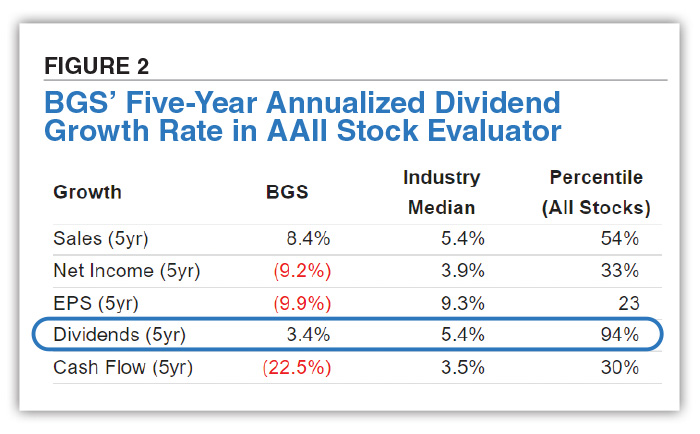
AAII members can find the information necessary to assess the current dividend yield and five-year dividend growth rate in AAII’s Stock Evaluator. Simply type a company’s name or ticker symbol into the search box located at the top of any page on AAII.com, and then select the name from the drop-down list that appears. On the evaluator’s snapshot page, the valuation section shows the current yield, along with a comparison to its industry median and percentile ranking among all stocks (Figure 1). The growth section shows the company’s five-year annualized growth rate for sales, net income, earnings per share, dividends and cash flow (Figure 2).
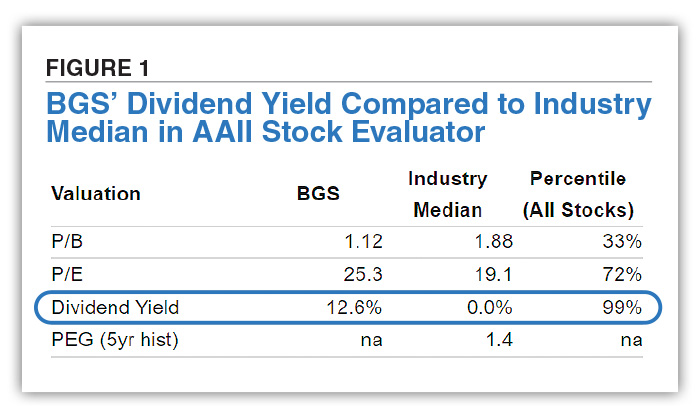
To illustrate the danger that income investors face in being seduced by high-yielding but higher-risk stocks, we look at B&G Foods Inc. (BGS). It has a yield of 12.6%, which ranks in the 99th percentile of all stocks in AAII’s Stock Investor Pro fundamental stock screening and research database. However, B&G Foods’ five-year annualized dividend growth rate 3.4%.
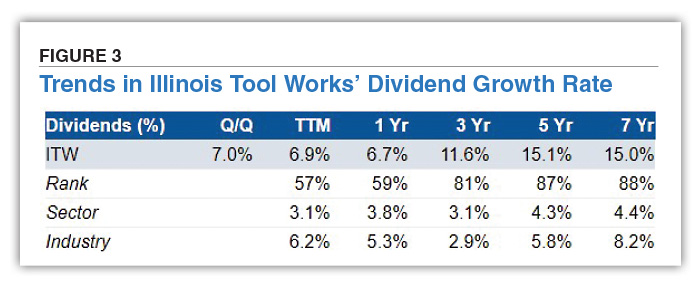
To find financially strong companies that are healthy enough to sustain and even grow their dividend, A+ Investor subscribers can look at data on the Growth tab. Figure 3 of the Stock Evaluator illustrates the strong history of dividend growth for Illinois Tool Works Inc.  (ITW).
To get a more complete understanding of a company’s financial situation, analysis would be combined with other measures such as free cash flow, payout ratio and relative valuation, among others.
Consider a Blend of These Two Strategies
AAII’s Dividend Investing strategy seeks higher-than-market yields and dividend growth at a reasonable price. Therefore, the Dividend Investing approach would be categorized as a hybrid strategy but would lie closer to the high dividend growth end of the spectrum. We think AAII’s Dividend Investing strategy delivers the best elements of both dividend strategies.
For more AAII How-To columns, go to the AAII Journal section of AAII.com and select AAII How-To from the Browse by Topic drop-down box on the right.
Discussion
FREE REPORT

ADAM G from MA posted over 3 years ago:
James F from USA posted almost 2 years ago:
You need to log in as a registered AAII user before commenting.
Log InCreate an account