


Related

Portfolio Strategies
Stories of investing loss that underscore the importance of preparation, vigilance and learning from others’ experiences.

Have you ever made a disastrous investment? My worst investment ever was sinking money into a friend’s start-up, resulting in a painful and embarrassing loss. I tell you about it in this article.
Have you bought an investment you later realized was a mistake? I know that I am not alone in making investment decisions that I later regretted. I know this to be true because I started the “My Worst Investment Ever” podcast in mid-2018 to interview people about their worst investment experiences.
Six years and 800 interviews later, I’ve uncovered six common mistakes. I share them—along with six stories from guests on my podcast who made such mistakes—to help you avoid them.
Josiah Smelser is a licensed real estate agent who operates an investment property business with a partner. He shared his story in the episode “Push Through When Everything Goes Wrong.”
Many real estate investors dream of achieving the perfect flip—a quick buy, a swift renovation and a profitable sale. Eager to enter real estate, Smelser devised a plan: buy low-priced houses, fix them up, sell them for a profit and use the earnings to acquire rental properties.
He found a seemingly promising investment: a house far from the city center but attractively priced. On the day Smelser was to close the deal, water rushed through the bathroom ceiling. Despite this warning sign, the seller’s significant price reduction convinced him to proceed. This was a decision he would soon regret.
Smelser then skipped a property inspection to save time and money. Unfortunately, he discovered extensive termite damage after purchasing the house. As renovations progressed, he uncovered mysterious holes in the backyard. Pest control revealed an unexpected armadillo infestation, adding to the costs. Further complications included rotten wood around the windows, which, in turn, stretched his budget.
With the house finally ready for sale, Smelser faced another setback. He arrived with the first potential buyer only to find the front yard swarming with hornets. This required another costly pest control visit.
Months passed before another buyer showed interest. Then, the buyer returned with a home inspector. The inspector identified 30 issues needing attention. Smelser painstakingly fixed all of them only for the buyer’s appraiser to find 15 more. Finally, the buyer found six additional problems close to the closing date. These problems included water damage to the foundation.
In a frantic race to meet the closing date, Smelser fixed everything. However, a chimney cleaner accidentally blew black soot into the living room on the closing day, necessitating a last-minute cleanup. With mere minutes to spare, Smelser and his team cleaned and painted the walls, finally making the house presentable.
Smelser sold the house at a significant loss of $20,000. Beyond the financial hit, the experience cost him precious time and delayed his business plans. The ordeal taught him the importance of thorough research and due diligence, highlighting the true cost of missed opportunities and lack of preparation.
Smelser’s story leads us to lesson number one: failing to do your own research. To avoid this, consider writing down your research about your investment idea—whether it is a house, stock, fund, etc.—and the potential gains you expect to realize.
Author of two No. 1 bestselling books on Amazon—“Money Grows on Trees” (2019) and “The Naked Trader” (2020)—and CEO of Real Life Trading LLC, Jerremy Newsome told his story in the episode “Stop Trying to Hit the Home Run Trade.”
Inspired by Forrest Gump’s success with Apple Inc.  (AAPL), Newsome convinced his father to give him money for investing. Newsome exited this first trade with excellent gains. This made his father happy and willing to further support his son’s newfound success.
Buoyed by the early win, Newsome’s father decided to go all in as Newsome turned his attention to investing in fast-rising silver. Unfortunately, this second investment didn’t go as planned, as Newsome bought just before a peak. Being a novice to the world of investing, he failed to consider a risk management plan to handle the market’s volatility.
To make matters worse, Newsome’s investment was not in physical silver but through derivative instruments, a risky move. As silver’s price plummeted, Newsome faced a 100% loss. The real blow came when he realized his father had given him his entire retirement savings, making this a devastating loss.
Newsome’s oversight was not considering the downside risk. The experience taught him the harsh reality of speculation and the importance of managing risk. The painful lesson: Always protect your capital and be cautious when everyone feels excited about an investment. The lesson for his father was to never allocate all your money to any particular investment opportunity.
Newsome helped us understand lesson number two: failing to properly assess and manage risk. To avoid this, separate your research on return from your research on risk. Then rank risks by probability and severity. Finally, use your research analysis to create a risk-reduction plan in case the investment does not go your way.
Jim Ponvanit is the founder and CEO of PeerPower Platform Co. Ltd., a fintech start-up focusing on the small- and medium-sized business marketplace lending in Thailand. Ponvanit shared his story in the episode “Apply Behavioral Finance Principles to Make Better Decisions.”
Ponvanit, who had seen gains in U.S. stocks post-2008, became obsessed with investing in market volatility in 2015. He invested 50% of his portfolio in the iPath S&P 500 VIX Short-Term Futures ETN (VXX) on the belief that volatility had bottomed out.
After a 40% loss in four months, Ponvanit doubled down. In doing so, he ignored opposing views and put the rest of his money into the falling investment. Though he was exposed to a myriad of opposing opinions by seasoned professionals, his belief in his research led him to disregard market signals and criticism.
By early 2017, Ponvanit sold his position. The total loss was equivalent to 70% of his initial investment (Figure 1). His story illustrates the dangers of overconfidence and the importance of listening to contrary opinions. The key takeaway: Never ignore market realities and avoid information-selection bias.
FIGURE 1
Overconfidence Can Lead to Big Losses
Jim Ponvanit became obsessed with investing in market volatility in 2015. He invested heavily in the iPath S&P 500 VIX Short-Term Futures ETN (VXX) on the belief that volatility had bottomed out. When his investment fell 40% in four months, he bought more shares rather than listening to opposing opinions. This eventually led to a 70% loss—a mistake that could have been avoided if he was open to the possibility of being wrong.
The exchange-traded note (ETN) Ponvanit bought was delisted in 2019. In its place, this 10-year chart of the ProShares VIX Mid-Term Futures ETF (VIXM) illustrates the drop exchange-traded funds (ETFs) and ETNs tracking the Chicago Board Options Exchange’s (CBOE) Volatility index (VIX) incurred between 2015 and early 2017, when Ponvanit sold his position.
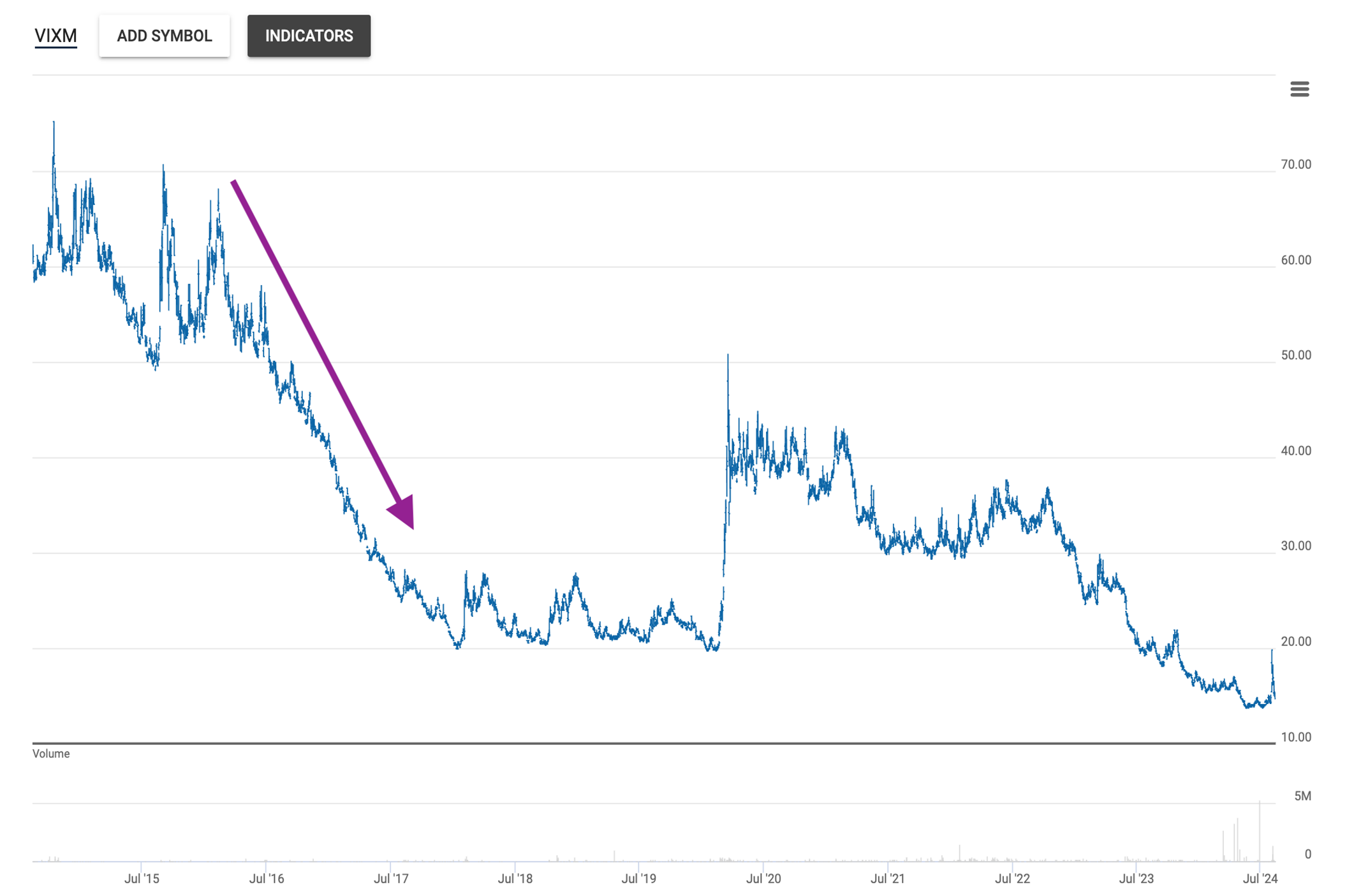
Source: QuoteMedia and AAII.com. Data as of 8/13/2024.
Lesson number three is about making the right decisions. The mistake is to be driven by emotion or flawed thinking. To avoid this, find, explore and list opposing views. It is a good idea to discuss your ideas with a knowledgeable and objective person.
CEO, venture founder, speaker and author Azran Osman-Rani shared his story in the episode “From Zero to a Billion Dollar IPO.”
 Osman-Rani, the founding CEO of airline AirAsia X, invested all his savings and took out loans to buy shares of the company after being urged on by the founder and investment bankers. Of course, people who sell commission-based financial products (like stockbrokers and insurance agents) make money no matter what happens. Osman-Rani, himself, believed in the concept of “skin in the game.”
The AirAsia X initial public offering (IPO) initially yielded a 600% return. So, Osman-Rani seemed to be rich, at least on paper.
In 2007, the airline owner urged Osman-Rani, as CEO, to invest his wealth rather than be awarded stock options. Investing nearly all his wealth was a stretch for Osman-Rani, but he did it. Before the IPO in 2013, Osman-Rani trusted his investment banker’s advice to use his original shares as collateral for a loan. Doing so allowed Osman-Rani to borrow more money from the bank to use toward buying additional shares of AirAsia X at the IPO price.
AirAsia X aggressively expanded by using the proceeds from its IPO to double its fleet and focus on China and Australia. Then, three major airline disasters hit in succession. Malaysia Airlines Flight 370 disappeared with 239 people on board in March 2014. Malaysia Airlines Flight 17 was shot down over Ukraine in July 2014, killing all 298 passengers and crew. Indonesia AirAsia Flight 8501 crashed into the Java Sea in December 2014, resulting in 162 fatalities. These crashes severely impacted the industry and AirAsia X’s stock price.
As CEO, Osman-Rani couldn’t sell his shares even as they plummeted. In fact, he decided to buy more. Osman-Rani had trusted his mentor and investment bankers and ended up having leveraged investments in AirAsia X. He eventually lost all of his shares when the bank sold them to cover his debt. Osman-Rani incurred a seven-digit loss and tendered his resignation.
This leads us to mistake number four: misplacing trust. To avoid this, get to know the person you are investing with, as trust only develops over time. Additionally, avoid excessive leverage like Osman-Rani accumulated, have a backup plan for unforeseen risks and be cautious of financial advice motivated by fees and commissions.
Creator and host of the weekly personal finance podcast “Money for the Rest of Us” David Stein shared his story in the episode “Trading Currencies and Commodities is Harder Than You Think.”
As he was transitioning into retirement, Stein was enticed by the excitement of the trading he witnessed at a hedge fund. With years of investment experience, he ventured into commodity futures and currency options. However, in doing so, he underestimated the difficulty of trading.
Despite his knowledge, Stein found trading challenging. He decided to stop but forgot a buy order he had previously placed. This order was to automatically buy silver if the price fell to a particular level. When silver’s price dropped, it triggered the buy order. The purchase led to an unexpected loss of $25,000 as silver continued its collapse. This oversight turned into a costly mistake made by a seasoned investor.
Stein’s experience highlights that trading is speculative and risky, even for experts. The key takeaways are to always monitor your trades and never underestimate the market’s unpredictability.
The loss reminds us of the importance of vigilance and caution. It also brings us to our fifth mistake: failing to monitor your investments—in this case, outstanding orders. To avoid this mistake, follow a regular, predetermined monitoring process.
Viola Llewellyn is the president and cofounder of Ovamba Solutions Inc. and now helps empower women to succeed. She told her story in the episode “Learn to Embrace Failure.”
Llewellyn and her partner Marvin Cole launched a peer-to-peer lending platform for small African market enterprises with initial investments from friends and family. They soon attracted the interest of an investment firm at a conference. This seemed like it would secure a promising partnership. Because Llewellyn was so eager for funding, she didn’t spend time doing a background check on the potential investor.
After a glamorous start, the investment firm promised a significant investment but delayed transferring the funds. Llewellyn faced mounting pressure, as she had committed to funding small businesses and launched a major marketing campaign. However, the promised capital never arrived.
Llewellyn had to retract her promises to her customers and face the embarrassment of failure. The collapse of the investment firm partnership taught her the importance of thorough due diligence and not relying solely on positive references. She learned to do background checks on financial advisers and planners. The process included regulatory agency checks on those professionals and their firms. The experience underscored the necessity of a backup plan and transparent communication with stakeholders.
Mistake number six occurred when my podcast guests invested in a start-up. To avoid losing everything in a start-up investment, allocate only what you can lose to start-up companies.
This brings me back to my story. Like Llewellyn, my worst investment was investing in my friend’s start-up. I found the experience painful because I lost a sizable portion of my wealth. It was also shameful because, as a top analyst and president of the CFA Society Thailand at the time, I was someone who should have been well-equipped to avoid such errors.
Through my journey of interviewing 800 people on the “My Worst Investment Ever” podcast, these six stories highlight crucial lessons. The lessons underscore the importance of preparation, vigilance and learning from others’ experiences to avoid repeating the same costly errors.
Portfolio Strategies

Portfolio Strategies

Behavioral Finance

BARRY J from TX posted over 2 years ago:
ROBERT A from NC posted over 2 years ago:
JAMES E from FL posted over 2 years ago:
JOHN D from LA posted over 2 years ago:
Hugh P from WA posted over 2 years ago:
CHARLES B from WA posted over 2 years ago:
You need to log in as a registered AAII user before commenting.
Log InCreate an account