



Related

AI-Powered Investing
Why earnings growth, yield and valuation are the critical components of stock performance.

Matt Fruhan is a portfolio manager in the equity division at Fidelity Investments, where he manages several funds. Cynthia McLaughlin sat down with Fruhan in mid-June to discuss his investment process for the Fidelity Growth & Income fund (FGRIX) and how he approaches factors such as dividends, stock valuation and portfolio turnover.
Cynthia McLaughlin: When managing funds that have both a value and growth tilt, do you use a growth at a reasonable price (GARP) strategy, or do you blend both value and growth stocks?
Matt Fruhan: This might not be a satisfying answer, but I actually don’t approach investing through either a growth lens or a value lens. I think about both.
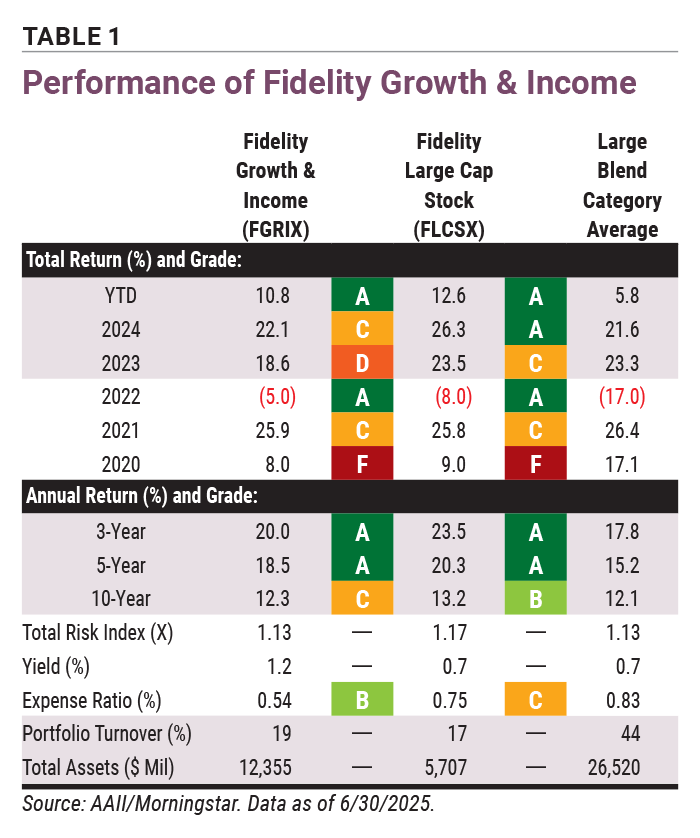
When people ask if I’m a growth investor, I think they’re really asking if I’m a fundamental investor who looks primarily at the earnings growth of a company. When they ask if I’m a value investor, they’re actually asking if I use valuation as my primary investment tool. They’re also asking whether I’m buying cheap stocks on a valuation or a multiple basis. I use both fundamental and valuation analysis in my stock selection process. I don’t think you can use one or the other because they’re both important to the total return of a stock.
My investment process starts with fundamental analysis, looking out three to five years at both the earnings growth and the dividend yield of a stock and trying to see whether the combination of those factors is more than the consensus expects from the stock. Once I do the deep-dive analysis of a stock’s earnings growth and yield potential, I then use a valuation overlay to determine if the market is already discounting my out-of-consensus view.
To me, both value and growth are critical, so I don’t approach my analysis with either a value or growth framework. I guess you could say I use both. The fundamental outlook and the valuation overlay are parts of the equation. You can’t ignore one or the other.
How does the income side of Fidelity Growth & Income cause your approach to differ from other funds you manage, such as the Fidelity Large Cap Stock fund (FLCSX)?
The stock-level analysis doesn’t change at all. I don’t go into stock analysis thinking about which fund the stock is going to be appropriate for. I look at a lot of stocks, many of which have a payout ratio and an income component to them. That’s part of the overall total return equation.
In terms of performance, if a stock’s valuation is held constant over time, the investor receives the earnings growth plus the yield. As such, they’re both critical components of stock performance. The valuation is also a critical piece of performance, as it changes over time based on what the market thinks of the return and growth profiles of a company. So, my analysis of the individual stocks is not dictated by the fund or its objectives.
Where these funds differ is in what I’m trying to achieve with the portfolio construction. Fidelity Growth & Income, for instance, primarily holds stocks that have an income component to the total shareholder return equation, whereas Fidelity Large Cap Stock can and does own stocks that don’t really have any yield. The Fidelity Mega Cap Stock fund (FGRTX), which I also manage, has a market-capitalization overlay, so I try to keep that at a very high-level market-cap concentration.
When you’re assessing dividends, do you focus on certain metrics, such as the dividend growth rate or dividend yield?
When I’m looking three to five years out at the earnings growth and dividend yield, part of what I’m looking at is the income capacity, or the dividend capacity, of the stock. That’s driven by two factors.
One factor is the payout ratio, which is the dividend divided by the net income as a percentage. The payout ratio shows how much of the company’s earnings are being returned to the shareholder directly through income. The second piece is the company’s underlying earnings growth.
Those are the drivers of that absolute dividend, or income, level and how much it can be increased over time. A dividend can be increased by raising the payout ratio, or by keeping it consistent and growing earnings. I try to look at both of those factors.
When I first started managing Fidelity Growth & Income, I realized that there were going to be different environments where the income stream—or the growth of the income stream—would matter more to investors. In various inflation scenarios, I think it’s important to have an income stream that is able to keep up.
If people are investing in income-oriented stocks to support a certain lifestyle or to help them live, it’s important that their income stream can grow over time, if not necessarily keep up with inflation. That’s why I think dividend income from equities is an interesting part of an investor’s toolkit. Over time, the S&P 500 index and its holdings do have an increasing dividend income stream because companies usually grow their earnings over time. If you have a flat payout ratio and underlying earnings are growing, then the absolute income that’s paid out every year is growing. So, I think it’s important to look at both the payout ratio and the underlying earnings growth that supports the potential for a company to uphold its payout ratio over time.
The actual yield is also an important part of the total return. Obviously, the dividend can be flat, but if a stock moves higher or lower, the yield at which you buy that initial investment changes. That’s all part of the equation where you’re thinking about the total return of a stock over a multiyear period.
I would add that—for my investing style, at least—the optimal area for a payout ratio is somewhere in the 30% to 60% range. If you’re at the lower end of the range, it provides the potential for the payout ratio to slowly rise.
You also want to make sure that the company’s earnings and free cash flow can be used in many ways, such as for paying down debt, buying back stock and supporting the dividend income stream to the investors through the payout ratio. The way the management team and the board allocate a stock’s earnings or free cash flow every year can lead to faster earnings growth if they’re buying back stock, or it could lead to a higher yield because they’re paying out more of the earnings directly to the shareholder. It’s really important to look at both of those inputs when you’re assessing a stock.
You need to be cognizant of companies that have very high payout ratios. If, for some reason, the earnings falter, you could be in an environment where the company needs to cut the payout ratio, and that can be an unpleasant journey for investors.
What warning signs do you watch for to signal that a dividend is at risk of no longer being raised or, worse, of being cut?
It’s important to understand the payout ratio—how much of a company’s earnings are being returned—and the volatility of the earnings stream, or the volatility of the cash flow stream. A higher payout ratio is great; you’re getting more of the income returned to you. But, there are some areas where you get really high payout ratios. Companies can certainly temporarily pay out more than the net income or free cash flow they generate, but that’s hard to manage over long periods of time. So, you want to look at the volatility of the company’s earnings and free cash flow stream. The more stable that is, the higher the company’s payout ratio can be.
I don’t bat a thousand on these, but I try to find companies that don’t have dividend cuts, because it is usually a tough journey for the stock. When you do your analysis, you want to make sure that you’re comfortable that the payout ratio can be sustained. Make sure you do your work on the earnings or free cash flow range that a company can generate over time.
Balance sheet strength is also very important. If balance sheets are levered, you have a high payout ratio, and if the range of earnings or free cash flow is also wide, there is less room and less tools in the company’s toolkit to sustain the payout ratio.
In a 2023 interview you did with Business Insider, you said that you vary your valuation metrics based on the stock’s industry. Are there guidelines that individual investors can follow to determine which valuation metric makes the most sense for a given industry or sector?
I look at a variety of valuation metrics. You have to be cognizant of the valuation metrics you use when you’re thinking about different risk-rewards in a stock.
A lot of people, myself included, will look at earnings growth in relationship to a price-earnings (P/E) ratio. But, I’ve also found that, in certain sectors, there are other tools you can also use to strengthen and further your investment case.
When analyzing companies in the financial sector that have spread-based investing, such as banks, a lot of investors sometimes look at the return on tangible equity that a company can earn—that is, the return power of the earning equity capacity of a company. They will look at that in relation to the price-to-tangible-book-value ratio. It’s just another way of looking at valuation metrics to try to get comfortable with the potential range of stock outcomes in companies or industries where there’s a lot of amortization, marketing costs or customer acquisition costs.
It’s very important to understand the earnings power of a company, but sometimes you want to look at the company’s free cash flow power as well. For example, 10 or 20 years ago when cable companies were first growing very quickly, the earnings for some companies were negative. But, they were growing, they had subscribers—you had to look at the churn of the subscriber base—and they were sometimes generating free cash flow even though the earnings were negative.
There’s no one catchall valuation metric that I think matters for individual industries or sectors, but a blend of various valuation metrics sometimes makes sense. However, at the end of the day, I do think free cash flow is what drives stocks over time. Earnings are sometimes a good proxy for free cash flow, but I tend to focus a lot on the free cash flow power. I use the term earnings power, but it’s really the free cash flow power of a company over three to five years. What investors receive at the end of the day is the actual cash flow a company generates. So, that’s probably my true north. That said, I use many different valuation metrics in trying to understand the range of outcomes in a stock.
The funds you manage have low turnover rates. Do you have specific criteria that prompt you to sell a stock?
Turnover is not an objective. It’s the outcome of the investment philosophy and the process. I use very strict price target criteria based on what I think stocks are worth. In most of the funds I manage, I use these price targets to manage the position sizes of the funds’ holdings. I look at the risk-adjusted returns as well as the alternative options available to me.
For example, let’s say I think a stock has 40% upside versus the stock market. If the stock goes up 20% versus the market, meaning it has realized 20% of that return, the upside is now 20%, not 40%. The stock’s weighting in the portfolio may have actually increased because of the stock’s performance versus the stock market.
That means that the bet versus the stock market will be bigger, even though the upside might be less. But that doesn’t make sense to me. Why would my upside be less and my holding versus the stock market be larger?
So, what I tend to do is change the position sizes of the stocks I have in the fund. Even though my turnover is low, I’m constantly assessing the upside and downside of stocks and whether the position sizes make sense. Unless the fundamental case or the valuation case has changed, it’s rare that I wake up and think, “Oh my gosh, why is this stock in my portfolio?” One of the reasons you see low turnover in the funds I manage is that I’m constantly re-underwriting my investment case in stocks.
What actually prompts me to sell a stock outright would be if the stock price gets near to or reaches its target price. Most of the time, the position size will just change as the risk-reward changes.
When we’re talking about specific stocks, the valuation and my view of the fundamental earnings power need to change, so that the upside to the stock is not the same. For instance, if my view of the earnings power and yield power of a stock changes, but the stock valuation correspondingly changes and the upside or downside does not change, I will not take much action in that stock. I’m prompted to sell a stock when the fundamental earnings case changes my view of a stock’s target price, or when the stock realizes that target price.
What role do dividends play in the overall strategy? Has their role changed from when bond yields were somewhat lower?
Over time in Fidelity Growth & Income, I want to have competitive earnings growth compared to the S&P 500 and a dividend yield or income stream that’s higher than the S&P 500. There are time periods where that strategy works and time periods where it struggles.
I do not invest only in equities. Fidelity Growth & Income can hold convertible bonds, and it has held high-yield bonds in the past. That is all driven by my view of the earnings and yield power of a stock. I’ve also tried to think about inflation and how investors use their current income to support their lifestyles.
One of the things I’ve talked about is the earnings capacity and payout ratio of a stock. Fidelity Growth & Income is not a dividend growth fund, but I do think about that piece of the puzzle when I’m looking at the earnings and yield power of a stock over three to five years. It all factors into the alternative universe I have to invest in.
For investors, there’s a wide menu of options that a portfolio can hold. People can invest in bonds, equities that have income attached to them, etc. One of the time periods that I think is difficult for income-equity investing is when the stock market is into non-dividend-paying stocks. We’ve seen that over the last 10 to 15 years. There are time periods when the stock market narrows into low-yielding, fast-growth stocks. That’s tough for an income-oriented fund to compete against.
One of the things we notice over time is that the market has cycles. So, we try to look through cycle investing, and that helps guide us to looking at a three- to five-year outlook and environment, knowing that the market is going to change over time.
AI-Powered Investing

Stock Strategies


No comments have been added yet. Add your thoughts to the discussion!
You need to log in as a registered AAII user before commenting.
Log InCreate an account