

Related

AAII + BetterInvesting
Combining systematic screening with disciplined stock analysis creates a powerful framework for individual investors.

Finding quality stocks to buy has never been more challenging. With thousands of publicly traded companies and endless market noise, individual investors need systematic approaches to identify promising opportunities and avoid costly mistakes.
AAII is partnering with BetterInvesting (BI) to help investors improve their ability to find and analyze stocks by combining two proven methodologies: AAII’s screening tools, which efficiently filter thousands of companies down to manageable candidate lists; and BetterInvesting’s Stock Selection Guide (SSG), which provides disciplined analysis to determine which stocks merit investment.
AAII’s 55 stock screens, based on strategies from successful investors like Warren Buffett and Peter Lynch, help investors discover opportunities they might otherwise miss. BetterInvesting’s time-tested SSG framework then guides the deeper analysis needed to evaluate growth potential and determine fair value.
Together, these complementary approaches create a complete workflow from initial discovery to final investment decision, helping individual investors build portfolios of quality companies while avoiding the emotional decision-making that often undermines long-term returns.
AAII helps individual investors solve the stock selection challenge with easy-to-use systematic stock screening. Comprehensive screening tools help investors cut through the noise and identify companies that match their investment criteria in an organized, disciplined fashion.
Stock screening serves three critical functions for individual investors. First, it helps discover potential investment opportunities that might otherwise go unnoticed in the vast universe of available stocks. Second, it saves valuable time by filtering out companies that don’t meet basic criteria. Most importantly, screening adds a crucial layer of discipline to the process, forcing investors to develop and refine their investment parameters while clarifying their personal investing style.
The key to successful screening lies in identifying a philosophy that aligns with your time horizon, risk tolerance, analytical skills and time commitment. Different investing approaches require varying levels of maintenance and monitoring. Momentum-based strategies typically demand more frequent attention and entail higher portfolio turnover, while value-oriented approaches may require patience through extended periods when market sentiment favors growth over fundamentals.
AAII’s screening methodology draws inspiration from legendary investor Charlie Munger’s philosophy: “I believe in the discipline of mastering the best that other people have ever figured out.” Rather than reinventing investment analysis, AAII has systematically studied successful investors and distilled their approaches into quantitative screening strategies.
AAII’s 55 distinct screening filters fall into two categories. Guru screens replicate the methodologies of renowned investors like Benjamin Graham and William O’Neil. Factor screens focus on specific quantitative characteristics such as low price-to-book-value (P/B) ratios or high dividend yields. Each screen undergoes continuous performance tracking, with daily updates of companies that pass the filters and historical analysis of returns and risk metrics.
AAII members can access screening tools through the Stock Ideas section of AAII.com. The Screen Power Rankings page allows investors to evaluate all 55 strategies based on various performance metrics.
For investors seeking a systematic approach to strategy selection, the risk-adjusted return ranking provides an excellent starting point. This metric helps investors identify strategies that have delivered superior long-term performance relative to their risk profiles.
With each individual screen, AAII provides performance history, a detailed explanation of the underlying investment philosophy and the specific criteria used to filter companies. For example, the Dreman With Estimate Revisions screen targets contrarian opportunities by identifying beaten-down stocks that are experiencing upward earnings estimate revisions—combining value characteristics with improving fundamental momentum.
The AAII Stock Screens page on AAII.com enables side-by-side comparison of different strategies through three key tabs. The Performance tab displays historical returns and risk metrics (Figure 1). The Characteristics tab reveals typical attributes of companies that pass each screen, such as average price-earnings (P/E) ratios, market capitalizations and dividend yields. The Grades tab provides AAII’s proprietary scoring system across value, growth, momentum, earnings quality and financial strength dimensions.
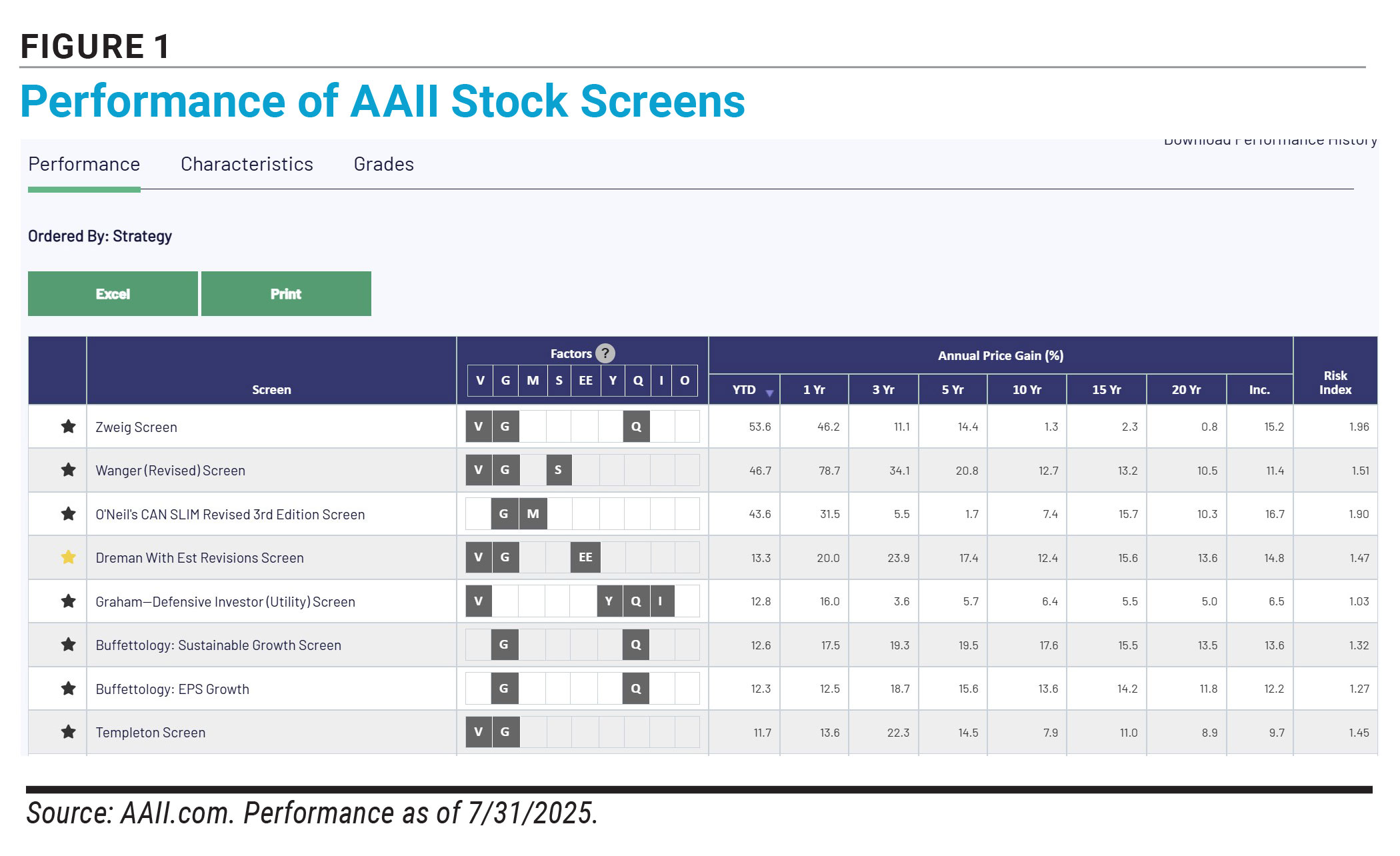
This helps investors identify strategies that align with their risk tolerance and investment preferences. Value-oriented investors might gravitate toward screens showing low price-to-book ratios and high dividend yields, while growth investors may prefer strategies emphasizing earnings momentum and revenue expansion.
AAII’s My Screens allows you to track your favorite screens in one place.
AAII members who use the My Portfolio tracking tool can look at the My Stocks Passing Any Screens tab to see which screens the stocks they follow are passing.
Perhaps the most powerful feature of My Screens is the Stocks Passing Multiple Screens tab. It identifies stocks that simultaneously satisfy several different screening criteria.
When a stock passes five or more screens—a rare occurrence affecting fewer than 10 companies at any given time—it suggests broad-based appeal across different analytical frameworks. These multiscreen passers often combine attractive valuations with solid fundamentals and positive momentum characteristics, making them prime candidates for deeper analysis.
The most effective screens combine clearly defined primary criteria with secondary criteria that help determine whether companies pass for the right reasons. For instance, a low price-earnings screen might include secondary filters for debt levels and earnings stability to avoid value traps.
Importantly, even the most sophisticated screen serves only as a starting point for investment analysis. Companies that pass a given stock screen should be researched further. You want to verify that the quantitative metrics reflect genuine business strength rather than temporary anomalies or accounting irregularities.
AAII’s screening tools work best when integrated into a systematic investing process. Investors should select strategies that match their investment philosophy and stick with them through various market cycles, as jumping between approaches during periods of underperformance often proves counterproductive.
Through disciplined application of these screening principles, individual investors can level the playing field with professional money managers, identifying promising investment opportunities that match their specific criteria and risk parameters while avoiding the emotional decision-making that often undermines long-term investing success.
We think you’d like this related webinar! AAII + BetterInvesting: Your Stock Strategy Edge
While screening tools help identify promising candidates, the next critical step involves conducting thorough fundamental analysis to determine whether these stocks merit investment. BetterInvesting’s SSG provides a disciplined framework for this analysis.
BetterInvesting developed and teaches the Stock Selection Guide as a disciplined approach to individual stock picking based on fundamental analysis. Discipline is key when investing in individual stocks, and the SSG helps investors focus on attributes most likely to contribute to long-term company success.
The approach borrows from business school textbooks and principles employed by legendary investors like Lynch’s growth at a reasonable price (GARP) methodology and Graham’s value framework famously used by Buffett. The SSG utilizes a long-term buy-and-hold framework, looking past each economic cycle and beyond bull and bear market fluctuations.
This methodical, disciplined approach helps reduce “mistiming” risks—buying when prices are too high—while identifying maximum return opportunities. The SSG also suggests when it might be time to sell because a company’s fundamentals are not performing well.
The SSG was developed in the 1940s and 1950s by George Nicholson, one of BetterInvesting’s founders and a securities analyst interested in democratizing Wall Street and making it accessible to Main Street. Nicholson created a method to analyze stocks that didn’t require a business school diploma or accounting degree.
The beauty of the SSG lies in its simplicity and accessibility. Simplicity does not mean the tool is “unsophisticated.” The SSG distills thousands of available financial ratios and metrics into a handful that convey the essence of what makes a “good company,” then helps investors make informed buying decisions (Figure 2).
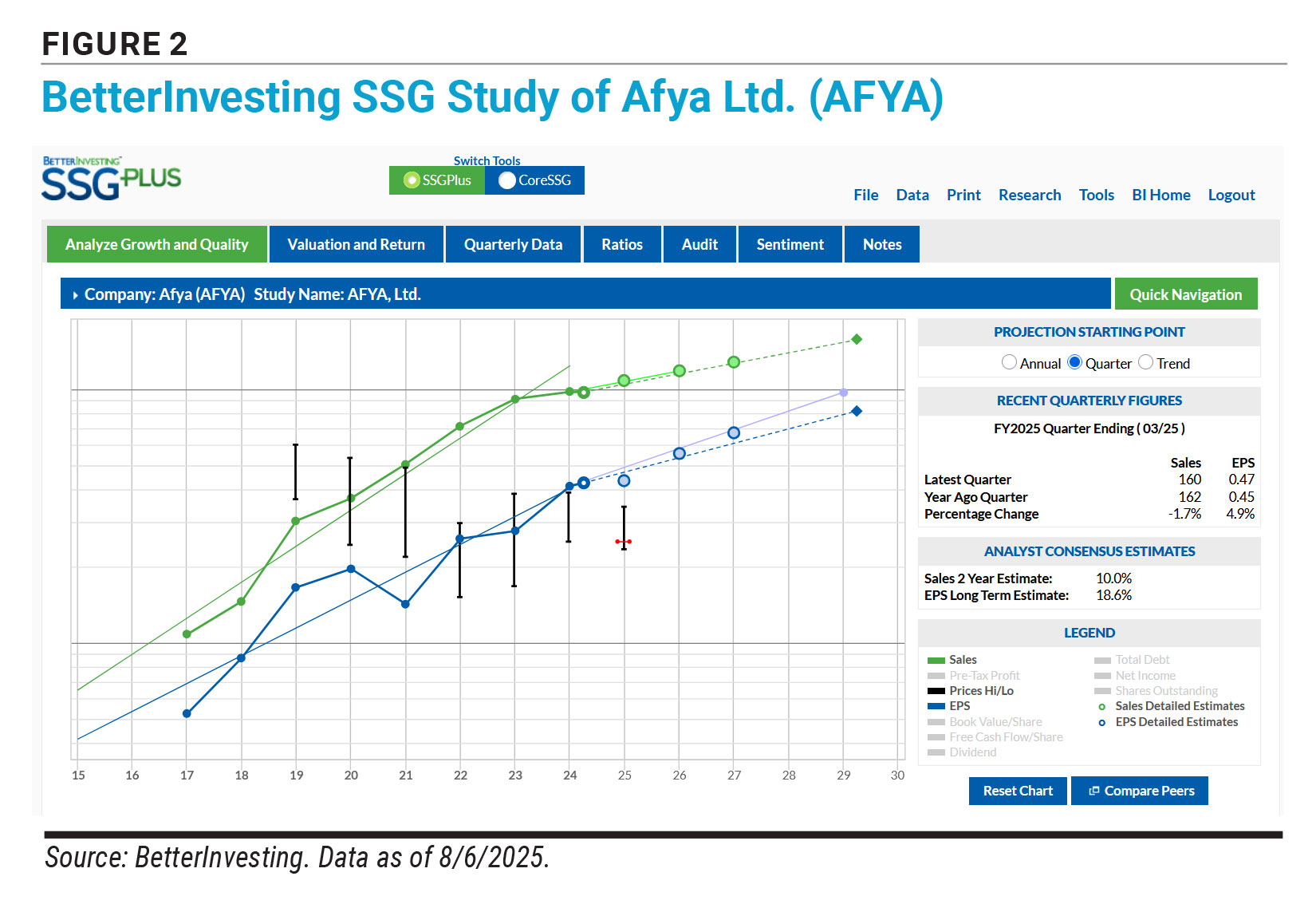
The SSG is now an online web application included with BetterInvesting membership, providing data on 8,000 companies. Underlying the Stock Selection Guide is a discipline requiring review of a company’s financial history, diving into growth and valuation trends.
Companies that fit the SSG model must meet two key criteria before becoming buy candidates.
First, they must be well-run, successful companies with track records of growing sales and earnings, operating in environments where continued growth is expected. Besides considering growth strength and consistency, there’s a strong quality overlay to the GARP approach. Companies should demonstrate exemplary profit margins that compare favorably to peers, competitors and industry benchmarks.
The second criterion involves buying quality stocks only at the “right price.” The Midwest ethos of BetterInvesting’s founders is obvious—Midwesterners never want to spend more than necessary! Applied to investing, this value approach means avoiding overpayment and purchasing stocks only when they offer acceptable return rates.
Often this assessment proves contrarian—popularity doesn’t necessarily indicate good opportunity at current prices. It’s important to compare a stock’s current price-earnings ratio to its history, industry average multiples and broader market levels. Determine whether price-earnings ratios have remained stable, contracted or expanded over time. Compare the current price-earnings ratio to estimated future ranges.
Before buying, consider downside and upside potential from current prices, always seeking opportunities with more upside than potential downside.
Like any analysis method, the SSG doesn’t work on every company. It offers insights but only works when used properly. The GARP model functions with profitable companies that have earned profits for several years. Consistent growth receives higher esteem because growing a business consistently year after year proves extremely difficult for management.
Businesses tend not to withstand time’s test when growth appears erratic, guiding principles are lacking or management seems more opportunistic than strategic. Fallen angels or turnaround opportunities aren’t necessarily excluded, but concrete evidence of business soundness is required.
BetterInvesting favors buying reasonably valued companies, often following Buffett’s admonition: “It is better to buy a great company at a fair price than a fair company at a great price.” However, BetterInvesting doesn’t demand that every stock sell at 30% markdowns, accepting reasonable prices when return potential exists.
Importantly, the Stock Selection Guide is not a replacement for stock research. It is an aid to judgment and a tool for making better investing decisions. The SSG provides investigation starting points, but extensive research beyond the application remains necessary.
Investors must understand company business basics. Read earnings call transcripts for management clues. Determine addressable market size. Identify future growth drivers. Recognize business headwinds and tailwinds. Consider how management will resolve discovered issues.
Many public companies don’t fit the SSG model. Perhaps 300–400 companies traded on North American exchanges possess sufficient track records for SSG analysis. Of those, more than half will be overpriced due to popularity, which reduces returns when excessive prices are paid.
Discipline is key to the SSG’s effectiveness over time. When Lynch wrote about his GARP approach in the 1990s, it aligned closely with the SSG methodology.
The SSG works because it follows established business and investing principles without inventing new ratios. It examines companies as management does, providing fundamental insights without requiring interpretation of hundreds of financial statements or ratios. Key concepts adapt to recessions and bear markets.
Does the SSG work? Evidence supporting its effectiveness can be found in BetterInvesting’s Investor Advisory Service newsletter, published since 1971. A team of Chartered Financial Analysts (CFAs) using the Stock Selection Guide have delivered returns ranking among the very top of all newsletters tracked by Hulbert Ratings, earning placement on the Hulbert Investment Newsletter Honor Roll for 15 consecutive years.
The KISS principle (Keep It Simple, Sweetie) proves useful for many investors. Don’t invest so much research effort that by conclusion time, stocks have moved outside buy zones. Instead, use the SSG to quickly scan key metrics, and when opportunities look promising, invest time in deep-dive research—reading earnings releases, conference call transcripts and investment presentations—learning businesses as owners would.
Experienced SSG users find it advantageous to integrate personal insights and experiences into the tool. Professional analysts and money managers use the SSG to support investment decision-making, with admirable track records suggesting that the methodology works effectively for stock pickers.
The combination of systematic screening with disciplined SSG analysis creates a powerful framework for individual investors, helping identify quality companies at reasonable prices while maintaining the emotional discipline essential for long-term investment success.
AAII and BetterInvesting are cohosting educational webinars through December 2025 and providing additional insights through articles in both magazines.
AAII members can join BetterInvesting for just $99 for the first year (regularly $145). Click here and use the promo code AAII at checkout to receive your exclusive discount. New BetterInvesting membership includes: the BetterInvesting Magazine, full access to the SSGPlus online tools suite, First Cut stock studies and a learning library.
AAII + BetterInvesting

BARRY J from TX posted about 1 year ago:
ROBERT A from NC posted about 1 year ago:
DAVID A from CA posted about 1 year ago:
PAUL S from OR posted about 1 year ago:
PAUL S from OR posted about 1 year ago:
CHARLES R from IL posted about 1 year ago:
Robert K from MA posted about 1 year ago:
You need to log in as a registered AAII user before commenting.
Log InCreate an account