Target-date funds have become the dominant vehicle for retirement saving in the U.S. More than half of 401(k) participants are now invested in them, either by choice or through automatic enrollment. Their appeal is obvious: one fund that provides diversification, professional management and a shifting asset allocation that grows more conservative as retirement approaches.
The pitch is simple: Choose the fund with the year closest to your expected retirement date, invest regularly and let the professionals handle the rest. For many investors, that simplicity has been a saving grace. Yet beneath the surface, target-date funds are far from identical. The year in the fund’s name can obscure critical differences in design, cost and risk that can shape retirement outcomes in profound ways.
A target-date fund is a fund of funds. Inside a single ticker symbol sits a portfolio of stock and bond funds. The mix shifts gradually over time along what’s called a glide path.
Early in your career, when retirement is decades away, the allocation is weighted heavily toward stocks for growth. As the target year approaches, the allocation shifts toward bonds and cash to mitigate volatility. At and after the target date, the allocation shifts to a “conservative” mix designed to sustain retirees through decades of withdrawals.
The date in the fund’s name is not an expiration date. It is a reference point. What matters more is how the fund behaves at that date and beyond, which brings us to one of the most consequential design choices in the entire category.
Target-date funds follow one of two philosophies when they reach the target year.
Here’s a simplified comparison:

Suppose you expect to retire in 2035. A “to” fund might be sitting at 30% equities on day one of your retirement. A “through” fund could still be holding ~50% equities at that same point, only reaching ~30% decades later.
That divergence affects both risk and reward. A “to” fund offers stability but limits growth potential just as retirement withdrawals begin. A “through” fund offers more growth but exposes you to larger losses early in retirement. Neither approach is inherently better. The right choice depends on your spending plans, your risk tolerance and whether you intend to keep most of your assets invested throughout retirement. The crucial step is knowing which type of target-date fund you own. A fund labeled “2035” could be either—the glide path documentation is the only way to know for certain.
Beyond “to” or “through,” glide paths vary widely among providers. At retirement, stock allocations can differ by as much as 20 percentage points.
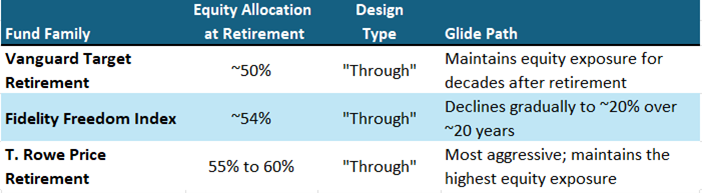
These differences are significant. Two investors with the same retirement year could end up with very different portfolios—and very different experiences in market downturns.
Why this matters for sequence of returns risk: The first five to 10 years around retirement are fragile. Imagine two $1 million portfolios at retirement facing a 30% equity drawdown and flat bonds:
Layer a 4% withdrawal ($40,000) on top and the more aggressive glide path digs a deeper early hole. That may be acceptable if you value longer-term growth and can ride it out. It’s a problem if you cannot.
Expenses are often highlighted as a selling point of target-date funds, especially index-based series. But costs come in layers:
Expense ratios for retail share classes of a Vanguard Target Retirement fund often run approximately 0.08%–0.12%. Expense ratios for institutional or collective investment trust (CIT) versions in many 401(k)s can be around 0.04%–0.06%. By contrast, actively managed series expense ratios can exceed 0.60% at some providers.
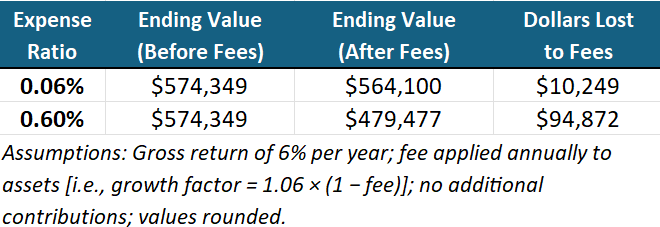
A 50-basis-point difference may sound minor, but compounded over 30 years, it translates into very different dollar outcomes.
The table below provides an illustration: $100,000 invested for 30 years at 6% gross return, with fees deducted annually.
In workplace plans, many investors are not invested in mutual funds at all but in CITs.
CITs are pooled investment vehicles operated by banks or trust companies under trust law. They’re functionally similar to mutual funds but have important differences.
The practical implication is that the numbers you see in the press (for the mutual fund versions) may not match what you actually own in your 401(k) plan. The solution is simple but vital: Request the fact sheet for your exact CIT or share class from your plan administrator and confirm fees, glide path and whether the design is “to” or “through.”
One of the strongest arguments for target-date funds is behavioral. By outsourcing asset allocation and rebalancing, they remove the temptation to chase performance or time the market. That discipline can be as valuable as the diversification itself.
But “set it and forget it” is not the same as risk-free. A near-dated fund (say, 2025) may still hold roughly half its assets in stocks. In a severe downturn, that means steep losses. Investors who succeed with target-date funds are those who understand in advance the level of equity risk embedded in their fund and commit to staying invested through volatility. Abandoning the strategy mid-storm is far more damaging than choosing a glide path that’s slightly too aggressive or conservative.
Target-date funds are designed for tax-deferred or tax-exempt accounts—401(k)s, 403(b)s, individual retirement accounts (IRAs) and Roth IRAs—where ongoing rebalancing and bond interest don’t trigger current taxes.
In taxable accounts, however, target-date funds are typically inefficient. Bond income is taxed at ordinary rates, and periodic rebalancing can realize capital gains. Investors building wealth outside of retirement plans often achieve a similar risk profile more tax-efficiently using a mix of equity exchange-traded funds (ETFs) for broad stock exposure and municipal bonds for tax-advantaged fixed income and adjusting the mix over time.
While the financial media often compares Vanguard, Fidelity and T. Rowe Price, most investors don’t have that freedom. A given retirement plan usually offers one target-date fund family, and the version you get is whatever your employer and recordkeeper selected—often a CIT, sometimes an institutional mutual fund share class.
Even within a single fund family, your plan’s series can differ from the retail version. Fees can be lower, disclosure can be lighter and glide path details can be slightly different. That’s why you should not assume your plan’s target-date fund matches what you see in public materials.
What you can do:
You don’t need to be a professional analyst to read a target-date fund’s fact sheet. Focus on three line items:
If any of those three are unclear, ask your recordkeeper to point you to the document that provides this information.
Start with the fund year that aligns with the year you’ll be age 65. That’s the default. Then adjust one “vintage” earlier (more conservative) or one later (more aggressive) only if it better reflects your risk tolerance and savings trajectory. What you shouldn’t do is mix and match multiple vintages or stack other funds on top of a target-date fund—doing so defeats the purpose of the glide path and rebalancing.
Someone who is 50 years old and wishes to retire at age 65 would be looking for a 2040 target-date fund. As of August 31, 2025, the A+ Mutual Fund Screener identified 17 true no-load 2040 target-date funds that are noninstitutional funds, are open to new investors, have a minimum purchase amount no greater than $10,000 and rank in the bottom 20% of their category in terms of expense ratio. (The Target-Date 2024 category is found under Allocation in the Global Asset Type filter drop-down menu.) Note that you will likely see similar funds from the same fund family with different classes, such as K, R and Z, which typically indicate that they are available to specific employer-sponsored plans.
Among the 17 target-date 2040 funds that meet these filters, the allocation to stocks ranges from 84.7% for Fidelity Freedom Blend 2040 fund  (FHYDX) to 70.3% for PGIM Target Date R6 2040 fund (PDHJX).
Looking at foreign holdings, the allocation among these 17 target-date 2040 funds ranges from a low of 23.8% for PGIM Target Date R6 2040 to 40.1% for Fidelity Freedom Blend 2040.
This data reinforces the need to examine the underlying exposure to stocks, foreign stocks and fixed income, especially the allocation to high-yield bonds, to determine if this allocation aligns with your risk tolerance.
Since I am a fan of Vanguard funds, I was drawn to Vanguard Target Retirement 2040 fund (VFORX). According to fund data provided by AAII’s Mutual Fund Evaluator, it is a true no-load fund, charging no front load, deferred charge or redemption fee. The fund also does not charge a 12b-1 fee. Overall, the fund charges a low annual expense ratio of 0.08%.
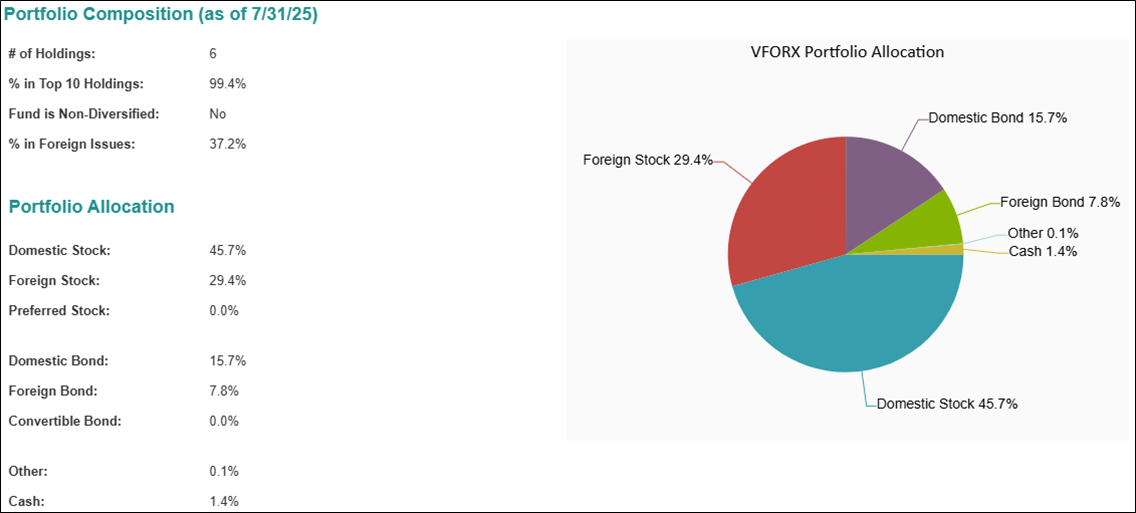
The Mutual Fund Evaluator pages generated by A+ Investor provide statistics about a fund’s portfolio. For example, below is the snapshot of the big-picture asset allocation for Vanguard Target Retirement 2040. Here, you can see that the fund’s stock allocation is 75.1%, with 45.7% in domestic stocks and 29.4% in foreign stocks.
According to the Vanguard website, the fund offers a diversified portfolio with a single fund that adjusts its underlying asset mix over time. The fund provides broad diversification while incrementally decreasing exposure to stocks and increasing exposure to bonds as its target retirement date approaches. The fund continues to adjust the mix for approximately seven years after the target retirement date. The fund is for those planning to retire between 2038 and 2042.
The website also provides the graphic below depicting the glide path of Vanguard Target Retirement 2040.

At the target date (2040), when the now 50-year-old turns 65, the fund aims for less than 60% in stocks, eventually settling at around 30% in stocks.
You check your retirement plan options and see a single target-date family offered as a series of “Trust” options. Here are the steps to take to decide whether it’s a good choice for you.
Reaching the year in the fund’s name doesn’t trigger maturity. The fund continues—either at a fixed allocation (“to” retirement) or along a continuing glide path (“through” retirement). At retirement, you have three practical options:
Whatever you choose, make it a deliberate decision—not the byproduct of inertia.
To choose the right target-date fund, look past the label and ask:
Target-date funds simplify investing by packaging diversification, discipline and age-appropriate risk into one product. However, they are not all the same. Glide paths differ, fees compound and the structures used in workplace plans (especially CITs) often lack the transparency of retail funds.
For investors who dig deeper—understanding allocations, costs, tax implications and post-retirement roles—a target-date fund can be more than a default option. It can be a deliberate, well-chosen strategy that supports retirement goals for decades.

