



While nothing is said to be certain in this world, except for death and taxes, it does not mean that we can’t try to put off both for as long as possible.
If you are in a higher tax bracket and your portfolio generates significant income from fixed-income investments such as bonds that are not held in tax-deferred accounts, then you might consider using tax-exempt income sources such as municipal bond funds.
Municipal (muni) bonds are issued by local and state governments and their interest payments are generally free from federal taxation. The income may also be free from state and local taxes as well, if you are a resident of the state or municipality that issued the bond. Note that tax-exemption does not apply to any capital gains you receive. The income from muni bonds that are issued to fund private-purpose or more businesslike enterprises such as a stadium might be subject to the alternative minimum tax (AMT).
Because of the tax-exempt nature of their interest—or coupon—payments, muni bonds are issued at lower yields than their taxable counterparts: corporate and federal bonds. Calculating the taxable-equivalent yield allows you to understand if you would benefit from holding a muni bond given your marginal tax rate.
The taxable-equivalent yield calculation is:
Tax-exempt yield ÷ (1 – Marginal tax rate)
Where:
- Tax-exempt yield is the annual interest payment divided by the market value of the investment and
- Marginal tax rate is the percentage tax rate that you pay on your last dollar of taxable income.
For example, if a muni bond is trading with a 3.00% yield and your marginal tax rate is 37%, then the taxable-equivalent yield is 4.76%:
3.00% ÷ (1 – 0.37)
As Table 1 shows, the higher the yield and the higher the tax bracket, the more the benefit is from the tax shield provided by an investment that generates tax-exempt income. [See the March 2022 AAII Journal article “Calculating the Tax-Equivalent Yield of Muni Bonds” by Charles Rotblut, CFA, for additional information on the tax-equivalent calculation.]

Bonds or Bond Funds?
Bonds typically pay their coupon or interest payment every six months and have a fixed face value (principal/par value) that gets paid at maturity. Direct ownership of bonds allows you to plan your income stream, control the cost basis and any realized gains/losses and achieve a predictable value at maturity. If rates fall, however, some bonds may have a call provision that allows the issuer to redeem the bond at face value or some predetermined value. Investing outside of Treasury bonds requires additional time and capital to research and manage a diversified portfolio. Bond pricing tends be more opaque, and institutional buyers generally receive better pricing than individual investors when buying or selling bonds.
Bond funds provide greater diversity by issuer, maturity, coupon and credit ratings. Interest is typically paid monthly and can be reinvested in the fund or paid out to you. You do not need a large investment to gain optimal diversification. One of the biggest things you lose is control over coupon payments and the repayment of the principal at maturity. A traditional bond fund has no maturity date and is thus an ever-changing stream of assets as the manager buys and sells bonds to maintain the fund’s objectives. The net asset value of the bond fund will fluctuate with the market, and there is no way to be certain of the portfolio value or payments at a future point in time. You will also have to pay a continuous management fee. Mutual funds and exchange-traded funds (ETFs) offer a cost-effective way to add a diversified selection of muni bonds to your portfolio, but you need to do some basic homework.
There are 1,725 muni bond funds but only 71 muni bond ETFs. Our focus in this article is on national muni bond funds. If you live in a state with higher local income taxes that also treats locally issued muni income as tax exempt, then you may wish to consider a state-specific fund, but understand you are giving up some diversification benefits. You should also make sure that the tax-equivalent yield of a state-specific bond fund compares favorably to similar national bond funds.
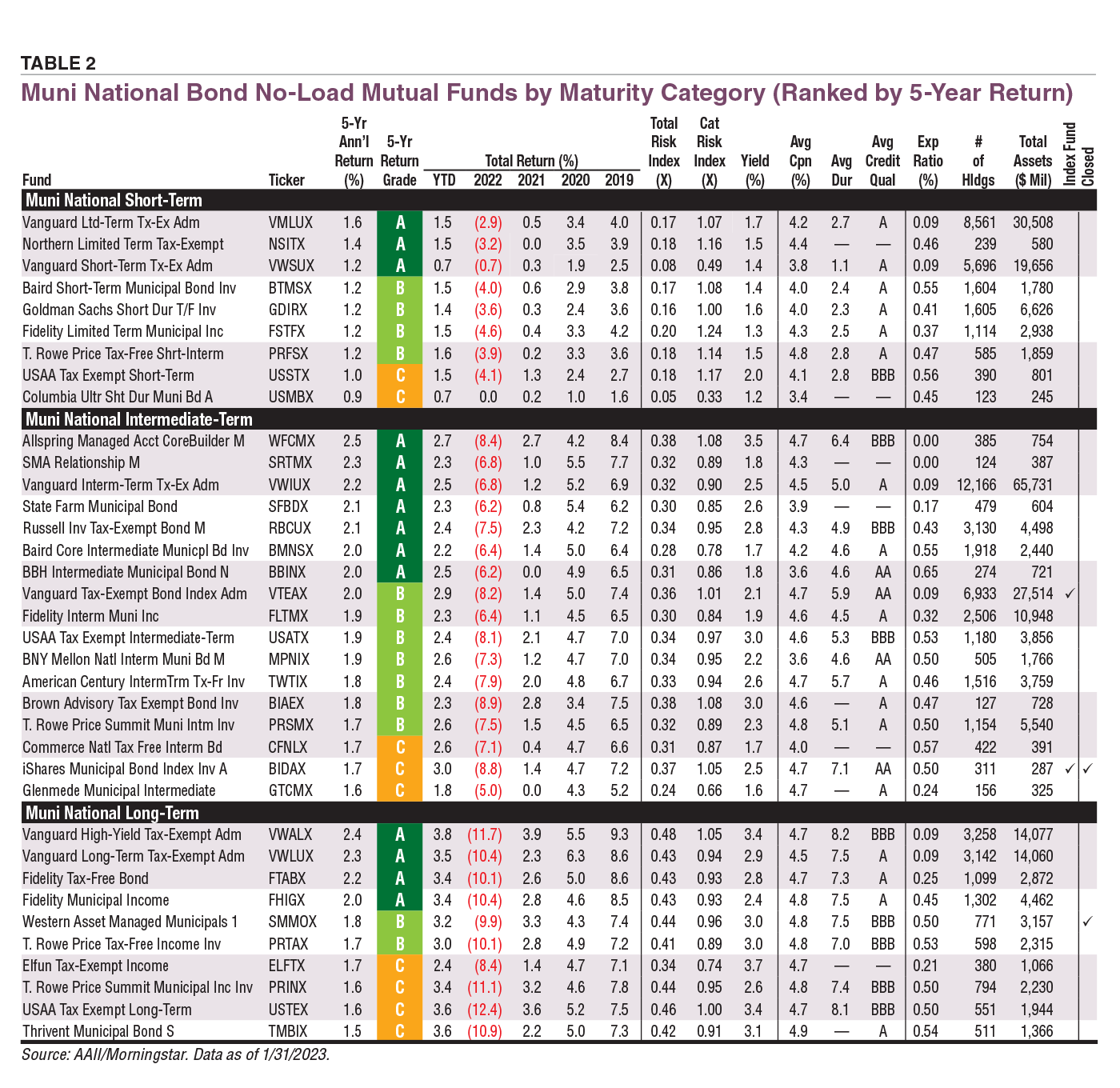
To arrive at the list of funds in Tables 2 and 3, a few filters were added beyond the short-, intermediate- and long-term category designations. For mutual funds, we required that a fund be in operation for at least five years and that it is a no-load fund. We excluded institutional and adviser class mutual funds as well as funds with the highest expense ratios within their categories (a grade of F), the highest volatility within their categories (a grade of F for the category risk index) and a lower relative performance within their category over the last five years (grades of D and F for five-year annual average return). Since there are so few muni bond ETFs, we simply excluded ETFs with less than five years of performance data. Table 3 reports the total assets and average daily trading volume to help you measure the liquidity of the ETFs.
Tables 2 and 3 rank the mutual funds and ETFs by their five-year return to emphasize their intermediate-term performance. Returns for the individual years capture performance during environments of both falling and rising interest rates.

Returns: More Than Income
It is natural to focus on bond income, but ultimately, your realized returns also involve the change in bond values. The returns in Tables 2 and 3 are total returns that capture the capital gains and losses over each period as well as the reinvested income of these funds.
Any short-term net capital gains—whether on the bonds held by the funds or fund shares sold by the investor—are taxed at your ordinary income tax rates and are not exempt from federal taxes.
The same holds true for any long-term capital gains distributed by the fund or incurred when you sell your shares, although the lower long-term capital gains tax rate will be used.
Maturity Matters
A quick glance at returns for the funds highlights the impact of maturity on bond prices and returns. Longer-term maturity bonds normally pay a higher coupon rate and in periods of stable or falling interest rates will have a higher total return.
The price you pay for investing in longer-term bonds is volatility. As highlighted in the 2022 total-return column, the greatest losses were incurred by the long-term maturity bonds as interest rates shot up throughout the year. These bond funds continued to pay dividend income, but the interest income could not overcome the large decline in the bonds’ market value. When interest rates fell in January, these longer-maturity bonds rose more than the
intermediate- and short-term funds. The Vanguard Long-Term Tax-Exempt Admiral fund  (VWLUX) had a 2.9% yield at the end of January 2023, compared to 1.4% for the Vanguard Short-Term Tax-Exempt Admiral fund (VWSUX). The Vanguard Long-Term Tax-Exempt fund suffered a 10.4% loss during 2022 but was up 3.5% during January. The Vanguard Short-Term Tax-Exempt fund lost only 0.7% during 2022, but then gained only 0.7% during January.
Bond prices fall when interest rates rise, and the price movement is greater the longer the maturity of the bonds. When interest rates fall, the reverse happens—total returns of bonds rise as capital gains are added to interest income.
Measures of Risk
We calculate two types of volatility-based risk measures for mutual funds and ETFs—total risk index and category risk index. The total risk index compares the individual fund to all funds—stock, bond, domestic, foreign, commodity, etc. The average risk index is 1.00. As you can see in both tables, even the long-term muni funds are relatively less volatile than the average fund or ETF. The Vanguard High-Yield Tax-Exempt Admiral fund (VWALX) has a total risk index of 0.48, which makes it less than half as volatile as the average fund. By way of comparison, the Vanguard 500 Index Admiral Fund (VFIAX), which tracks the S&P 500 index, has a total risk index of 1.19. The total risk index is helpful to compare funds or ETFs across categories.
Although these bond funds have lower risk relative to the overall fund universe, the risk increases, on average, as the maturity lengthens. This volatility is also evident when viewing the category risk index, where individual funds or ETFs are compared with other funds and ETFs in the same category. The average category risk index for a fund is 1.00. The Vanguard High-Yield Tax-Exempt fund has a category risk index of 1.05, indicating that its returns have been 5% more volatile than the category average for muni national long-term bond funds. The category risk index is useful when comparing investments within the same category, but not across different categories. The Fidelity Limited Term Municipal Income fund (FSTFX) has the highest category risk index in the short-term category at 1.24, but its total risk index of 0.20 is lower than any other fund in the intermediate- or long-term categories.
Estimating Volatility: Duration
In the world of bond investing, duration is particularly useful because it allows you to get a quick understanding of how your bond price will react to changes in interest rates. Duration is defined as the average time it takes to receive all the cash flows from a bond, weighted by the present value of each cash flow. Duration considers both the time to maturity and periodic coupon payments until maturity in its calculation. The longer the time to maturity and the lower the coupon rate, the greater the duration. If a bond pays no coupon (zero-coupon bond), its duration is equal to its years to maturity.
One of the benefits of the duration measurement is the ability to use it in order to estimate the price movement of a bond, given a percentage-point change in market interest rates. As a rule of thumb, if you multiply the actual or expected change in market interest rates by the weighted average duration of a bond, you will derive the change in the value of the bond.
The change in bond value calculation is:
Interest rate change (FSTFX) Duration
Let’s assume you expect interest rates to decline from 4.0% to 3.0%, a 1.0-percentage-point decline. The Fidelity Tax Free Bond fund (FTABX) has a weighted-average duration of 7.3. With a 1.0-percentage-point decline in interest rates, your price change estimate is 7.3%:
7.3% = –1.0% (FSTFX) 7.3
Remember that bond prices move inversely to the direction of interest changes. So, the 1.0-percentage-point decline results in a price increase. If instead the interest rate goes up by 1.0 percentage points, then the portfolio would be expected decline by roughly 7.3%.
Credit Quality
It can be useful to examine the average credit quality of a muni bond portfolio. The lower the credit rating of the bond and the issuer, the higher the yield required by the market. When economic conditions are strong, the spread between the higher- and lower-rated bonds tends to tighten. The spread widens as greater uncertainty is perceived by the market. Lower-rated bonds may boost the yield and return of a portfolio at the greater risk of credit downgrade or even default.
The weighted average credit quality for these funds is reported in the tables when available. Generally, AAA-rated bonds are the highest-rated bonds, while bonds rated D are in default. Typically, investment grade is BBB or higher, while anything bellow BBB is considered “speculative,” “high yield” or “junk.”
We use Morningstar’s mutual fund categorization of funds. It is interesting that the Vanguard High-Yield Tax-Exempt fund is not placed in the muni high yield category. The average credit quality of its holdings is BBB, lower than the A average for the Vanguard Long-Term Tax-Exempt fund. Both funds have over $14 billion in total assets under management and hold over 3,000 individual bonds.
Expense Ratios
The difference in five-year annualized returns between the best- and worst-performing bond fund in each category is not massive, making it very important to keep an eye on the expense ratio.
The expense ratio is the sum of the administrative fees—and for mutual funds, adviser management fees and 12b-1 fees—divided by the average net asset value of the fund, stated as a percentage.
Summary
Are muni bond funds or ETFs the right choice for you?
The answer might be yes, if:
- You are in a relatively high tax bracket or you reside in a high-income-tax state or municipality.
- You have interest income from investments that are not in tax-sheltered accounts such as 401(k)s and IRAs.
- You desire interest income exempt from federal and perhaps state and local income taxes.

Related

Discussion
FREE REPORT

Get your free copy of our special
report analyzing the tech stocks
most likely to outperform the
market.
Ted H from MI posted over 3 years ago:
DALE H from TN posted over 3 years ago:
You need to log in as a registered AAII user before commenting.
Log InCreate an account