


Related

AAII + BetterInvesting
While the fear of the unknown is always present, investors have to look past the headlines.

Charles Rotblut leads a class in AAII's new Essential Investing Video Course. Go to https://www.aaii.com/ves for more information and to subscribe.
AAII and BetterInvesting held a webinar on March 24, 2026, that offered insights into what history can teach us about investing during periods of military conflict and where opportunities may lie in the current market environment. AAII’s Cynthia McLaughlin moderated the discussion between BetterInvesting’s Doug Gerlach and AAII’s Charles Rotblut. Here is an excerpt with timely guidance. For the full recording, see the box at the end of this article.
Cynthia McLaughlin (CM): We all woke up to a different world on Saturday, February 28, with the news of the Iran war. Does market history offer any guidance for investors regarding geopolitical events?
Charles Rotblut (CR): History does offer some clues. There have always been big concerns throughout history. We’ve had two world wars, pandemics—not only the coronavirus pandemic, but other pandemics like the Spanish Flu—and the oil embargo in the 1970s, to name a few. Yet, over the long term, the stock market has ‘climbed a wall of worry,’ as the saying goes.
That doesn’t mean that history will continue as it always has. The stock market is not guaranteed to keep rising, but if we ever experience an event so bad that it breaks the historical trend of the stock market creating long-term wealth, it probably means that something far more serious than we’ve seen in the past has occurred.
The fear of the unknown is always present, but as investors, we have to look past headlines and be prepared to understand that while history often does not directly repeat itself, it does rhyme. That rhyming suggests that there is a reason to remain patient with your portfolio even during periods of geopolitical conflict.
Doug Gerlach (DG): Charles and I are looking at the market from a similar perspective. I think this 1958 quote from Philip Fisher in “Common Stocks and Uncommon Profits” (Second Edition, Wiley, 2003) is very apropos: “Don’t be afraid of buying on a war scare.”
Figure 1 looks at the largest one-day market moves since 1940. The red bars mark down days. The green bars mark up days. The red downturns often correlate with military action or the commencement of a conflict somewhere around the globe. On the other hand, there’s a whole raft of green bars around 2008 when the housing financial markets broke down and the bubble burst. By and large, the conclusion is that war doesn’t drive sustained market declines by itself.
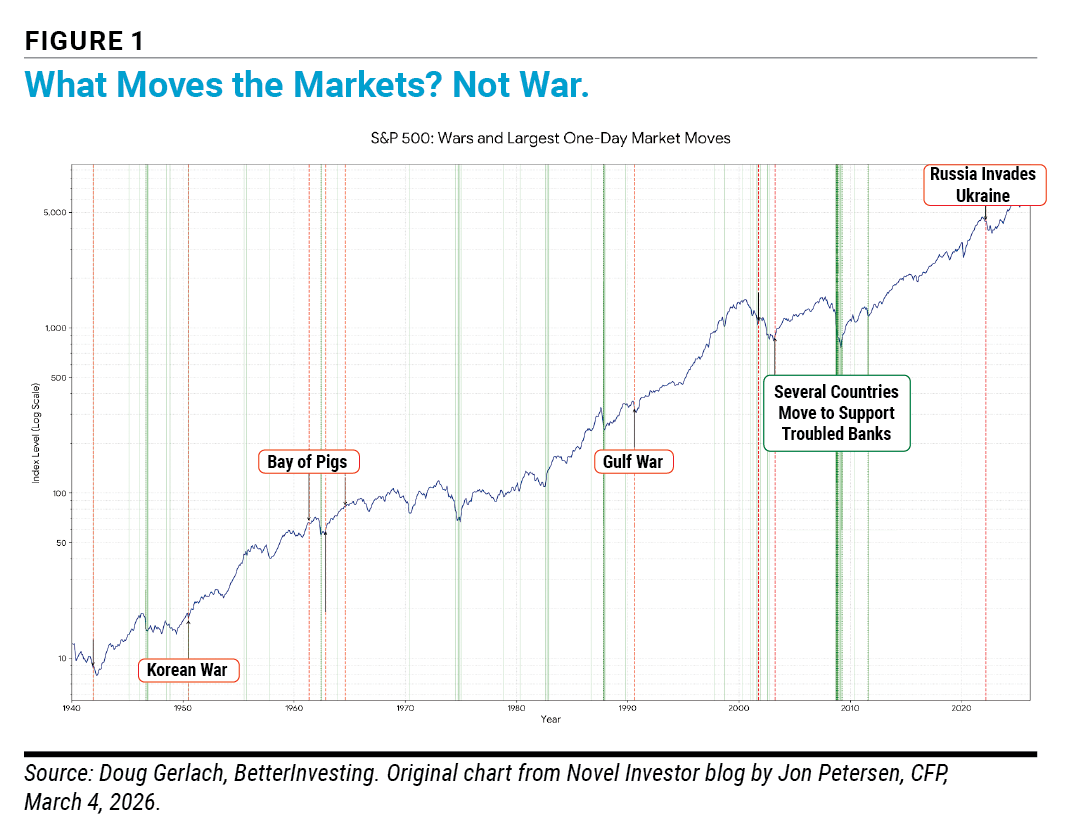
It’s been said that wars are not market problems, but money problems from a financial standpoint. We’ve seen the start of that recently in that when the U.S. engages in military conflicts, the spending goes up. This higher spending benefits a lot of companies and gives a boost to the economy. However, because the government needs to raise that money, it needs to borrow, which puts the overall financial footing of the country in a particular place that’s not always advantageous to other participants in the economy.
The blockage of the Strait of Hormuz and attacks on the energy infrastructure sent oil prices above $100 per barrel in March. What reaction have you seen to oil stocks?
CR: Oil prices went up far more than oil stocks. There are a couple things to realize. Oil prices themselves are extremely volatile. It’s easy for traders to move oil prices back and forth, but if you’re an oil company, it’s not necessarily easy to ramp up production. In fact, oil companies tend to be slower to ramp up production because it takes a lot of logistics and money to do so. As such, oil companies want to be confident that oil will remain at a certain price.
It’s worth noting that oil stocks were doing well before the Iran war broke out. Maybe that was partly due to chatter leading up to the start of the war.
My suggestion for investors who are interested in oil stocks is to look at the valuations. Trying to buy shares of oil stocks just because their prices rose isn’t a winning strategy unless you are purposely using a momentum or technical analysis strategy.
DG: As oil prices go up, energy stocks see their margins go up. They’re able to push their prices upward and become more profitable.
I looked at a couple of the energy sector stocks in the BetterInvesting Dividend Informer newsletter. They are companies that have a good, sound foundation to pay out dividends. Similar to AAII’s Dividend Investing (DI) strategy, our dividend approach is very much about finding stocks with good dividend growth characteristics on top of their fundamentals and buying them at advantageous valuations. We imagine that it will take some time for the oil supply and demand to equalize, and that’s something to look forward to as energy companies are navigating the war’s impact.
A lot of investors hold energy stocks as a diversification hedge. Energy stocks are not always good growth or capital appreciation prospects in a portfolio, but they do pay yields, and I perceive that these will continue to perform well.
The side effect of this is what happens to other companies as a result of rising energy costs. Airlines, for instance, notoriously fall victim to rising jet fuel prices that they may or may not hedge, and so they can get hit pretty hard. You can also think about cruise ship operators and the surcharges that they add on for the convenience of providing you with travel and transportation in an era of rising fuel prices. Even looking at other staples, defensive businesses like food services and grocery stores see their margins pressured when oil prices go up because transportation is such a big cost.
For those nearing or living in retirement, is there any specific guidance you would offer given the current geopolitical uncertainty?
CR: AAII founder James Cloonan created the Level3 withdrawal strategy (Figure 2). If you are nearing or living in retirement, Cloonan suggested having an allocation to defensive assets so you’re not selling stocks when the market is down. The reason to prevent from having to sell stocks whenever the market is down is to avoid locking in losses. Having some defensive assets—cash, money market accounts, short-term bonds, etc.—allows you to take portfolio withdrawals without having to sell growth assets like stocks during a market downturn. This strategy gives your stocks time to rebound in price from a downturn.
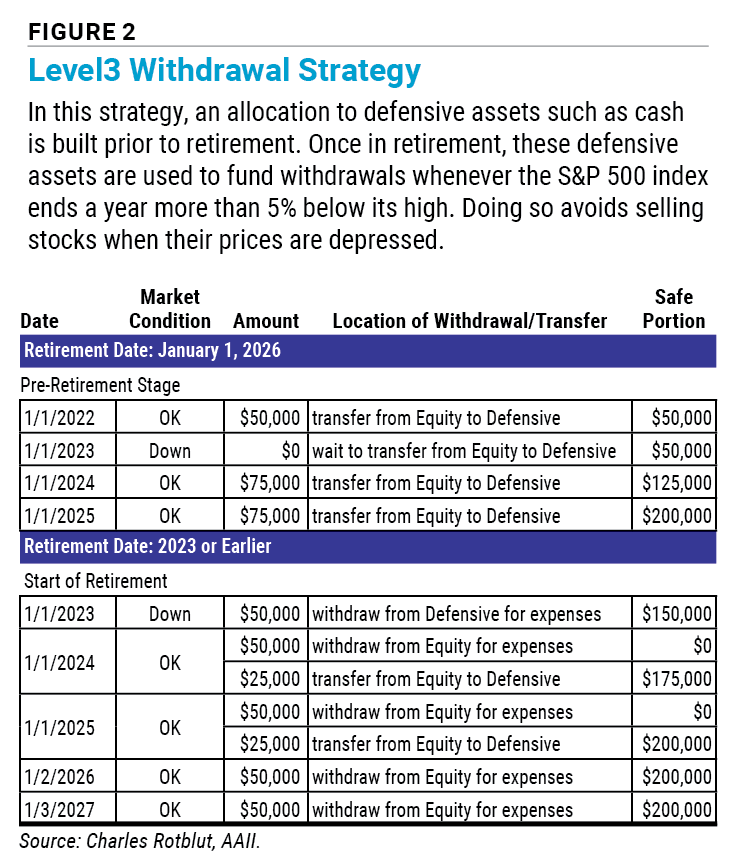
If you’re in your working years, you want to think about having emergency savings. What if something happens to your job? At least you would be protected from having to withdraw from your 401(k) while you are in a transition period between jobs.
DG: Many investors don’t recall the last time we had a major bear market in the U.S. or what it felt like. The coronavirus pandemic drop in 2020 was a blip.
BetterInvesting’s approach has always been about having a five-year horizon, and many of our members go into retirement 100% invested in equities. There are ways you can downshift. The strategy Charles described is very valid.
We approach it from a slightly different perspective. Perhaps instead of seeking that full-on capital appreciation in their core portfolio, investors mix in the dividend growth approach.
I still hear the 60% stock/40% bond portfolio allocation recommended. However, I think this is an artifact of the 1970s and 1980s, which was the last time a 60% stock/40% bond allocation was truly effective.
Nobody goes into retirement saying, “My plan is that everything is going to go great, and if it doesn’t, I’ll just dump my stocks at the bottom and see what happens.” Yet, it is often exactly what happens.
Only a relatively small number of people go into retirement with a clear understanding of how they’re going to approach risk management and ensure they have enough capital to outlive their needs. These are key elements.
Additionally, the big risk is getting out of the market, selling high and buying even higher. That’s no way to profit in the market or build wealth. I prefer the portfolio design of constantly monitoring the risk and return aspects of your portfolio and making microadjustments.
The valuations on the S&P 500 index were high before the Iran war started. Where can investors look to find value?
CR: Small-cap stocks are definitely a place to look for value. AAII publishes updated versions of the chart in Figure 3 quite often for our Model Shadow Stock Portfolio, which is a micro-cap value portfolio.
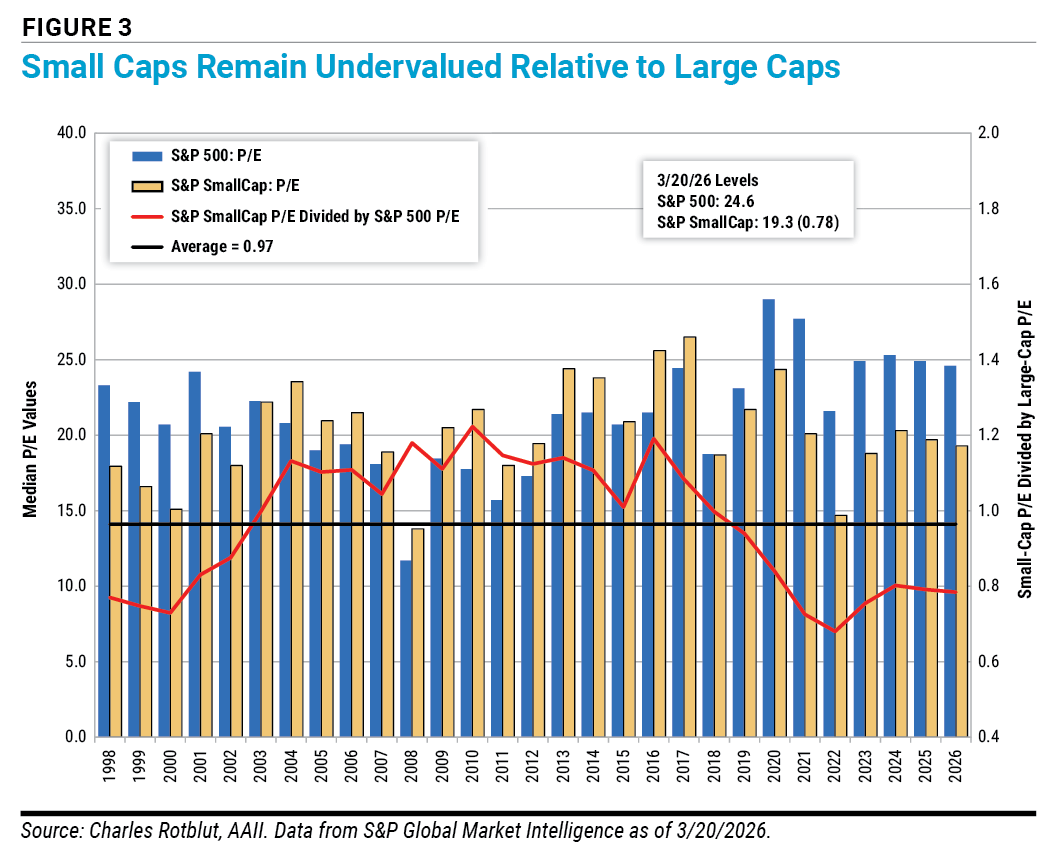
The red line in the chart is where S&P SmallCap 600 index is valued on a price-earnings (P/E) basis. The black horizontal line is the average relationship of the S&P SmallCap 600 relative to the S&P 500. As you can see, small-cap stocks are really undervalued. The median price-earnings ratio of all stocks included in the S&P 500 is 24.6. For the S&P SmallCap 600, the median price-earnings ratio is 19.3. So, there are bargains in small caps.
Doug spoke about dividend stocks earlier. I’m the editor of AAII’s DI newsletter. Dividend stocks outperformed during the first quarter of 2026, and there are still opportunities among them. Our DI model portfolio, which follows a dividend growth strategy, yields 2.4%. The iShares Dow Jones U.S. ETF  (IYY), a broad market index, has a 1.0% yield.
When you’re looking for yield, realize that the yield for the overall market is low compared to the past. So, if you want a high yield, say 5%, you might find some but, by and large, what is considered a high relative yield now is lower than it used to be. Adjust your expectations. If you can do that, you will be able to find many attractive dividend stocks. These are fundamentally sound stocks trading at attractive valuations that have a history of growing dividends.
DG: Charles and I are aligned in terms of the dividend approach. BetterInvesting’s dividend newsletter is only a couple of years old. When we first launched and highlighted a stock with a 2.5% dividend yield, we got emails claiming that this yield was not much better than that of the broader market. Yet, it is an above-average yield.
You are not going to beat the market on a 2.5% yield, but you do get the prospect of dividend growth. If you’re able to buy when valuations are low, you will get bigger dividend payments and capital appreciation. The combination will lead to a reasonable rate of return without the volatility that a lot of investors don’t want. We think that’s a good place to be if you’re nervous.
There are a lot of great dividend stock opportunities. There are also a lot of great small-cap opportunities, as Charles pointed out. I like the S&P SmallCap 600 over the Russell 2000 index. The Russell 2000’s holdings are larger. The S&P SmallCap 600 is the target benchmark for small-cap performance.
The value aspect of small caps is what makes them attractive. For instance, right now, you can go after Cava Group Inc. (CAVA) and see multiples approaching 100 along with all sorts of volatility. Alternatively, you can look at small-cap companies like Vital Farms Inc. (VITL) or Federal Agricultural Mortgage Corp. (AGM) that have growth in the mid- to high teens.
I think that everybody should have a little bit of exposure to small-company stocks in their portfolio.
An attendee would like to know what the average length of the recovery period is after a major decline.
CR: CFRA Research’s Sam Stovall has written a lot about market history. According to his data, recoveries from mega-meltdowns—meaning bear markets with a drop of more than 40% in the S&P 500—take four to five years. The typical bear market for the S&P 500 is defined as a drop of between 20% and 40%. Large-cap stocks recover within about one year following those drops.
Stovall describes the stock market as taking the elevator down and the staircase up. That’s pretty much how it feels, but certain parts of the stock market recover faster than others. And often, certain areas of the market rebound much quicker.
The stock market can move faster than you expect. This matters because those who get out of stocks in response to downside volatility frequently miss the chance to get back in before stocks recoup much of their losses.
DG: Recovery periods vary a lot, but a time frame of two to three years is pretty average. Some recoveries take much longer, and some happen much more quickly. So, I think it’s probably one of the least useful bits of knowledge to have the specifics of the lengths of bear markets, because they’re all over the map.
The confluence of circumstances that led to a bear market’s particular state of affairs is never duplicated. The same can be said about the economy right now. You can look at every single one of the indicators and say if it’s bullish or bearish, but when you put them all in a pot, what comes out at the end is completely unpredictable, because we’ve never had this particular set of indicators at these particular levels at this particular period in time.
The takeaway for bear markets, or down markets in general, is that you’re not going to get an invitation to get back into the stock market. You’re not going to get an announcement that the market has bottomed and the bear market is going to end.
AAII members can join BetterInvesting for just $99 for the first year (regularly $145). Visit BetterInvesting’s site and use the promo code AAII. New BetterInvesting membership includes: the BetterInvesting Magazine, full access to the SSGPlus online tools suite, First Cut stock studies and a learning library.
We think you’d like this related webinar! What Global Conflict Means for Your Portfolio in 2026.
AAII + BetterInvesting

Portfolio Strategies


JOHN L from NJ posted 5 months ago:
ROBERT A from NC posted 5 months ago:
JOHN M from VA posted 4 months ago:
You need to log in as a registered AAII user before commenting.
Log InCreate an account