

Related

Beginning Investor
Tapping into the experience of other investors yields a fountain of wisdom on how to accumulate a nest egg.

Charles Rotblut leads a class in AAII's new Essential Investing Video Course. Go to https://www.aaii.com/ves for more information and to subscribe.
AAII members are an affluent group. Respondents to our 2022 member survey reported having a median investment portfolio of $1.5 million.
 Given this, we wanted to tap into their collective knowledge and experience to help other individual investors learn. This led to our latest Big Question survey, which asked AAII members how they built up their savings.
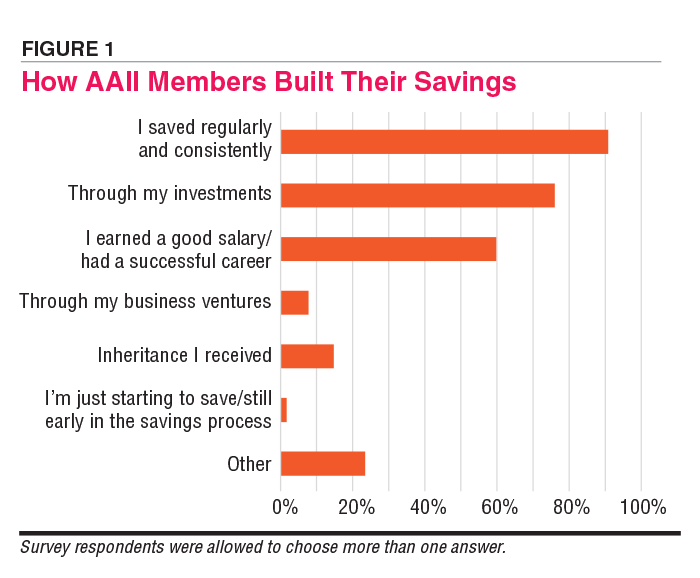
The tried-and-true approach of saving regularly and consistently was overwhelmingly credited for helping respondents build up their savings, as shown in Figure 1. Three-quarters of surveyed members also credited their investments for helping to grow savings.
“Managed our family spending. Used a budget with goals to guide spending and savings,” wrote Bob Doose. His open-ended response echoed a discipline many other AAII members expressed. John Ogorzalek was one of them: “It’s not how much you save, but how often you save. This credo is important to someone trying to accumulate a decent chunk of dough.”
A good salary and/or a successful career certainly facilitate the ability to save and invest. About 60% of respondents credited this as a contributing factor.
The Big Question survey is part of a periodic initiative to give AAII members a chance to talk about their investment decisions and challenges. Each survey asks what we’re describing as a “big question” about a subject of interest to many individual investors. A randomly selected group of AAII members is asked a specific question, as well as follow-up questions intended to provide more clarity and background.
Time in the market matters immensely when it comes to building long-term savings. Many AAII members used time in the market to their advantage by starting to invest in their 20s (53%). An additional 24% started investing in their 30s. Some started even earlier, investing at age 20 or younger (11%).
Not surprisingly, mutual funds ranked high as the first place investors put their savings. Almost 70% of respondents listed mutual funds as the type of investment they started with. Stocks ranked as a fairly close second, picked by 57% of surveyed AAII members in response to this multiple-answer question. Cash savings ranked third, at 48%.
Only 5% of respondents picked exchange-traded funds (ETFs) as their initial investment. This is largely due to the fact that over 80% of respondents have been investing for more than 30 years, so they started investing prior to the launch of ETFs.
Planning for the future, particularly retirement, was the most common reason for saving. Nearly two out of five respondents listed this as their reason. Wanting to avoid struggling financially, fear of running out of money or the desire for financial security was a distant second reason. Beyond that, reasons varied. Those other reasons included, but were not limited to, encouragement by family members, wanting a better life, learning about personal finance or investing and having children. A very small percentage listed a desire to be wealthy as their primary motivation.
We then asked AAII members at what age they felt they had accumulated a significant amount of savings. Most didn’t think they had until after age 50. Specifically, 38% reached such a level of wealth between the ages of 51 and 60, while another 26% said they didn’t do so until age 61 or older.
Around 30% of members surveyed accumulated significant savings under the age of 50, with less than 10% of respondents saying they had done so by age 40. The vast majority of AAII members in these younger demographic groups credited a good salary and/or a successful career for building up their wealth.
There was a significant split regarding whether members had a targeted amount to save. Slightly more than half of respondents (52%) said they had a certain dollar amount they wanted to achieve, while 40% did not.
There were no surprises when it came to what AAII members cited as being the most helpful in terms of building savings: keep spending levels below income, save regularly and boost the amount saved.
“Always saving. Always living within my means,” wrote Vincent Putiri. “The advent of IRAs, company thrift plans and ultimately 401(k) plans with matching contributions were all helpful, but developing a consistent savings mentality was most important.”
Richard Hertel put savings as “a line item in the household budget. This made the household reliably operate within 80% of the available annual means. Even so, we were still able to travel and have an enjoyable lifestyle.”
Many besides Putiri took advantage of their employer retirement plans. Randy Moresi made “401(k) contributions for 25 years,” and credited “not panicking every time the market went down and instead staying the course.” In a follow-up email, Moresi added, “I wish I had started earlier and concentrated more in the equity market.”
Consistency was another key trait. Ralph Mondella “kept investing through all the different troubles that the market went through.” He further “tried not to move investments around too much.”
“Steady, consistent maximization of tax-deferred savings and taking advantage of my employers’ matching contributions, as well as dabbling in dividend investing in individual stocks all contributed to building my savings,” answered Heidi Brown.
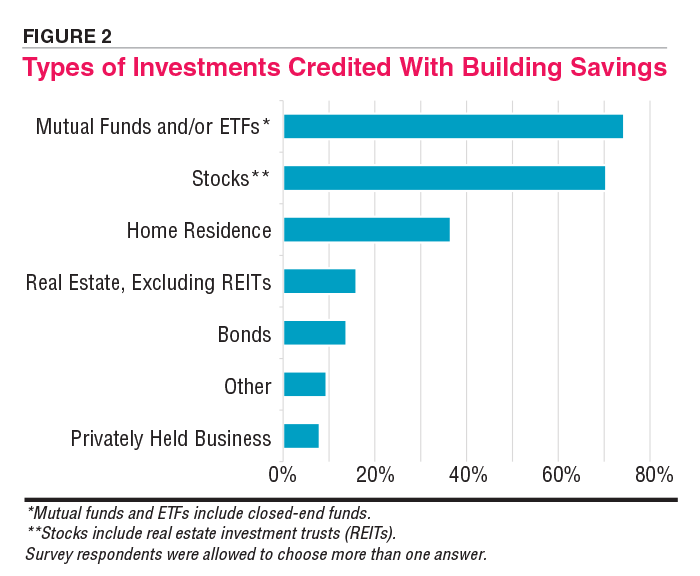
Mutual funds, ETFs or closed-end funds were most credited as the types of investments used to build wealth. They were followed closely by individual stocks. Personal residences were a distant third, as shown in Figure 2.
In addition to finding out what helped members, we asked about what mistakes were made along the way. Investing errors were brought up a lot. Members told us about being too speculative, holding on to bad investments too long, not doing proper research and reacting too much to market conditions.
John Lawler engaged in “haphazard investing in my youth until I found the investing philosophy of Warren Buffett and the disciplined investing of AAII; then I developed a solid investing plan that has yielded good results. My biggest mental mistake was wanting to get ‘rich’ too fast instead of slow and steady.”
Frank Krasowski engaged in “too much trading. I should have stayed with market-beating stocks instead of trying for the fences.”
Other members wrote about not being aggressive enough with their allocation choices. Ed Walters was one of them. “I was too conservative when I was young. I didn’t realize how much ‘protection’ an approximate 40-year window gives a 20-year-old from ‘market risk.’ The real risk was being too conservative.” In a follow-up email, Walters told us that “Thirty-some years after the fact, I shake my head at my (then) adviser’s suggestion that I have a portion of my IRA in a bond fund and that I not invest in a science/tech type fund that they had (due to its potential volatility).”
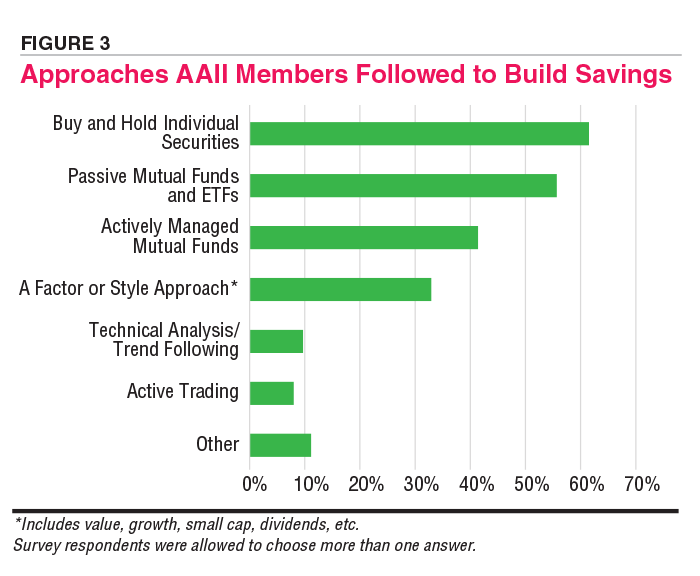
No single approach stood out when it came to building savings. Rather, as Figure 3 shows, many respondents selected more than one of the choices when asked what best characterizes their approach to building savings.
When survey respondents were asked for a brief description of their investment approaches, diversification was brought up by many members, as well as both aggressive and conservative allocation approaches.
In terms of stock strategies, members expressed a preference for dividends or value than for growth. Many of the responses fell into the “other” category, including those who mentioned using technical analysis.
Owen BeMent “took more risk at the beginning” of his career, saying that his portfolio was “90% stocks and ended at the 60/40 allocation some 40 years later. Target-date funds were not available in the 1970s and 1980s.”
“Buy good quality stocks that offer a decent yield—Dividend Aristocrats—and reinvest the dividends. I diversified the investments both in my personal account as well as in my 401(k). I actively manage the accounts by reviewing them once a year,” said Nino Pionati.
Michael Murphy’s strategy involves “maintaining a broadly diversified portfolio of low-cost ETFs and paying attention to taxes.”
Since approaches evolve over time, we asked AAII members how their investment approaches have changed. Responses to this question also varied.
A switch to a more conservative approach was the most common answer but was nowhere near representative of the responses. (Some respondents discussed becoming more aggressive, for instance.) Many AAII members wrote about simplifying their approach and/or weighting their portfolio at least partly toward passive investments. Others talked about boosting their portfolio income through a greater focus on dividends or fixed-income investments.
“For a period of time, my husband and I used a money manager. After we learned more about index funds—and the performance of index funds versus investment
managers—we took over our investments and have gradually converted a large portion to index funds,” explained Christine Frank.
Gary Kushner said that he has “become even more passive and long term. We have shifted to mostly ETFs and index funds and really let them play out for long periods of time. We buy a few stocks to keep things interesting, but that is less than 10% of our entire portfolio.” Kushner further said, “I liked the Level3 book by AAII founder James Cloonan and I am moving toward less bonds and fixed income except for my immediate needs bucket.”
Finally, we asked survey respondents to share suggestions they would give to others on how to build savings. The one dominant theme among responses was “start early.” Almost 22% of members who responded to this question used this specific phrase in their open-ended answers.
Other suggestions included saving as much as you can—even if the amount is small, spend less than you make, be consistent in your savings approach and participate in your employer’s 401(k) plan.
Neil Chase echoed common themes by writing, “Start early, at least get your match on 401(k)s.”
Beginning Investor

The Big Question

Beginning Investor

JEFF S from MN posted over 3 years ago:
ANDREW D from PA posted over 3 years ago:
DONALD S from PA posted over 3 years ago:
ROBERT A from NC posted over 3 years ago:
GREGORY H from OH posted over 3 years ago:
ROBERT A from NC posted over 3 years ago:
ROBERT G from WI posted over 3 years ago:
You need to log in as a registered AAII user before commenting.
Log InCreate an account