The stock market continues to be choppy. There are many strong up or down days, but nothing seems to be sustained—at least not so far.
Despite the seeming uncertainty, the market does creep gradually upward, as does our Model Shadow Stock Portfolio.
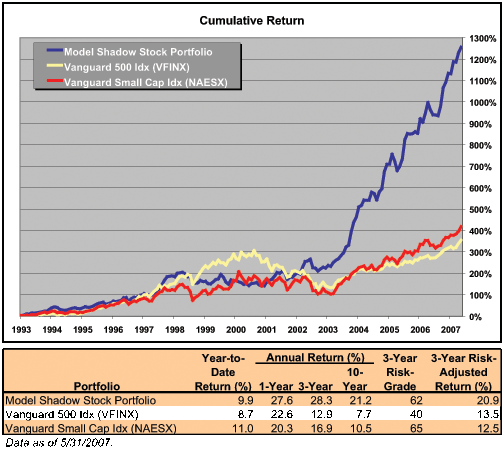
As of the end of May 2007, the portfolio is up 9.9% year-to-date compared to 8.7 % for the S&P; 500 (as represented by the Vanguard 500 Index fund). Small caps, as represented by the Vanguard Small Cap Index fund, are up even more—at 11.0%.
Figure 1.
Model Shadow Stock
Portfolio vs. Benchmarks
(Through 5/31/07)
|
|
CLICK ON IMAGE TO
SEE FULL SIZE.
|
|
Growth stocks have made a bit of a comeback; the Vanguard Small Cap Index fund includes growth stocks while our model is purely value. Growth stocks have a run every once in a while, but long-term value outperforms, as Figure 1 illustrates. Table 1 further demonstrates the value advantage, providing yearly data back to 1993, as well as the long-term average over that 14-year time period.
As confusing as the market seems, if it continues at its current pace for the balance of the year, we will have the normal “year before the election” return of around 23%.
On the bearish side, inflation is still a concern. On the bullish side, there now are a number of bearish analysts.
Quarterly Portfolio Activity
Table 2 shows the current Model Shadow Stock Portfolio holdings and their status in the portfolio, while Table 3 presents the portfolio rules with some clarifications recently added. Table 4 summarizes the portfolio activity for the three months ending May 31, 2007:
- CPAC, Inc. (CPAK) and Blair Corp. (BL) were bought out.
- IntegraMed America (INMD) exceeded the value limit and was sold.
- Handleman Co. (HDL) and Huttig Building Products (HBP) were sold because they violated earnings probation.
- McRae Industries (MRINA), which was on my list to sell, updated their financials and showed profitable results. This would make them eligible to be listed again, so I did not sell but will continue to watch.
- During the last week of May while we were selling, we also bought two stocks—Allion Healthcare Inc. (ALLI) and ILX Resorts, Inc. (ILX). These were the only two qualifying stocks at the time.
- We had more cash than I normally keep because of the buy-outs and because there were only two qualifying stocks, so I purchased additional shares of Avalon Holdings (AWX), Hastings Entertainment (HAST), L.S. Starrett (SCX), Merix (MERX), Rex Stores (RSC), SigmaTron International (SGMA) and Willis Lease Finance (WLFC).
Last quarter I bought additional shares of Rocky Brands (RCKY) right before it announced a loss. This quarter Nashua Corp. (NSHA) came up as a buy, but because of a partial buyback offer it ran up and I accidentally bought it at a price well beyond the level that would qualify under the price-book criterion. I sold it immediately and it is not in the portfolio.
As described in the rules, if you buy a stock, even a partial portion, and then something happens to disqualify it, you should hold the position you have until it violates one of the sell rules. However, if you make a mistake and the entire position didn’t qualify, I favor reversing the position immediately and taking the small gain or loss.
Excess Cash
For some time now, there have not been enough new qualifying stocks to use up the funds generated by sales; these sales have primarily been due to buy-outs.
Similarly, the portfolio has several stocks that could be sold under the two-year rule (see the Notes column in Table 2), but there are not enough new candidates.
One solution would be to relax the price-to-book ratio requirement by raising it to 0.9 for next quarter, but that is as high as I want to go. Another possibility would be to raise the market capitalization and price-to-book limits, particularly if there are no stocks to invest the cash in. I will see what happens next quarter before making changes.
Rule Changes
Because of the shortage of qualifying stocks and also because of a number of member questions, I have adjusted the portfolio rules to make the buying process more clear. Please read the revised Stock Order Guidance section of the portfolio rules in Table 3.
Also, note that the two-year rule means two years have elapsed since the stock last qualified, not two years from when you first bought it.
| Table 4. Second-Quarter 2007 Transactions
|
| Company (Ticker) |
Reason |
| Tender |
| Blair Corp. (BL) |
acquired by Appleseed’s Topco Inc. |
| CPAC, Inc. (CPAK) |
acquired by Buckingham Capital Partners |
| Buy |
| Allion Healthcare, Inc. (ALLI) |
|
| Avalon Holdings Corp. Class A (AWX) |
purchased additional shares with excess cash |
| Hastings Entertainment, Inc. (HAST) |
purchased additional shares with excess cash |
| ILX Resorts, Inc. (ILX) |
|
| L.S. Starrett Company (SCX) |
purchased additional shares with excess cash |
| Merix Corporation (MERX) |
purchased additional shares with excess cash |
| Rex Stores Corp. (RSC) |
purchased additional shares with excess cash |
| SigmaTron International, Inc. (SGMA) |
purchased additional shares with excess cash |
| Willis Lease Finance Corp. (WLFC) |
purchased additional shares with excess cash |
| Sell |
| Handleman Co. (HDL) |
negative earnings |
| Huttig Building Products (HBP) |
negative earnings |
| IntegraMed America (INMD) |
exceeded value limits |
Market Valuations
Does the lack of qualifying stocks indicate the market is overvalued in general?
It is possible, but the portfolio has been in this situation before, and it did not result in a significant downturn.
Perhaps the addition of more micro-cap funds and a greater interest in micro caps and value stocks is having an effect. Certainly buyouts and firms going private have affected our holdings.
Change, I believe, is inevitable and all we can do is to adjust when necessary.
So far the market looks healthy. It would be nice to see it run up even more before we face the election year—which does not have a good history.
I’ll discuss that in more detail in my October column.





No comments have been added yet. Add your thoughts to the discussion!
You need to log in as a registered AAII user before commenting.
Log InCreate an account