



The year 2017 has started out with a bullish tone.
While it is only one month old as of this writing, it is nice to see market gains despite a number of uncertainties.
In my last column, the uncertainty was: Who will be president? Now it is: What will he do? That is being answered day by day.
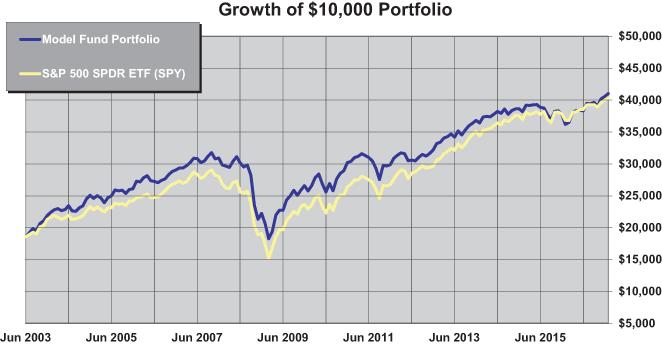
The Model Fund Portfolio is up 2.4% year-to-date as of January 31, which is somewhat better than the 1.9% gain for the S&P 500 index as measured by SPDR S&P 500 ETF  (SPY).
Longer-term results can be viewed in Figure 1 and Tables 1 and 3.
Portfolio Changes
When I established the Level3 Passive Portfolio, which is a conservative and less-active portfolio approach, I indicated that the Model Fund Portfolio would be made more aggressive to try to take advantage of intermediate-term market trends.
Since inception the Model Fund Portfolio has done only slightly better than the market, as can be seen in Figure 1 and Table 1 (8.8% versus 8.6% for the SPDR S&P 500 ETF).
If a portfolio is to be active, it should pursue a policy that will lead to results that are noticeably better than the market, and that is my objective.
Toward that end, one mutual fund and one exchange-traded fund (ETF) have been sold and two sector ETFs purchased; Table 2 summarizes the changes.
Fidelity Capital & Income (FAGIX) and iShares MSCI Frontier 100 (FM) have been removed. Fidelity Capital & Income is really a defensive stock fund.
It is valuable because it has been able to provide market returns with less than market volatility. But since the portfolio’s focus is transitioning to be less concerned with volatility as a measure of risk and more concerned with returns, it does not fit the current objectives.
Even though long-term forward markets (pre-emerging markets) should outperform established markets, iShares MSCI Frontier 100 has a heavy representation of financial institutions in oil-dependent countries, and I believe any potential reward will now be a long time coming.
|
|
Fund (Ticker) |
Market Cap Size |
YTD Return (%) |
Annual Return (%) |
Fund Assets ($ Mil) |
Exp. Ratio (%) |
Std Dev (36 mo. Ann’l) (%) |
Worst |
|||
|
1- Yr |
5- Yr |
10- Yr |
Since 6/30/03 |
||||||||
| Type | |||||||||||
| MF | Aston/Fairpointe Mid Cap N (CHTTX) | Mid-Cap | 3.0 | 40.5 | 14.5 | 9.8 | 11.7 | 1,565.0 | 1.11 | 15.8 | (7.9) |
| MF | Fidelity OTC (FOCPX) | Large-Cap | 5.7 | 24.9 | 16.4 | 11.5 | 12.1 | 10,067.4 | 0.91 | 16.2 | (9.3) |
| ETF | First Trust US IPO (FPX) | Large-Cap | 2.7 | 18.3 | 17.8 | 10.2 | nmf | 650.1 | 0.60 | 13.1 | (2.3) |
| ETF |
Guggenheim S&P 500 Equal Weight (RSP) |
Large-Cap | 2.1 | 23.7 | 14.3 | 7.8 | 10.3 | 12,494.7 | 0.40 | 11.0 | (11.4) |
| ETF | Guggenheim S&P 500 Eq Wt Consumer Staples (RHS)* | Large-Cap | 1.2 | 6.5 | 16.2 | 11.4 | nmf | 507.8 | 0.40 | 10.1 | 2.4 |
| ETF |
Guggenheim S&P MidCap 400 Pure Value (RFV) |
Mid-Cap | 1.3 | 43.9 | 14.3 | 7.5 | nmf | 215.7 | 0.35 | 17.5 | (4.3) |
| ETF | Guggenheim S&P SmallCap 600 Pure Value (RZV) | Small-Cap | (2.9) | 43.0 | 13.4 | 6.3 | nmf | 265.8 | 0.35 | 20.2 | (8.0) |
| ETF |
SPDR S&P Insurance (KIE)* |
Large-Cap | 0.6 | 29.3 | 18.6 | 5.80 | nmf | 958.6 | 0.35 | 12.1 | (13.7) |
| ETF |
Vanguard REIT Index (VNQ)** |
Large-Cap | (0.0) | 12.2 | 10.4 | 4.36 | 10.4 | 33,739.0 | 0.12 | 14.9 | (11.9) |
| Average of Funds in Actual Model Fund Portfolio† | 1.5 | 26.9 | 15.1 | 8.3 | 11.1 | 6,718.2 | 0.51 | 11.8 | (7.4) | ||
| Actual Fund Portfolio Performance†† | 2.4 | 28.0 | 10.9 | 6.1 | 8.8 |
– |
– |
11.8 | (6.4) | ||
|
Optional Investment: |
|||||||||||
| ETF | iShares Barclays 1-3 Year Treasury Bond (SHY) | Bonds | 0.1 | 0.2 | 0.4 | 2.0 | 2.5 | 11,086.9 | 0.15 | 0.8 | 0.3 |
|
Comparison: |
|||||||||||
| ETF |
Spider S&P 500 (SPY) |
Giant-Cap | 1.9 | 19.9 | 14.0 | 6.9 | 8.6 | 227,392.8 | 0.10 | 10.3 | (8.4) |
|
nmf= no meaningful figure |
|||||||||||
We have added the Guggenheim S&P 500 Equal Weight Consumer Staples ETF (RHS) and the SPDR S&P Insurance ETF (KIE). In both cases, these sectors should prosper if the market continues its upward movement and, importantly, they should outperform other sectors if the bull runs its course in the next year or so.
Table 2. Model Fund Portfolio Transactions
| Buy | |
| Company (Ticker) | Reason |
|
Guggenheim S&P 500 Equal Weight Consumer Staples ETF (RHS) |
promising sector |
|
SPDR S&P Insurance ETF (KIE) |
promising sector |
| Sell | |
| Company (Ticker) | Reason |
|
Fidelity Capital & Income (FAGIX) |
adjusting portfolio philosophy |
| iShares MSCI Frontier 100 (FM) | adjusting portfolio philosophy |
Table 3. Model Fund Portfolio Annual Performance
|
Average Annual Return (%) |
Cumulative Growth of $10,000 ($) |
|||
|
|
Model Fund Portfolio |
S&P 500 SPDR ETF (SPY) |
Model Fund Portfolio |
S&P 500 SPDR ETF (SPY) |
|
|
||||
|
|
||||
| 2003* | 18.6 | 15.0 | 11,858 | 11,500 |
| 2004 | 17.7 | 10.7 | 13,955 | 12,735 |
| 2005 | 5.4 | 4.8 | 14,711 | 13,350 |
| 2006 | 16.1 | 15.6 | 17,086 | 15,438 |
| 2007 | 10.2 | 5.4 | 18,820 | 16,268 |
| 2008 | -35.9 | -36.9 | 12,071 | 10,273 |
| 2009 | 24.9 | 26.4 | 15,080 | 12,981 |
| 2010 | 20.3 | 14.9 | 18,136 | 14,914 |
| 2011 | -1.7 | 2.0 | 17,827 | 15,207 |
| 2012 | 12.6 | 15.8 | 20,075 | 17,608 |
| 2013 | 26.7 | 32.2 | 25,436 | 23,279 |
| 2014 | 9.9 | 13.6 | 27,962 | 26,439 |
| 2015 | -4.5 | 1.3 | 26,711 | 26,793 |
| 2016 | 15.3 | 11.8 | 30,807 | 29,957 |
| 2017 YTD** | 2.4 | 1.9 | 31,554 | 30,523 |
| Since Incep** | 8.8 | 8.6 | 31,554 | 30,523 |
|
*June 30 to December 31, 2003 **Through Jan. 31, 2017. Portfolio was started on June 30, 2003. |
||||
The Level3 Passive Portfolio
There are no changes in the Level3 Passive Portfolio, shown in Table 4. I am hoping that Guggenheim will reduce its expense ratio for the Guggenheim S&P 500 Equal Weight ETF (RSP), since it is currently overweight in the portfolio.
Table 4. Level3 Passive Portfolio
|
|
Initial Weight |
Return (%) Since 5/31/2016 |
|
|
||
| Fund (Ticker) | ||
|
Guggenheim S&P 500 Equal Weight (RSP) |
40% | 10.4 |
|
PowerShares Russell 1000 Equal Weight (EQAL) |
20% | 10.6 |
|
Vanguard Mid-Cap Value (VOE) |
20% | 13.1 |
|
Vanguard REIT Index (VNQ) |
20% | 2.2 |
| Weighted Avg of ETFs in Portfolio* | 9.4 | |
| Actual Level3 Passive Portfolio** | 9.3 | |
|
Comparison: Spider S&P 500 (SPY) |
10.1 | |
|
*A weighted average return of the ETFs in the current Level3 Passive Portfolio. **Performance of actual Level3 Passive Portfolio, including reinvested dividends. Source: Morningstar, Inc. Data as of 1/31/2017. |
||
Looking Forward
While we now know who the president is, there is still uncertainty about the implementation of his programs. He has established a priority for reducing government regulation and reducing corporate taxes, two items that should impact the stock market favorably. As always though, the devil will be in the details. It seems likely that the requirement of brokers having to meet the fiduciary standard for retirement assets will be reversed, which I believe is a mistake.
There will be many more changes in rules and laws before the next column on the Model Fund Portfolio in May. In the meantime, you can keep up with the model portfolios at AAII.com.
Investment Rationale and Processes
Level3 Passive Portfolio
This portfolio is intended to be either the complete equity portfolio for those investors who wish to manage their own portfolio but do not choose to be involved in individual stock selection, or one portion of a whole portfolio for those who may wish to select individual equities and actively managed funds on a limited basis but keep the majority of their portfolio in index funds.
The portfolio consists of index ETFs that should have, based on their approach, returns above that of the S&P 500 index. As a portfolio, it is more diversified than the S&P 500, which should reduce portfolio downturns that are based on the impact of a few sectors.
Portfolio changes should be relatively rare and will occur only when a new or different ETF is felt to be more effective at accomplishing a similar objective than one of the current holdings. There are some new index ETFs with promising approaches, but there will be at least a year of observation before they can be considered.
Level3 Portfolio Holdings
Four ETFs make up the Level3 Passive Portfolio. The weights of the holdings in the portfolio are very likely to change over time based on experience.
A more thorough discussion of the ETFs in the Level3 Passive Portfolio and other new funds that might qualify when they have sufficient volume and history are discussed in my book “Investing at Level3.”
Note: The Vanguard Mid-Cap Value ETF (VOE) is being held in the Level3 Passive Portfolio, but the Guggenheim S&P MidCap 400 Pure Value ETF (RFV) is being retained in the Model Fund Portfolio. The difference between the two funds is slight.
Guggenheim S&P 500 Equal Weight ETF (RSP) This exchange-traded fund has outperformed the cap-weighted S&P 500 index over the 13 years of its existence. Other indexes also indicate that equal weighting provides higher returns. Equal weighting gives more weight to value stocks and smaller-cap stocks in an index, which leads to superior performance over the long run.
This fund, because of its size and history, is given a portfolio weight of 40%.
PowerShares Russell 1000 Equal Weight ETF (EQAL) This ETF includes the top 1,000 stocks by capitalization size and gives some exposure to mid-cap stocks. Mid-cap stocks historically have had higher returns than large caps. It is a new fund, however, and uses an innovative approach that needs some observation before comparing it to Guggenheim S&P 500 Equal Weight ETF.
For now, it is weighted at 20% of the portfolio.
Vanguard Mid-Cap Value ETF (VOE) Mid-cap value has had higher returns than large stocks or mid-cap growth stocks.
It is weighted at 20% of the portfolio.
Vanguard REIT Index ETF (VNQ) The returns of real estate investment trusts (REITs) have exceeded the returns of the S&P 500 over the long run and provide diversification as well.
This ETF is weighted at 20%.
The Model Fund Portfolio
The new approach to the Model Fund Portfolio is more aggressive than in the past, now including some holdings with an intermediate-term focus. The portfolio focuses on:
- Actively managed funds that seem able to adjust to the market and outperform the S&P 500 over the intermediate and long term,
- Actively managed funds in investment areas that have proven to outperform in the intermediate and long term, and
- Some index funds in investment areas that have been long-term winners.
Portfolio changes are only made every three months, and are sent out in the monthly Model Portfolios Update email.
Portfolio Management Notes
For the Model Fund Portfolio, the initial holdings are equally weighted. For the Level3 Passive Portfolio, the initial weightings are as previously indicated and as shown in Table 4. The approach to rebalancing in both cases is to keep it to a minimum. While momentum is less of a factor with funds than it might be with stocks, and transaction costs for funds are much less than for stocks, rebalancing frequently is a distraction and can make taxes a significant consideration.
You should be able to achieve almost all the rebalancing necessary when you add and withdraw funds or when changes are made in the holdings. In the 12 years of the Model Fund Portfolio, no rebalancing has been thought necessary. If over time a holding gets significantly out of line, adjustments can be made.
Decisions will have to be made by the individual since every investor will have added assets at a different time, so everyone’s weights will be different. But the following are some general guidelines:
- Don’t rebalance any holding unless you have held it for over a year.
- If a holding is 25% below where it should be with the planned weight, bring it back to the appropriate level by selling some overweighted holdings to provide funds.
- If a holding is 33% above where it should be with the planned weight, bring it back to the appropriate level by selling the excess and using the funds to buy underweighted holdings.
Related

Portfolio Strategies
Why a New Allocation Approach Is Needed
Discussion
FREE REPORT

Get your free copy of our special
report analyzing the tech stocks
most likely to outperform the
market.
Thomas Schaber from OH posted over 9 years ago:
Paul Murphy from CT posted over 9 years ago:
Hasan Sarwar from CT posted over 9 years ago:
H Mercer from TX posted over 9 years ago:
Rafael Santaella from Spain posted over 9 years ago:
You need to log in as a registered AAII user before commenting.
Log InCreate an account