



The slide that began in May has finally been reversed at the end of August, and the entire stock market is back at its high for the year.
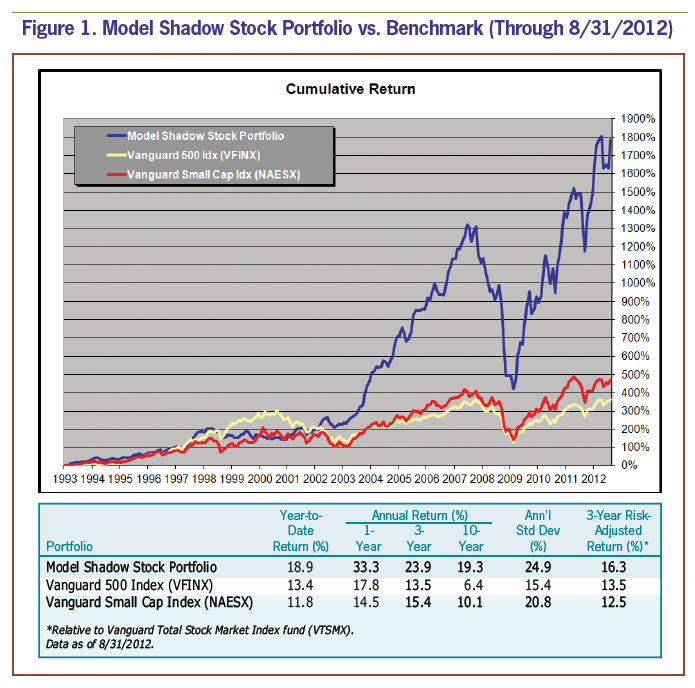
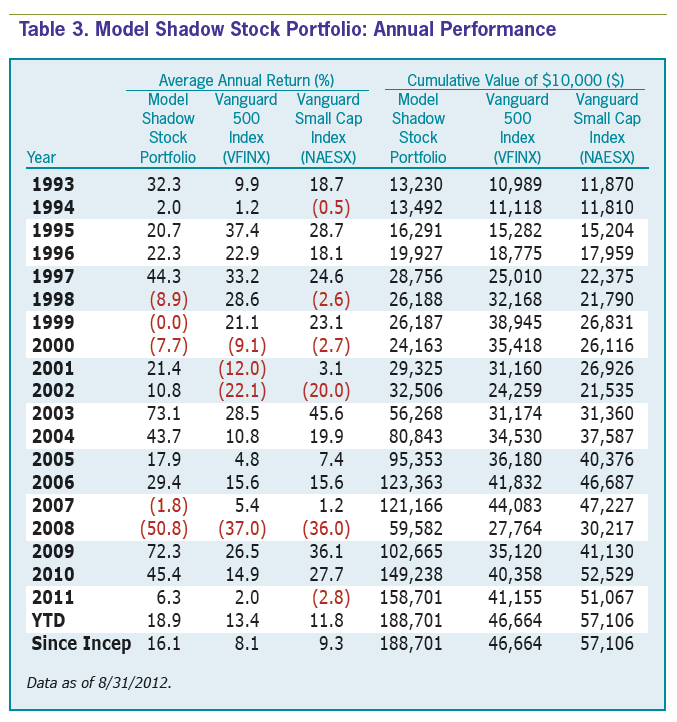
The Model Shadow Stock Portfolio has done particularly well recently and is now up 18.9% year-to-date, compared to 13.4% for the S&P 500 index as measured by the Vanguard 500 Index fund  (VFINX). We have not gotten back to our mid-March high of +22%, but it is an above-average year—so far. The returns for longer periods can be seen in Figure 1 and Table 3.
Not much has changed in the market environment. There seems to be a gradual recovery amid a wide variety of risks. In addition, the political rhetoric has hit full volume and will continue through the election, which happily will be over when I next write about the Shadow Stock Portfolio.
Transaction History
While we have always shown our past transactions, many of you have asked for more specific trade information, including price and quantity. We now provide this data for all transactions back to September 1, 2003. It can be accessed at AAII.com in the Model Shadow Stock Portfolio area. On the Transaction History Page, there is a link to “detailed transaction history.”
Portfolio Changes
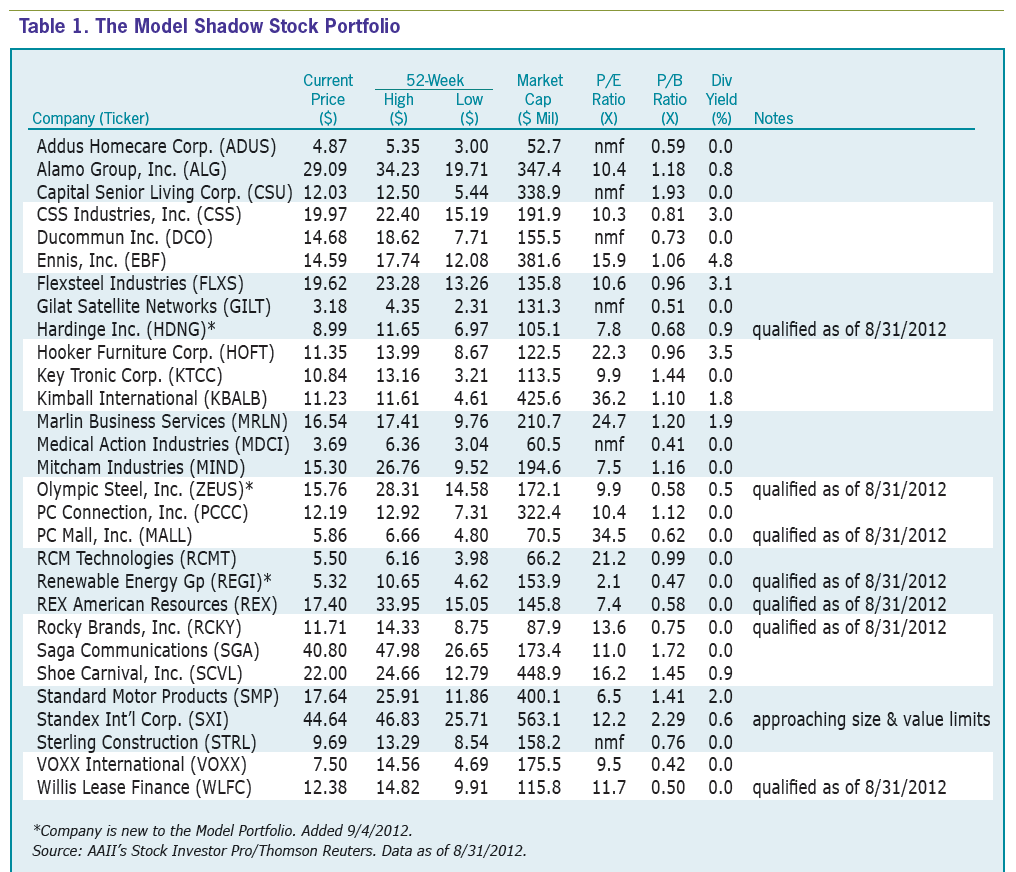
Table 1 lists the current holdings in the Model Shadow Stock Portfolio. CONN’S Inc. was sold for exceeding the size limit.
I was somewhat sad in March when I had to sell Lithia Motors (LAD) because it had become too large to be a Shadow Stock. The same thing has now happened with CONN’S Inc. (CONN). Both of these stocks looked very strong and their elimination presents an opportunity to discuss the second critical investment management rule. Rule number one is: Develop a consistent, well-defined approach to investing in stocks. Rule number two is: Stick to it. Rule number two is extremely difficult to follow. There is always a reason to deviate. If those two stocks had been in my personal portfolio, I might well have kept them—thinking, “This time is different.”
The Model Shadow Stock Portfolio has had a geometric return of 16.1% a year since inception (almost 20 years). I cannot find a single mutual fund or advisory letter that has done better. It would seem very unwise to think I could make on-the-fly adjustments to the rules and do better.
Explanation of Notes
Approaching Size Limit: Stocks are sold if their market capitalization goes above three times the initial maximum criterion. The current market capitalization maximum for initial screening is $200 million. Stocks are marked “approaching size limit” if their current market cap exceeds 2½ times the initial criterion, or $500 million.
Approaching Value Limit: Stocks are sold once their price-to-book-value ratio goes above three times the initial criterion. The current initial price-to-book ceiling is 0.80. Stocks are marked “approaching value limit” if their current price-to-book-value ratio exceeds 2½ times the initial criterion, or 2.00.
Earnings Probation: If the last 12 months’ earnings from continuing operations are negative, the stock is put on probation; if a subsequent quarter has negative earnings prior to 12-month earnings becoming positive, the stock is sold. The date within the parentheses lists the fiscal quarter during which the company first reported negative trailing 12-month earnings.
Qualified as of: The stock still qualified as a buy when the screen was run with current data. Stocks that don’t currently qualify as a buy are held until they meet one of the sell rules.
Following your rules doesn’t mean rules can’t be changed over time with evidence of a reason for change. We have looked at the historical impact of our rules and have modified some of them. We monitor the sell rules for market capitalization and for price-to-book ratio and have not found a justification for change.
However, if the Model Shadow Stock Portfolio is only part of your stock holdings and you also have a segment for larger-capitalization stocks, you could consider CONN if it meets your criteria for that portfolio segment.
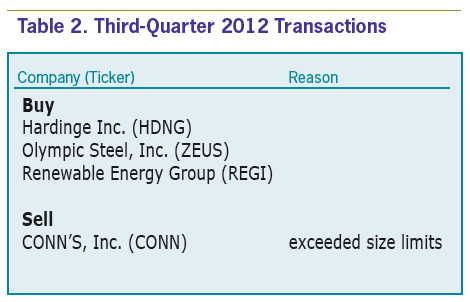
As shown in Table 2, we made three purchases with the proceeds from the sale of CONN: Hardinge Inc. (HDNG), Olympic Steel Inc. (ZEUS), and Renewable Energy Group (REGI).
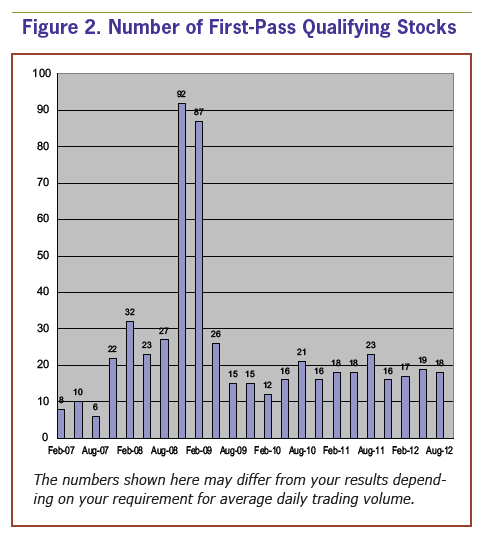
As shown in Figure 2, there were 18 companies passing the initial screen. Two were already in the portfolio, and three are located in China. I continue to be skeptical of data from Chinese companies. In addition to data problems, I have read that auditors are sometimes not permitted to contact third parties to verify information. There is probably a wonderful opportunity among these companies for someone who can verify data, but not for us. We continue to make the final selection on price-to-book ratio, bid/ask spread and liquidity.
Unless the stock market weakens, we will likely raise the upper capitalization limit above $200 million at the beginning of the year because of the overall market-cap increase.
Looking Ahead
While the stock market keeps inching ahead despite all the uncertainties, there are some substantial risks both here and abroad. On the other hand, there is considerable money sitting nervously in low-yield bonds that could fuel a sustained rally. As usual, investors face uncertainty. I hope we will know what taxes will look like before my next Model Shadow Stock Portfolio column in January 2012. In the meantime, you can keep up with the portfolio here.
Model Shadow Stock Portfolio Rules
Purchase and Sales Rules
Stock purchases must meet these criteria:
- No bulletin board or pink sheet stocks will be purchased.
- Price-to-book-value ratio must be less than 0.80. (Figure will change gradually with changes in overall market values.)
- Market capitalization must be between $17 million and $200 million. (Figure will change gradually with changes in overall market values.)
- The firm’s last quarter and last 12 months’ earnings from continuing operations must be positive.
- No financial stocks or limited partnerships will be purchased.
- No stocks on foreign exchanges or ADRs will be purchased because of different accounting and/or withholding tax on dividends.
- The share price must be greater than $4.
- In order to reduce trading by avoiding stocks that are forever marginal, any stock that was sold within two years will not be rebought.
- Note second item under Stock Order Guidance concerning spreads when buying shares.
- Price-to-sales ratio must be less than 1.2. (Figure may change gradually with changes in overall market values.)
- Eliminate any company that failed to file a 10-Q (quarterly) report in the last six months.
Stocks are sold if any of the following occur:
- If last 12 months’ earnings from continuing operations are negative, the stock is put on probation; if a subsequent quarter has negative earnings prior to 12-month earnings from continuing operations becoming positive, the stock is sold.
- The stock’s price-to-book-value ratio goes above three times the initial criterion.
- Market capitalization goes above three times the initial maximum criterion.
Stock Order Guidance
- These rules are for general guidance. Your own experience, market conditions and the size of the position will impact your own decisions. The results in the model portfolio were obtained while sometimes paying more.
- Market orders are not used. Instead, if the quoted bid-ask spread is less than 2% (ask price minus bid price, divided by ask price), place a limit order at the ask price for a buy and at the bid price for a sell. If the bid-ask spread is more than 2%, try to place a limit order between the bid and ask prices to keep transaction costs low. If necessary, build a position gradually. With low commissions, it is often better to place partial orders than to try to establish a large position all at once. Be patient.
- The average daily dollar volume should be at least four times the amount needed for your position. This will ensure liquidity to get in and out of the position, even if you need to grow the position gradually and sell gradually. This will result in a varying number of qualifying stocks for each investor.
- For NASDAQ stocks, it appears to be better to use day orders. If the order is not filled, it is placed again with a slight adjustment. For NYSE and Amex stocks, good-till-canceled (GTC) orders are used to keep a place in line in the specialists’ books. If the market isn’t close to the desired price, the price is adjusted in a few days with a new GTC order.
- If price changes cause a stock to become ineligible (due to changes in price-to-book-value ratio or market capitalization) when only part of the order has been filled, stocks already purchased are kept but the balance of the order is canceled.
Management Rules
- Equal dollar amounts are invested in each stock initially.
- Decisions are made only at the end of each quarter. In order to react to the majority of earnings reports as soon as possible, quarterly reviews are made in February, May, August and November.
- Best judgment is used for tenders or mergers, but all criteria must be obeyed.
- At the end of a quarter, if receipts from stocks sold exceed requirements for new purchases, the excess receipts—up to 5% of the portfolio’s value—are kept in cash until the next quarter. If the excess receipts are greater than 5% of the total portfolio value, the amount above 5% is distributed to smaller holdings that still qualify as buys. Efficient quantities are purchased: If over 10% of the portfolio is in cash, the price-to-book-value ratio can be moved up, but never over 0.90.
- At the end of a quarter, if receipts from stock sales are insufficient to buy all newly qualifying stocks, purchases are made in order of lowest bid/ask spreads.
- Note that if you are managing your own portfolio, it should consist of at least 10 stocks. If you are developing the portfolio gradually, you can do it stock by stock, but don’t put more than 10% of your funds in each additional stock. More than 20 stocks is not needed until the portfolio exceeds $1 million.
Discussion
FREE REPORT

Alice Brien from CO posted over 14 years ago:
Charles Rotblut from IL posted over 14 years ago:
Erik Wolf from CT posted over 14 years ago:
Erik Wolf from CT posted over 14 years ago:
J Fretty from WI posted over 14 years ago:
Lee from NY posted over 14 years ago:
Charles Rotblut from IL posted over 14 years ago:
Charles Rotblut from IL posted over 14 years ago:
Donald Dyson from SC posted over 14 years ago:
James Cloonan from IL posted over 14 years ago:
Ray Beall from TX posted over 14 years ago:
Erik Wolf from CT posted over 14 years ago:
Alpha Mean from NY posted over 13 years ago:
Alpha Mean from NY posted over 13 years ago:
Paul Vasdekis from IL posted over 13 years ago:
Cleo Townsend from FL posted over 13 years ago:
Charles Rotblut from IL posted over 13 years ago:
David Flanagan from CA posted over 13 years ago:
Charles Rotblut from IL posted over 13 years ago:
Erik Wolf from CT posted over 13 years ago:
Charles Rotblut from IL posted over 13 years ago:
You need to log in as a registered AAII user before commenting.
Log InCreate an account