


With the robo-advising industry rapidly expanding, we thought it would be useful to cover not only current players in the game, but new entrants. What a better way to get information about a company than to ask the CEO?
In this interview, we talk to Huygens Capital’s CEO, Walt Vester, to get a better idea of what his company offers and how it differs from other current robo-advising services.
Huygens Capital LLC is a systematic tactical strategist and robo-adviser enabled by proprietary predictive analytics. Their investment system is designed to invest client assets in U.S. equities while protecting against severe downside risk. The system updates its assessment of equity market risk each trading day, allowing for quick response to changing market conditions. The company’s investment products shift between offensive and defensive exchange-traded fund (ETF) portfolios in response to their proprietary measures of market stress.
And with that, we let Vester dive right into how Huygens Capital began and the subsequent launching of its robo-advising service in the summer of 2015:
Vester: There were two phases to my career before I launched Huygens. I was an engineer for several years and then spent several years in finance. More specifically, in the engineering part of my education I studied computer and systems engineering and applied physics, and I focused on artificial intelligence and signal processing. And so I later designed algorithms for covert military communication systems during my days as an engineer and I got a few patents along the way.
After doing that for a few years, I went to business school and studied finance. I then worked as a fundamental equity analyst for a few years at AllianceBernstein and then at Blackstone as a portfolio manager on a growth equity fund.
So I’ve got exposure to both the algorithmic side and the finance side of things. It was during my time at AllianceBernstein that I got some insight into how institutional money managers manage their downside risk. They are subject to certain regulatory and practical constraints in managing their portfolios; specifically, institutional money managers can’t easily reduce equity exposure when they see market risk coming. Instead of selling out of equities, they use hedging instruments. And really that’s the core bit of information that we follow at Huygens: We look at hedging instruments and how they’re being used by institutional money managers as a signal for their frame of mind, whether they’re being defensive or offensive.
The way that Huygens got started is this: I was originally developing a strategy for managing my own money when I was at AllianceBernstein and then at Blackstone. At those places, because of their compliance processes, it’s very hard for an employee to own individual equities in a personal account. So I began to focus hard on indexing instruments and that led me to want to develop a system. As I noted, I’m an algorithms guy from the first part of my career. So of course when I put on my investor hat I was thinking about how to systematize the investment process.
I confined myself to using only indexing instruments and was looking for a way to be able to invest just in indexes and still protect against downside risk. The constraints on portfolio managers that I observed at AllianceBernstein led me to using hedging activity as a signal for downside volatility risk.
I launched Huygens in 2011. The robo-adviser service is the newest part of our business. We originally introduced hedging strategies for institutional investors and hedge funds of funds. We introduced those in 2011 and 2013, and then, because of the way that our strategy works, it became pretty clear to us that our product offering was perfect for a robo-advisory platform. So starting in 2014 we laid the foundations for it and launched the service in the summer of 2015.
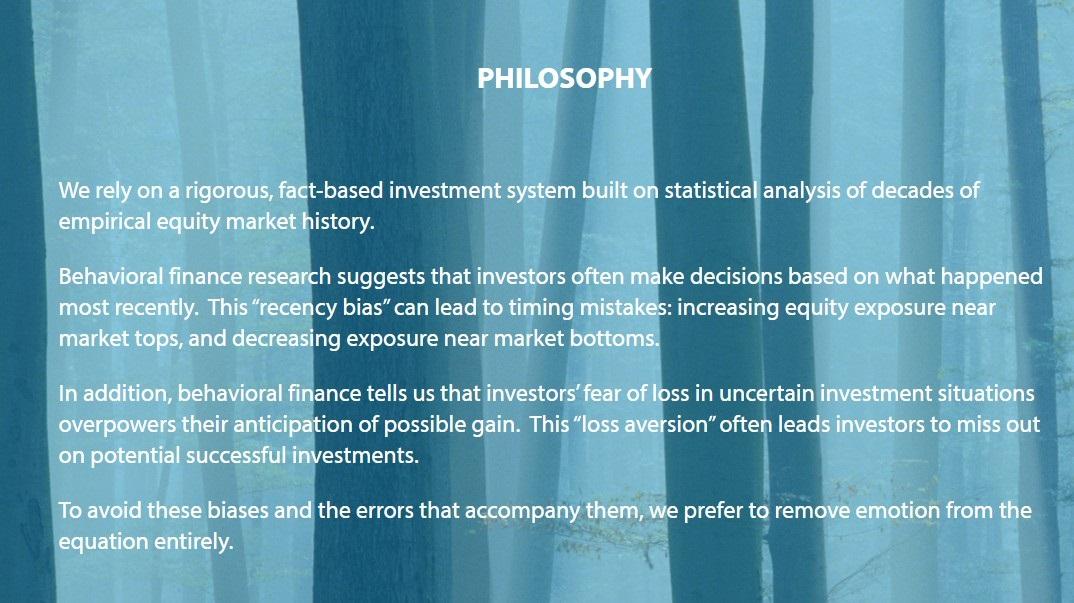
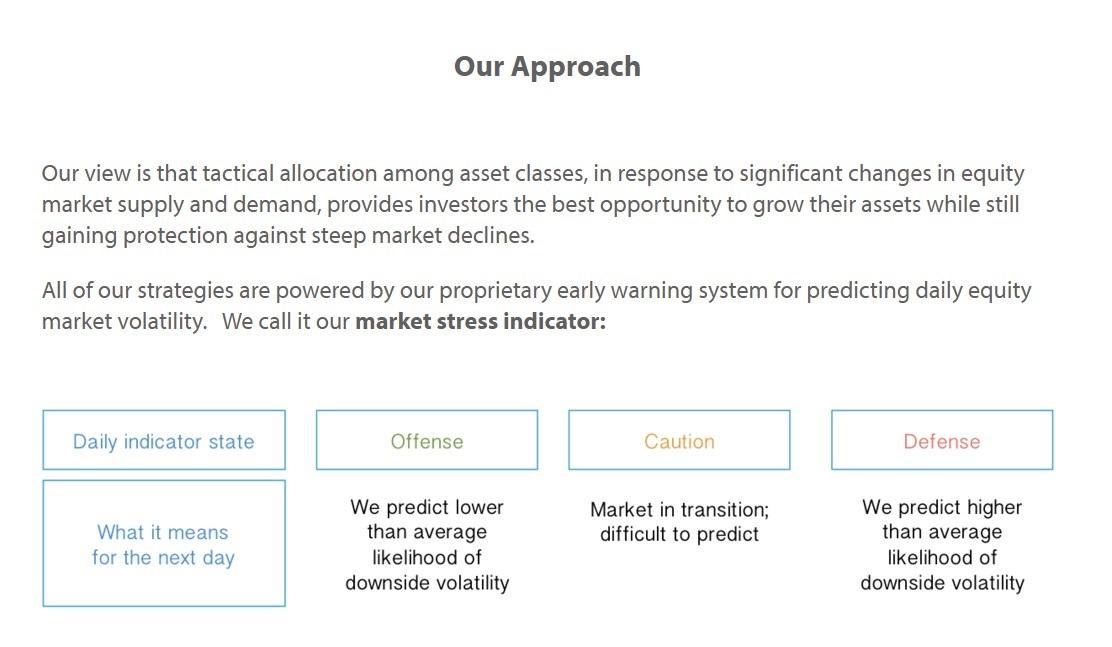
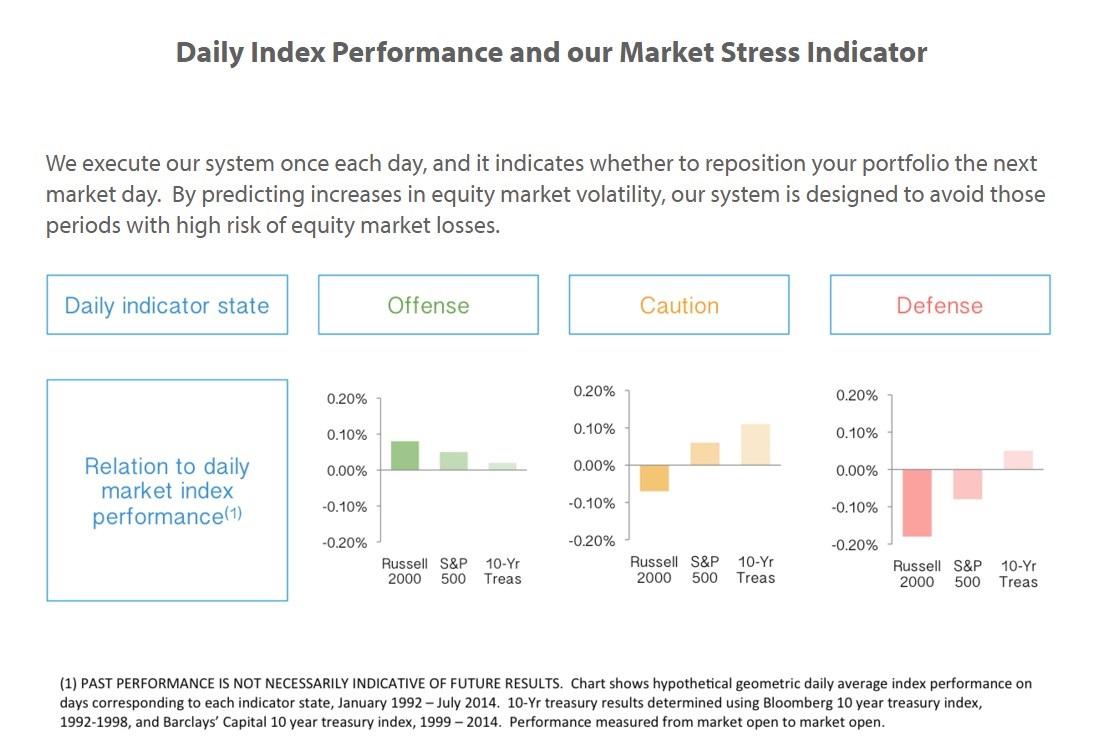
As I mentioned, we’ve got a system that follows institutional investor hedging activity. We use that as a way to predict downside volatility risks, and we use that prediction to tell us when to have offensive exposure to equities or defensive exposure using 10-year Treasuries. So we boil down that prediction of volatility to a binary indicator; we want to have exposure to equities or we want to be defensive. Our model allows investors to grow their money with equity exposure and downside risk protection, while still receiving the liquidity, transparency and diversification that comes with investing in index ETFs. And then we express the indicator’s decision in three products that differ only in the degree of equity exposure that they give in the offensive portfolio state.
McClellan: Do you have a minimum account size?
Vester: Yes, it’s $20,000 right now. Probably as we get bigger, we’ll be able to reduce that but right now that’s our threshold.
McClellan: And what are your fees?
Vester: We charge 1.25%. So that puts us at the high end.
We have our own view of the robo-adviser model and how we fit into the market segment. We refer to the current batch of robo-advisers as Robo 1.0. They all have a similar way of designing and managing a portfolio. They give you a static asset allocation based on modern portfolio theory [MPT], and once you’ve got your account funded they maintain your asset allocation over time with rebalancing. It’s a way to invest in indexes and to have a diversified portfolio but it’s maintained automatically, so they can do it for low cost.
Their portfolios end up being a bit of a compromise because on the one hand they’re well-diversified—they have exposure to a lot of different asset classes. But on the other hand you’ve got, at any one time, asset classes in the portfolio that have a low risk/return trade-off, and that means the returns are going to be kind of a compromise.
But Robo 1.0 blazed the trail here. They built this whole new market. They identified a way to serve a large class of underserved clients in a way that just wasn’t possible before, and that really was from using the Internet service delivery model in a way that hadn’t been used before.
We see ourselves as a natural evolution of the robo-adviser model, where we’re doing a very similar manner of Internet service delivery. A client can go to our website, they can learn everything about our product. They can get a recommendation of which product is right for them and then sign up for it and open up an account right from our website. So in that regard, we’re very similar to Robo 1.0.
But where we differ is in our investment management approach. Again, we have an active approach to giving our clients equity exposure and protecting against downside volatility risk. We’re particularly focused on the equity asset class, and our view is that clients who are seeking an equity strategy like ours are okay with the normal ups and downs of an equity market in a bull run where you might have fluctuations of 5% or 10%, but still stay within that “bull” market.
They want protection from more significant drawdowns, the 15%-plus drawdowns. They want a way to be protected against those, and our system is designed to identify when the risk of those big drawdowns is high and move our clients to defensive positioning.
So, as I said, we are an evolution of the robo-adviser model because we’ve got, number one, an offering that’s focused on just one asset class and, number two, we’ve got a systematic risk management process that’s tailored to that equity asset class.
McClellan: Are there particular robo-advisers in the game right now that you would consider more competition to you than others? How would you differentiate between them?
Vester: I would say there are three classes of robo-advisers. There is the true robo-adviser model like Betterment and Wealthfront, where they give you the static asset allocation and rebalance it over time. That’s one category. And Schwab is in there with their Intelligent Portfolios service. Then there’s a second category of services like FutureAdvisor and SigFig, where they are accessing all of your financial accounts and then giving you advice on how to reduce your spending and how to reallocate your existing investment accounts. I don’t really consider them part of our competitive set. I think they are an entirely different service offering. I think of our competitive set as really Betterment or Wealthfront.
And then there’s the third category of robo-advisers. We think we’re the first or the second entrant into this category and that’s the “active robos.” Hedgeable is probably there with us, but I think that’s where a lot of the new offerings will be: in different types of active and differentiated investment strategies that are delivered through the Internet service model.
McClellan: How are accounts handled and trades carried out? Is the process fully automated?
Vester: When a human goes to our website and goes through our questionnaire process, that’s a 100% automated process, and when they are going through the account opening process that’s also 100% automated.
Then once they’ve funded their account, our system is running, again, 100% automated. Our service is generating the indicator that says whether they have offensive exposure or defensive exposure.
And then when our indicator changes we tell the prime broker that we work with, Interactive Brokers, to trade all the client accounts exactly the same—consistent with the way we’ve designed the strategy—and they place a block trade. So that is an automated trade.
McClellan: Can you talk about modern portfolio theory and how you’re limiting downside exposure with a risk/reward trade-off?
Vester: We only focus on equities as the asset class for generating returns. What that allows us to do is to tailor our risk management approach to be best for that asset class, and we’re not simply rebalancing when we’ve got 10-year Treasuries in the portfolio and our indicator is signaling to be defensive.
We’re not choosing to have Treasury exposure or equity exposure based on a simple rebalancing signal. It’s a more sophisticated signal based on our proprietary prediction of downside volatility risk.
We wouldn’t be able to have that specialized risk management system if we weren’t just focused on equities, because the other asset classes don’t have the same kind of market structure that equities do. It’s the fact that we are focused on equities that allows us to have this proprietary risk management system.
McClellan: How do you communicate with your clients? Do you have email or phone services? Some robo-advisers have phone, email, online chat, and even in-person options.
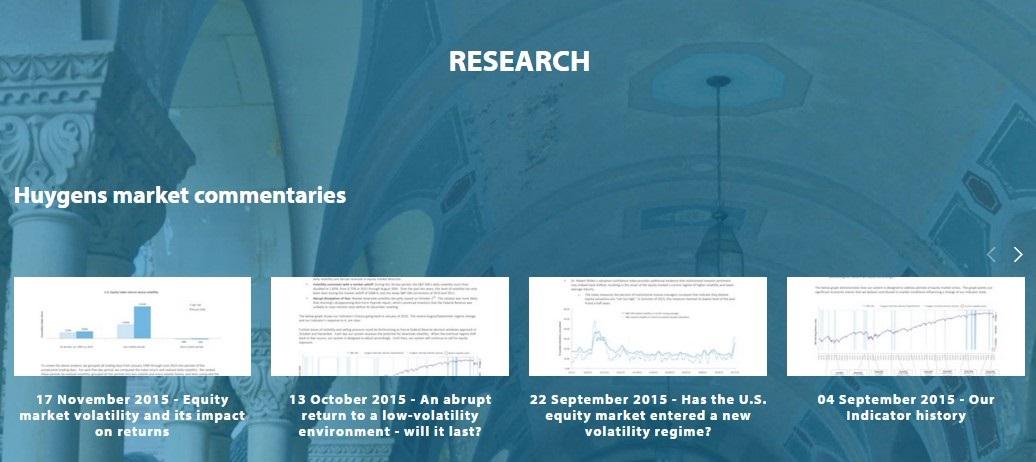
Vester: We focus on our prime broker for trading accounts, Interactive Brokers, and then we communicate, whether it’s macro-economic analysis or just updates for our clients, straight through email. If you look on our website, you’ll see that we have market commentaries posted there and those are things that we send to our clients.
We do those periodically and then we have quarterly notes where we talk about our performance and current macro-economic conditions. Both of those things get sent out through email and posted on our website. We recently launched our marketing campaign, so we have begun posting those market commentaries through LinkedIn and other social media venues as well.
But, no, we don’t use chat or any other communication mechanism besides email.
McClellan: Do you have specific licensing requirements for your staff members?
Vester: Oh yeah, definitely. Series 65 [a securities license obtained by completing a NASAA (North American Securities Administrators Association) exam] is absolutely required to be a registered investment adviser (RIA) and both of the partners in the firm are licensed.
McClellan: Can you talk to us about performance indicators historically, and how that mirrors volatility we saw recently?
Vester: We’d like to answer the question: Why even predict volatility?
If you look at the S&P 500’s history, going back to, let’s say, 1990—you can pick any year but let’s just talk about the period since 1990 for now—you can break that into five-day periods and then measure those periods both by realized volatility and by realized return. Then, sort them by lowest realized volatility up to highest volatility, and examine the cumulative returns.
As you go through the weeks, what you find is that the first half of the weeks in the list, the lowest volatility half, gives you positive returns that far exceed the total return that’s been produced by the S&P 500 over the last 26 years. And so, necessarily, the highest volatility half of those weeks has given up a substantial portion of that total return. Simply put, the highly volatile time periods are the ones where you give up your return, whereas you earn your return in the low-volatility periods.
And so that’s why our system is designed to have equity exposure during the low-volatility periods, because that’s where all the returns are earned. And if there’s a period that does not have the prospect for delivering returns, or has a prospect for delivering negative returns, as predicted by our system, then we’d rather have our client assets in defensive instruments.
McClellan: It seems pretty intuitive.
Vester: I would say that one of the things that makes it compelling for the robo-model is that it is intuitive, because we’re simply doing tactical asset allocation between equities and 10-year Treasuries. And the connections between how we predict volatility and the state or indicator is readily understood. It is good for the robo-model because when people read about it and understand it, they say, “Oh yeah, I like that. That works for me.”
McClellan: What do you think the whole robo-investing arena brings to the financial advising marketplace? How do you think these services will affect actual financial advisers?
Vester: We have a partnership with a $3-billion-plus wealth manager that is an RIA. They’re a multi-family office and their view is that robo-advisers are not a threat to them. They see it as an asset to them, which opens up a market that was otherwise just unavailable to them, and that market is this lower-account-size group and younger client set. Just about everybody my age or younger would rather shop for something online than talk to a salesperson about it.
If the information is presented in a seamless and objective way that allows us to make the evaluation, we prefer to buy that way, because it’s self-directed and it just feels like you’re more in control. The idea of a financial adviser going out and trying to bring in a client who is 30 just doesn’t make a lot of sense in some cases.
The robo-adviser model allows an existing RIA to develop new sales channels and also to have a degree of economies of scale in serving those smaller clients who weren’t available to them before. Most financial advisers don’t want to serve an account that’s less than $500,000 because it doesn’t make any sense for them to spend their time.
Back to your question to me of who is our competitor: I know there’s a market segment out there that will find our product interesting. I’d like to serve that client set, and I’m not worried about going toe-to-toe with anybody else.
McClellan: Can you summarize how your system switches, using recent market volatility as an example?
Vester: We just went through a period of pretty severe volatility in the equity market. There was the devaluation of the yuan, which started around August 17 or 18, and it caused a burst of volatility that led to that very rapid sell-off in late August.
Our system went defensive after the market close on August 21, which was a Friday, so pretty much in line with when volatility was really getting severe. And then it maintained its defensive positioning up until October 6.
During that period of volatility when nobody really knew if the market was going to sell down another 10% or what it was going to do, when markets were up 2% one day and down 2% the next day, our system was defensive, meaning that it was not moving anywhere near as much as the equity market. So it was delivering reduced volatility during a highly volatile period. When the market is getting nutty like that, just get the client out of it and wait until the storm passes.
McClellan: Yeah, we’ve talked a lot about the volatility over the last couple months.
Vester: Sure. It’s been the thing that’s been on everybody’s mind. I’m curious as you follow the robo-advisers… What has been your read on how they handle volatility like this? Have they handled it well?
McClellan: I read some articles saying that customers were panicking when markets became volatile and, to make matters worse, they couldn’t call in to someone to have their concerns put to rest. Phone lines were busy and calls weren’t being returned. Some robo-advisers, like Wealthfront, turned to social media to ease concerns about market volatility and sent email updates to clients before the worst of the storm began.
Concerning your portfolio composition: You invest primarily in ETFs and Treasuries?
Vester: Yes, equity ETFs and 10-year Treasury ETFs. There are huge benefits to doing that. It’s the lowest-cost way to get exposure to an asset class and the ETFs that we trade are some of the most liquid ETFs out there: a Russell 2000 index ETF and a 10-year Treasury ETF. Those both have just you know, massive amounts of liquidity and capacity in them.
And that’s important to us with our approach, because our objective is to be managing a lot of client money and you need to have very liquid instruments with a lot of capacity in order to be able to handle that.
McClellan: And your firm manages the money?
Vester: Yes, we are the registered investment adviser (RIA) and the manager. Interactive Brokers is the custodian.
A system like ours is trying to identify changes in market regime and changes of sentiment that can happen any day of the month, and so you really have to be running it every day. This is something we look at once a day, whereas other robo-advising services just purchase ETFs and check them periodically for rebalancing when they differ from a target asset allocation.
So that’s what we do. We run our system at market close and update our indicator and then in response to that, we trade our client accounts the next day if the signal changes. Most days, the signal doesn’t change and, in fact, this year our signal has only changed a few times. So most of the time our client accounts are just holding either an offensive position or a defensive position.
McClellan: And you said earlier that clients are notified when the signal changes or when trades are placed?
Vester: Well, the way we do it now is that they are they’re not notified directly by us every time we make a trade. They receive notification of trade confirmations from Interactive Brokers.
We do have clients who have a technical interest in our product, and so I keep them up to date, because they’ve specifically requested it. But on an ongoing basis, we’re not notifying our clients every time their account trades, unless they say they want that.
McClellan: Do you offer any tax guidance or retirement guidance?
Vester: No. We don’t do tax guidance, and we don’t do retirement accounts yet. Retirement accounts are definitely in the pipeline for us.
McClellan: Your site mentions choosing between a managed account and a model portfolio. What’s the difference?
Vester: The model portfolio is really for someone who already has their own brokerage account set up. They are actively managing their own money, and they would like to use our signal to manage their portfolio.
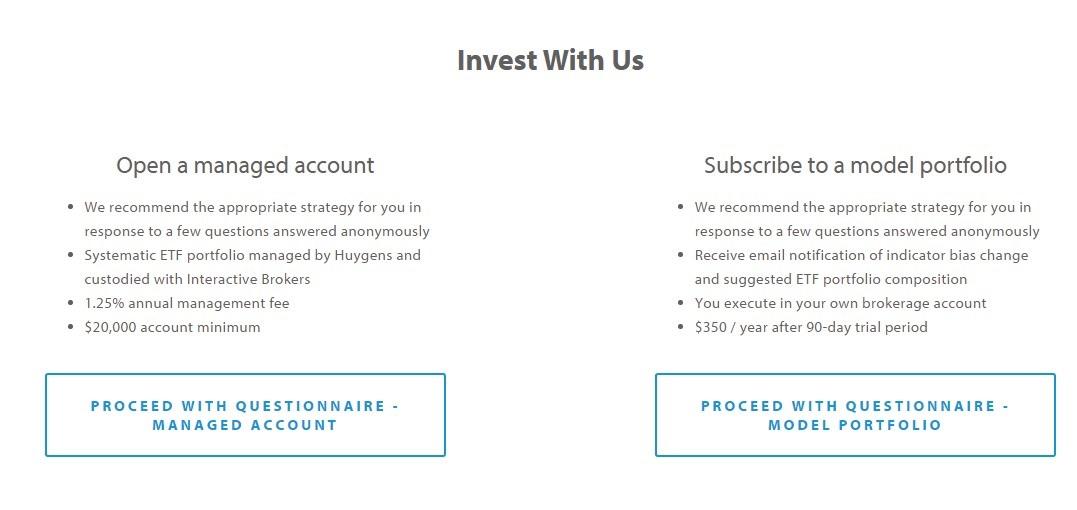
So they want to execute the trades themselves, in which case we will, for a fixed fee, send them our signal every time it changes and we’ll send them periodic updates during those times when it doesn’t change. We think that’s a way for some people to kind of try before they buy. If somebody wants to subscribe to our signal for a couple of months and just watch what it does, they could do that.
And if they want to continue that way and manage their money on their own account, then they can pay for the subscription, or after they’ve followed the signal for a couple of months they could switch to having a managed account.
McClellan: Thank you so much for joining us. You offered a lot of valuable insight.
Well there you have it – CI’s very first Robo-Adviser interview. If you have any further questions regarding Huygens Capital and their strategy, visit their website at www.huygenscapital.com. Keep in mind that Huygens’ approach is just one of several different strategies that robo-advisers employ. See my AAII Journal article What Exactly Do Online Advisory Services Offer?” for an overview of the robo-adviser universe.
As always, we welcome follow-up questions and comments.
Discussion
FREE REPORT

Michael Daillak from CA posted over 10 years ago:
Jackie McClellan from IL posted over 10 years ago:
You need to log in as a registered AAII user before commenting.
Log InCreate an account