

Many investors know that a bondholder receives periodic interest payments from the bond issuer and that principal is usually not due until the bond matures.
But when asked to explain the difference between coupon and yield, or what the risk of a bond is, confusion and misunderstanding can exist. This article provides an introduction to bonds, and a simple formula for pricing bonds.
Coupon and Yield
Suppose on January 1 of a given year, we were to lend $100 to Bob, at an interest rate of 10%, and that Bob promises to repay the loan at the end of one year. In return for our lending Bob $100 today, in one year he promises to pay us $10 interest and to repay the loan amount of $100. This is a simple example of a bond. By convention we refer to the $100 loan amount as the bond’s principal, or par value, while the $10 interest payment is referred to as the coupon payment and the 10% interest rate is the coupon rate.
A natural question might be, “what’s our return, or yield, on this bond?” We can answer it by using Formula 1, which is the standard return formula.
In our simple example, we end up with $100 plus $10 income in the form of interest, for a total of $110. We started with $100, so we have a net gain of $10. We can express this $10 gain as a percentage of our $100 investment, indicating that the return, or yield to maturity (YTM), on the bond is 10%.
But suppose that we decide we can’t wait a year for our money, and so almost immediately—still on January 1—we sell the bond to Joe for $95. At the end of the year Joe receives the $10 interest, plus $100 principal, from Bob, for a total of $110, just as we would have, had we chosen to hold on to the bond. But Joe’s investment was $95, not $100, so his gain is $110 – $95, or $15. That $15 gain can be expressed as a percentage of his investment of $95, so Joe’s yield to maturity (or, simply, yield) is $15 ÷ $95, or 15.79%. We can see that yield and coupon can be, and most of the time are, different.
The yield on the bond depends not just on the coupon rate, but also on the bond price. If we held on to it, then the 10% coupon bond would result in a 10% return for us, since we invested the full par amount of $100. However, if we sold it to Joe, then he would see a 15.79% yield, since he paid a bond price of $95, a $5 discount to the par amount. By selling the bond for $95, we experience a loss equal to $95 – $100, or $5, on our $100 investment. Our yield is –$5 ÷ $100, or –5%.
Joe’s 15.79% yield is higher than the 10% coupon rate, because he bought the bond at a discount. On the other hand, if Joe were to pay $105 for the bond, a $5 premium, then his gain would be $110 – $105, or $5. His return would be the gain, in this case $5, divided by the invested amount of $105, a yield of 4.76%. Joe’s yield on the bond in this example is less than the 10% coupon rate, because he bought the bond at a premium.
Table 1. Pricing a Semi-Annual Bullet Bond
| Par | $100 | Yield | 6.00% | |
| Frequency | 2 | Coupon | 5.00% | |
| Tenor | 5 |
|
||
| Period | Coupon | Principal | Total | Present Value |
| 1 | $2.50 | $0 | 2.5 | 2.427 |
| 2 | $2.50 | $0 | 2.5 | 2.356 |
| 3 | $2.50 | $0 | 2.5 | 2.288 |
| 4 | $2.50 | $0 | 2.5 | 2.221 |
| 5 | $2.50 | $0 | 2.5 | 2.157 |
| 6 | $2.50 | $0 | 2.5 | 2.094 |
| 7 | $2.50 | $0 | 2.5 | 2.033 |
| 8 | $2.50 | $0 | 2.5 | 1.974 |
| 9 | $2.50 | $0 | 2.5 | 1.916 |
| 10 | $2.50 | $100 | 102.5 | 76.270 |
| Sum: | 95.73 |
Payment Frequency
Not all bonds have the same payment frequency. The interest rate could be charged annually, as in Bob’s loan, or semiannually, quarterly, monthly, etc.
The dollar amount of interest paid each period is, typically, simply whatever the total annual interest would be, divided by the number of periods per year.
So if interest on this example loan was to be paid semiannually, then Bob would make two payments of $5
($10 ÷ 2), one six months into the life of the loan and the second six months after that, on the maturity date, when he repays the principal.
Accrued Interest
If we buy or sell a bond prior to maturity, we have to adjust for the interest. Let’s suppose our bond pays interest semiannually, meaning twice a year.
If we held on to the bond for exactly six months—until July 1—before selling to Joe, we would have received the first of the two coupon payments. Joe would therefore only own the bond for the second six-month period (from July 1) and so would only receive the second coupon payment.
If, however, we were to sell after, say, three months, on March 31, then Joe would receive both of the coupon payments. He would receive 12 months of interest even though he only owned the bond for nine months. Joe would, therefore, have to compensate us by paying us the three months accrued interest (from January 1 through March 31) in addition to the purchase price, at the time of the sale. The total amount that he would pay in this case, consisting of accrued interest plus the actual bond price, is known as the “dirty price.”
Traditional Bond Pricing
The price of a security, such as a bond that makes a series of payments in the future, is the present value of that cash flow stream. A typical bond consists of a series of one or more periodic coupon payments, C, and a single bullet payment of principal, B, at maturity. (The term “bullet bond” refers to a bond’s whose principal can solely be paid at maturity, meaning the bond cannot be called prior to maturity by the issuer.) The bond’s price is the sum of each of the cash flows discounted back to today, as shown in Formula 2.
Example: Consider a semiannual, 5% coupon bond, with a five-year tenor (maturity), priced to yield 6%. Table 1 shows the valuation of the bond using the traditional approach. The price is $95.73. (For simplicity, in these examples we assume all bonds pay $100 principal at maturity. In reality, many bonds have a par amount of $1,000.)
Bond Pricing With Financial Calculators
Pricing a bond using Formula 2, particularly with a long maturity such as 30 years, can be tedious. A financial calculator, such as the HP-12C or
TI-BAII, can do the calculations quickly, as can many other calculators that have time value of money (TVM) functions built in. Using the semiannual payment bond from our previous example, with the coupon paid in two installments per year resulting in 10 payments, and periodic yield of 3% (6% divided by the number of periods per year), you would enter $100 for FV, $2.5 for PMT, 3 for i, and 10 for n; then solving for PV returns $95.73. (The actual result is –$95.73 because it reflects the initial outlay of $95.73 to purchase the bond and receive the future cash flows.)
However, we don’t need to use a special financial calculator, or Formula 2, to find a bond price. There’s a much simpler approach: the Sum of Perpetuities method. This method can be used for the government and corporate bonds that individual investors are likely to encounter. (It does not work for amortizing bonds, such as asset-backed securities and mortgage-backed securities. Rather, the traditional approach is necessary.)
Pricing a Perpetuity
A perpetuity is one of the simplest forms of fixed-income security. It consists of a series of cash flow payments that continues forever and can be valued by simply dividing the periodic cash flow by the periodic yield. (See Formula 3).
Imagine, for instance, that we were to deposit $100 in a bank (with no default risk) that promised to pay us a periodic interest rate of 5% indefinitely, so that we would receive an unceasing stream of $5 payments, one per period. Substituting these values into our formula, we can see that a payment of $5, divided by a yield of 0.05 (or 5%), would result in a value of $100 for the stream of payments, which is equal to the price we paid in the form of the $100 that we deposited in the bank.
The Sum of Perpetuities Method
We can consider the cash flows that constitute a bond as consisting of two main parts: a truncated perpetuity and the bullet principal paid at maturity. Therefore, by combining a perpetuity with a deferred perpetuity and a deferred principal bullet, it is possible to exactly replicate the cash flows of a bullet bond, as shown in Figure 1.
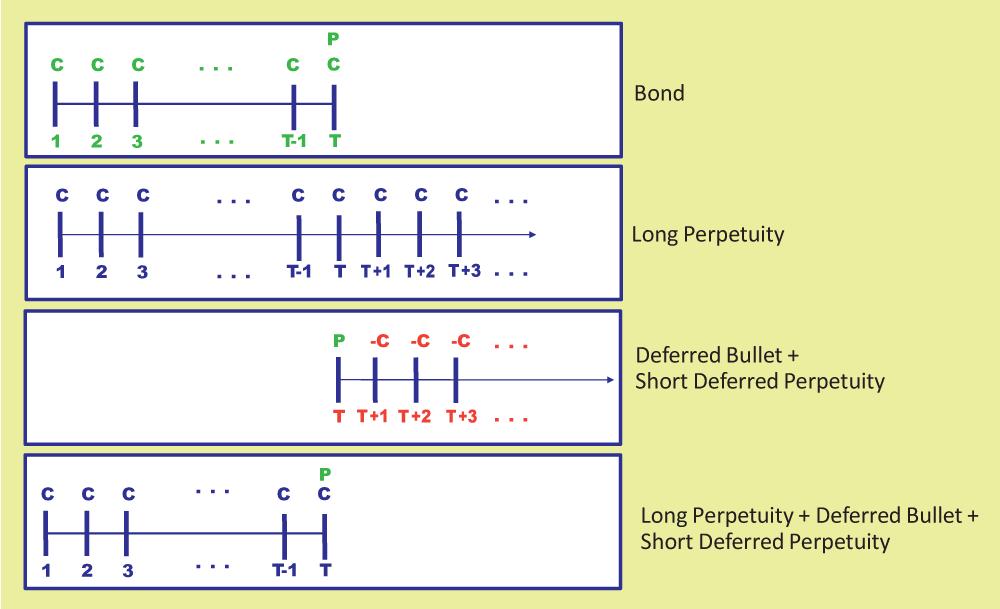
Imagine a five-year bond. It consists of five years of coupon payments, plus a principal payment, or bullet. The combination of a perpetuity and a bullet in Year 5 would have the same cash flows as the bond, except for cash flows continuing beyond Year 5, the maturity of the bond. Those extra cash flows (in Years 6, 7, 8, etc.) can be viewed as a perpetuity that starts in Year 5. So our five-year bond can be duplicated by combining a perpetuity, a bullet in Year 5, and subtracting a perpetuity that also starts in Year 5. We just need to remember that the bullet, and the second perpetuity, need to be discounted back to today in order to arrive at their present values.
In finance, the Law of One Price tells us that two identical sets of cash flows must have the same price. Since the bond and our replicating portfolio have the same cash flows, we can price the bond using the values of the perpetuities and the principal bullet. This gives us a relatively simple bond pricing formula, Formula 4.
Remember that the bullet cash payment and the short perpetuity are deferred positions, so their value must be discounted back to the present. In contrast to the traditional bond pricing formula, only one present value calculation needs be performed in Formula 4.
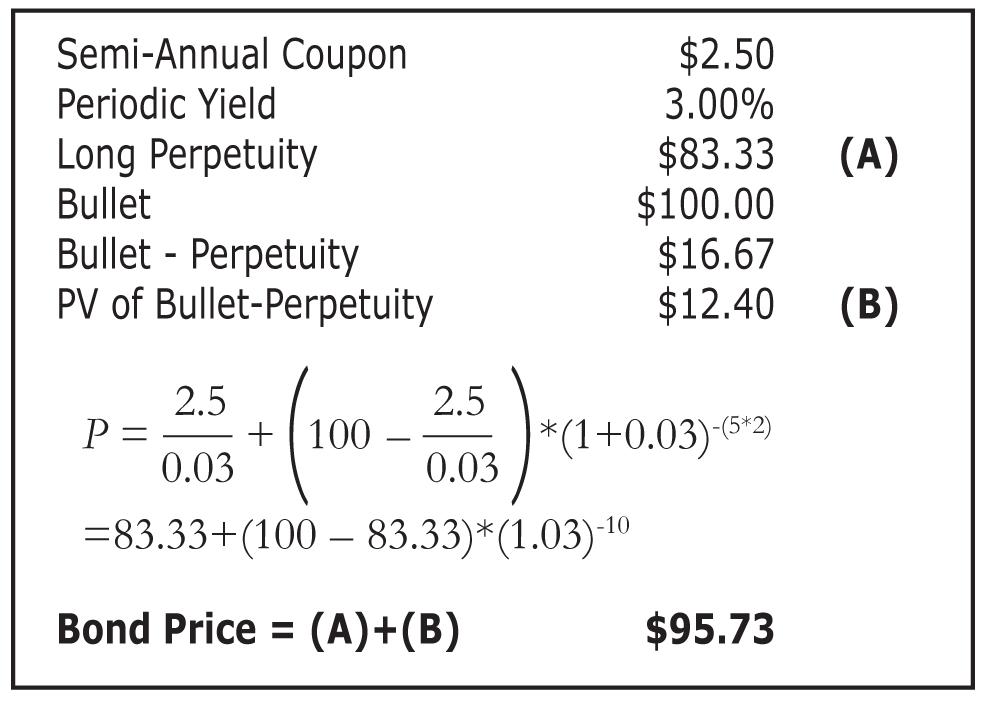
Example: Returning to our previous five-year, semiannual, 5% coupon bond, priced to yield 6%, we can price it using the Sum of Perpetuities method, as shown in Table 2. It produces the same result, $95.73, as produced using the traditional method, but with fewer calculations.
Callable and Putable Bonds
In addition to its application to bullet bonds, the Sum of Perpetuities method will also work for callable and putable bonds, where the redemption price differs from par. Callable bonds are those that can be redeemed early, by the issuer, often for a premium. In contrast, putable bonds are those that can be redeemed early by the bondholder. [In these cases, using Formula 4, the principal bullet (B), representing the principal that the investor receives on the call or put date, will be the call or put price, respectively.]
If our 5% coupon, 6% yield bond was callable in four years, at a redemption value of $102, then its price would be $98.07, as shown in Table 3. We can calculate the same price using the Sum of Perpetuities method, making sure to use $102 for the bullet principal amount and eight for the number of periods.
Table 3. Pricing a Callable Bond
| Par | $100 | Yield | 6.00% | |
| Frequency | 2 | Coupon | 5.00% | |
| Tenor | 5 |
|
||
| Call Period | 8 | Call Price | $102 | |
| Period | Coupon | Principal | Total | Present Value |
| 1 | $2.50 | — | $2.5 | $2.43 |
| 2 | $2.50 | — | $2.5 | $2.36 |
| 3 | $2.50 | — | $2.5 | $2.29 |
| 4 | $2.50 | — | $2.5 | $2.22 |
| 5 | $2.50 | — | $2.5 | $2.16 |
| 6 | $2.50 | — | $2.5 | $2.09 |
| 7 | $2.50 | — | $2.5 | $2.03 |
| 8 | $2.50 | $102.00 | $104.5 | $82.49 |
| 9 | — | — | — | — |
| 10 | — | — | — | — |
|
|
|
|
Sum: | $98.07 |
Zero-Coupon Bonds
Some bonds don’t have a stated coupon rate, and so make no coupon payments. These are called zero-coupon bonds, or zeros. The yield on these bonds arises from the fact that the bonds are sold at a discount. When applied to zero-coupon bonds, the Sum of Perpetuities formula reduces to Formula 5.
Summary
The yield on a bond depends on the price you pay for it. Similarly, the price that you have to pay depends on the yield at which the bond is trading. The Sum of Perpetuities method is a quick and intuitive formula for determining a bond’s price, given a yield to maturity.
Bond Formulas
Formula 1
The standard return formula for calculating a bond’s yield:

*Ending value is either par value, if the bond is held to maturity, or the price the bond is sold at prior to maturity. In the first example, the ending value is $100 if we hold Bob’s loan for one year or $95 if Joe buys the bond from us at a discount.
Formula 2
The present value of a stream of future cash flows, such as interest payments and the payment of a bond’s principal:
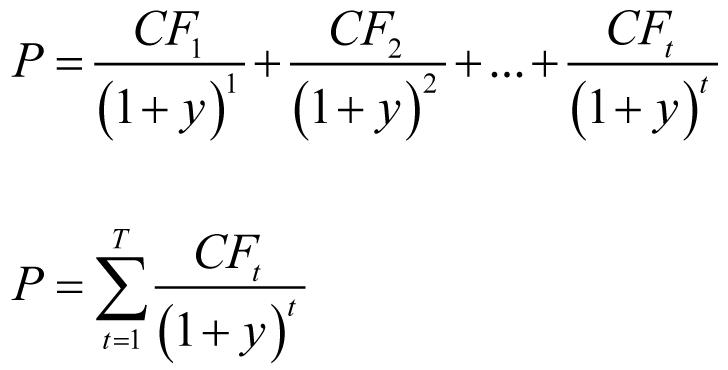
Where,
- P is the price,
- CFt the cash flow at time t,
- y the periodic yield, and
- T the number of periods to maturity.
Remember that the cash flow at maturity, CFt, will include the bullet payment. For annual pay bonds, the periodic yield y is simply the bond’s yield to maturity, while for semiannual pay bonds, and those with more frequent coupons, the periodic yield equals the yield to maturity divided by the number of payments per year. Similarly, the number of periods T equals the number of years to maturity multiplied by the number of payments per year.
In the example given above, the assumed discount rate is assumed to be equal to the yield to maturity on the bond, divided by the number of periods per year. In practice, one could use a vector of spot (current) rates, with each cash flow discounted at the spot rate of that maturity.
Formula 3
The price of a series of cash flows expected to continue into perpetuity can be calculated as:
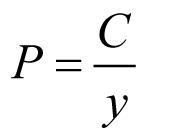
Where,
- P is the price of the perpetuity,
- C is the periodic cash flow, and
- y the periodic yield.
Formula 4
The price of a bullet bond with periodic interest payments can be calculated by using the values of the perpetuities and the principal bullet:

Where,
- P is the bond price,
- C is the periodic coupon payment,
- y is the periodic yield,
- B the principal bullet at maturity, and
- T the number of periods to maturity.
Note that the valuation expression for a perpetuity will be undefined at a yield equal to zero. When the yield to maturity is zero, the price of a bond is simply the undiscounted sum of all coupon and principal cash flows. In practice the formula can be used, however, if an infinitesimally small yield is assumed, such as 0.00001%.
Formula 5
When applied to zero-coupon bonds, Formula 3 reduces to

Where,
- P is the price of the bond,
- B the principal at maturity,
- y the periodic yield, and
- T the number of periods to maturity.
Related
Related
Investor Professor
How Interest Rate Changes Affect the Price of Bonds
Discussion
FREE REPORT

Get your free copy of our special
report analyzing the tech stocks
most likely to outperform the
market.
Tom Cooper from NV posted over 10 years ago:
You need to log in as a registered AAII user before commenting.
Log InCreate an account