

Related

AAII Stock Ideas

Charles Rotblut leads a class in AAII's new Essential Investing Video Course. Go to https://www.aaii.com/ves for more information and to subscribe.
Each week, I select a stock to feature as a “buy” or a “sell” on Money Life with Chuck Jaffe. The stocks selected can be recent additions or deletions from one of our model portfolios: Shadow Stock, AAII Dividend Investing, Stock Superstars Report or VMQ Stocks. They can also be stocks passing one of the more than 60 stocks screens available in the Stock Ideas section of AAII.com. (Audio clips of the podcast are posted to the AAII Blog at http://blog.aaii.com/category/podcast).
Periodically, I use one of two custom screens to select the buy or the sell, using AAII’s Stock Investor Pro fundamental stock screening and research database. Both are modified versions of our earnings estimate revisions screens.
My buy screen, highlighted here, seeks stocks with positive revisions to their earnings estimates made within the past 30 days. My sell screen seeks stocks with negative earnings estimate revisions made within the past 30 days.
Earnings estimate revisions are changes to the I/B/E/S consensus earnings estimates. These are the average of all earnings projections made available by the brokerage analysts covering a given stock. Positive revisions have been shown to lead to above-market returns, while negative revisions have been shown to lead to below-market returns.
Stocks are also required to have either met or exceeded the consensus earnings estimate for the most recent quarter. An earnings miss may suggest that analysts are too optimistic or that they are having a hard time predicting how the company will actually perform.
Since Chuck asks for how much potential upside (or downside) a stock may have, I include a relative valuation measure in the screens. Specifically, I require a stock’s price-earnings (P/E) ratio to be below its five-year average high; preferably below its five-year average P/E. Such stocks are currently trading at valuations below what investors historically have been willing to pay. To prevent stocks with excessively high P/E ratios from passing the “buy” screen, I also require the current price-earnings ratio to be no higher than 30.
To narrow down the list further, companies must have grown sales and earnings per share over the last 12 months. The screen is also restricted to companies included in the S&P Composite 1500 index to identify companies that listeners to the podcast are more likely to be familiar with. (The S&P Composite 1500 encompasses the S&P 500, the S&P MidCap 400 and the S&P SmallCap 600 indexes.)
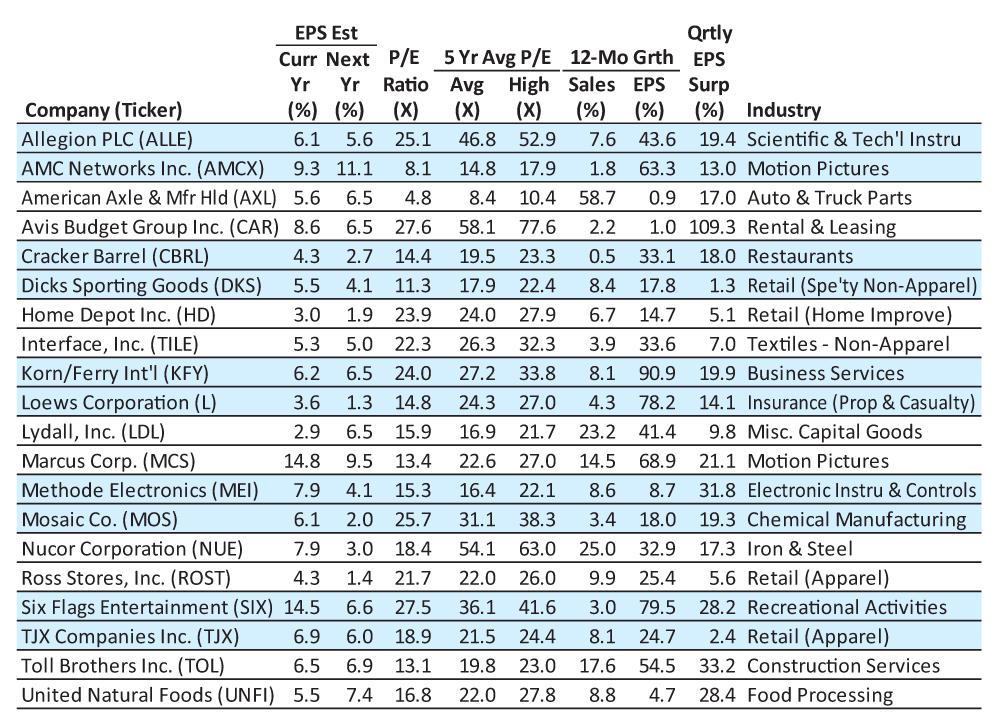
As of our publication date, 58 companies passed the screen. The 20 with the most positive earnings estimates are listed in the table here.
Stocks Passing Charles’ Buy Screen
Criteria for Stock Investor Pro Users
Download the Excel spreadsheet
| Field | Operator | Compare to |
|---|---|---|
| Standard and Poor stock | Not Equal | None |
| EPS Est Y0-% Rev-Last Month | > | 0 |
| EPS Est Y0-% Rev-Last Month | > | 0 |
| PE | < | PE-Average 5 years |
| PE | < | PE High - Average 5 years |
| Sales-Growth 12m | > | 0 |
| EPS Dil Cont-Growth 12m | > | 0 |
| EPS Est Y0 | > | EPS-Diluted Continuing Y1 |
| Quarterly Surprise-Percent | > | 0 |
| PE | < | 30 |
AAII Stock Ideas
Growth Investing
Investing Gurus

Tony Santiago from CA posted over 8 years ago:
Tom Tucker from PA posted over 8 years ago:
John from Texas posted over 6 years ago:
You need to log in as a registered AAII user before commenting.
Log InCreate an account