



In an age of transformative payment options, currency types and the digitalization of the world’s information, money, as we know it, is changing. Physical currency as a medium of exchange, payment or purchase can be counterfeited, stolen or lost and cannot be validated for ownership most of the time. Cryptocurrency is a digital currency that uses cryptography for security. The investment capabilities and risks of bitcoin and other cryptocurrencies are discussed below.
Cryptocurrencies: What are They?
A cryptocurrency is, in the simplest connotation, a digital asset that is constructed as a medium of exchange. Cryptocurrencies enable payments to be sent between users without passing through a central authority (like a bank). They are created and held electronically.
Cryptocurrencies are premised on the technology of cryptography, which is the process of writing or creating codes. Cryptocurrencies create value either through commercialization of products or services or through subsidized revenue generation.
These currencies can fluctuate significantly in value. Since they are not regulated by any central monetary authority like the Federal Reserve Bank, they suffer from major price instability. Many individuals view cryptocurrencies like commodities instead of currencies in their conventional sense.
There are five main differences between cryptocurrencies and regular (fiat) currencies:
-
Limited supply: Banks issue new fiat currency, while cryptocurrencies are controlled by a mathematical system.
-
Decentralization: Cryptocurrencies are not controlled by any monetary authority, as fiat currencies are.
-
Irreversible transactions: Cryptocurrencies cannot communicate or reverse transactions, whereas banks are able to reverse fiat currency transactions.
-
Divisibility: Cryptocurrencies can be divided infinitesimally, while fiat currencies cannot.
-
Identification: Cryptocurrency transactions have semi-anonymity because there is no regulator that requires identification, while regulations require electronic payments of fiat currencies to be identified.
Although initially based as a payment system, cryptocurrencies have transformed into something more volatile: an investment vehicle.
Popular Cryptocurrencies
In market capitalization (price multiplied by number in circulation) and popularity, bitcoin reigns supreme with a market cap of around $163 billion. Other cryptocurrencies that are also in the ‘mainstream’ include, by market capitalization, ethereum ($70 billion), ripple ($33 billion), bitcoin cash ($17 billion) and litecoin ($10 billion). Some of these are based on different applications of blockchain (defined below). A list of all cryptocurrencies, their price, market capitalizations, volume, supply and 24-hour price change can be found at CoinMarketCap.com. There have been quite a few cryptocurrencies created that are loosely based on software, products and hardware and they vary significantly; these are known as altcoins or alternative coins.
Technical: Bitcoin and Blockchain
In late 2008, Satoshi Nakamoto posted a link to a paper he authored titled “Bitcoin: A Peer-to-Peer Electronic Cash System.” The paper was the thesis for bitcoin, the first and most prevalent cryptocurrency. Very little is known about Nakamoto himself, as very little substantiated information regarding his background has been found. Nakamoto invented bitcoin and ‘mined’ the first ‘block’ (added the first transaction to a digital ledger), which then led to others mining transactions. This article does not delve too deeply into the creation or technical information behind blockchain and cryptocurrencies. I would recommend reading the above linked article by Nakamoto, which gives the basis for bitcoin. A more simplified description of blockchain can be found at CoinDesk.com.
Here are some basic definitions of terms used with cryptocurrencies:
-
Block: a page of a record book (of transactions)
-
Coin: another term for cryptocurrency
-
Token: representative unit for an asset
-
Blockchain: linking of blocks together using cryptography
-
Public key: a key (virtual) that can be distributed widely
-
Private key: a key (virtual) that is tied to an owner
-
Hash: an algorithm that takes any amount of data and inputs it into a fixed size
-
Public-key cryptography: a system that uses two kinds of keys—public and private keys—to both authenticate and encrypt information, respectively
Investment
Since a cryptocurrency is unlike a fiat currency, such as the U.S. dollar, but similar to a commodity, individual investors can only bet on price appreciation in order to achieve a return for their investment in a cryptocurrency. Although fewer and fewer bitcoins will be released over time, individuals confident in bitcoin believe that demand will remain constant, raising the price. The price of bitcoin is seemingly determined by its ability to attract new “investors,” rather than fundamental statistics such as those that stocks trade by. Technical analysts may thrive in the cryptocurrency market.
Since bitcoin’s only true measure of value is its price appreciation or depreciation, the CBOE and CME Group launched their own individual bitcoin futures. Futures are an agreement to buy or sell an asset on a specific future date at a specific price. Once the futures contract has been entered, both parties must buy and sell at the agreed-upon price, irrespective of what the actual market price is at the contract execution date. Investors can place a long position or a short position. A long position is placed when the investor expects the price to rise in the underlying asset, and a short position is placed when they expect the price to fall in the underlying asset, below or above the current asset price. Futures are not just physical assets but are traded as financial assets as well.
Bitcoin futures act the same way. The contract is based on the price of bitcoin and speculators can place a “bet,” as a long or short position, on what they believe the price of bitcoin will be in the future. You do not have to own bitcoin to speculate on its price. Bitcoin futures, unlike bitcoin itself, can be traded on regulated exchanges that allow for some risk management. Additionally, individuals residing in places where bitcoin trading is banned can speculate through these futures.
According to Cointelegraph, a website devoted to explaining and exploring cryptocurrencies, the futures contract works as follows. If an individual owns bitcoin priced at $18,000 and believes that the price will drop in the future, they can sell a bitcoin futures contract at the current price, which is $18,000. Close to the settlement date, the price of bitcoin—and therefore the price of the futures contract—has dropped. The investor now decides to buy back the bitcoin future. The investor makes the spread.
In January, the U.S. Securities and Exchange Commission (SEC) outlined its views on cryptocurrency in a letter to two Wall Street trade groups that was later publicly released. The SEC questioned how cryptocurrency’s volatility (bitcoin in particular, in this case) and potential liquidity issues would fit with funds that must calculate a fair market price for their portfolio at the end of every trading day. “Until the questions identified above can be addressed satisfactorily, we do not believe that it is appropriate for fund sponsors to initiate registration of funds that intend to invest substantially in cryptocurrency and related products,” the SEC’s director of investment management, Dalia Blass, wrote in the letter.
In 2017, the SEC rejected two proposed exchange-traded funds (ETFs) that would directly own bitcoin, arguing that the global market for bitcoin wasn’t transparent enough to support sufficient oversight.
More recently, Coinbase, one of the most popular cryptocurrency exchanges, said it would let investors buy bitcoin and other cryptocurrencies listed on Coinbase through a new fund. The index fund, which will invest in the same cryptocurrencies traded on Coinbase and its institutional exchange GDAX—currently including bitcoin, ethereum, bitcoin cash and litecoin—will be available only to U.S. accredited investors, or those who have annual income of at least $200,000 or a net worth of at least $1 million. The fund requires a minimum investment of $10,000 and weights its cryptocurrency holdings by market capitalization.
Coinbase hopes to launch a similar fund available to all investors regardless of wealth, likely structured as an ETF, pending regulatory approval. No specific dates have been set.
There are also other cryptocurrency index funds available to accredited investors—such as the Digital Large Cap Fund (which invests in bitcoin, ethereum, bitcoin cash, litecoin and ripple’s XRP) and the Bitwise HOLD 10 Private Index Fund (which also invests in other cryptocurrencies such as stellar, monero and dash).
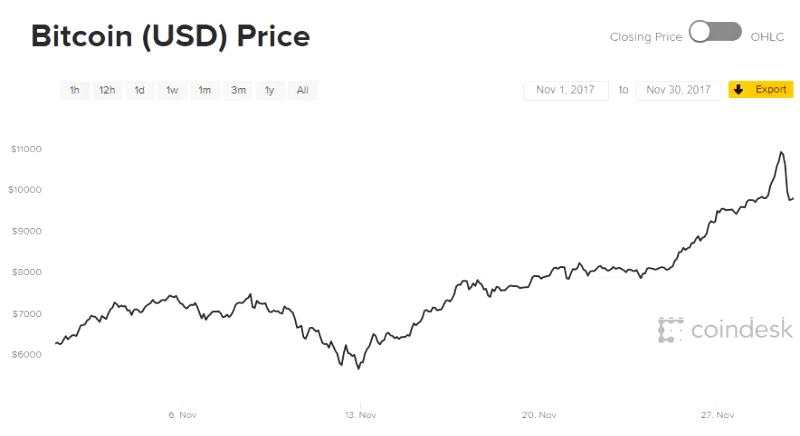
Below, the price chart for the month of November from Coindesk.com shows the volatile nature of bitcoin’s price swings.
There are ETFs that invest in companies involved with the development of cryptocurrency. These funds do not buy the cryptocurrency themselves, and since they are publicly listed they are under exchange regulations and guidelines. Reality Shares Nasdaq NextGen Economy ETF (BLCN) and the Amplify Transformational Data Sharing ETF (BLOK) are two new ETFs that invest in companies researching and developing blockchain technology. After launching, both ETFs pulled in over $240 million in less than two weeks—signaling investor appetite for such investments.
Other ETFs include:
-
Innovation Shares NextGen Protocol ETF (KOIN)
-
First Trust Indxx Innovative Transaction & Process ETF (LEGR)
Payment Mechanism
Although its investment compatibility is still up for debate, bitcoin can be used to make payments. Similar to fiat currency online wallets, there are wallets that allow for peer-to-peer transfers of bitcoin.
BitPay is one example. According to BitPay, you require a digital wallet to store, spend or receive bitcoin. Each bitcoin transaction requires a “miner” to confirm the transaction on the bitcoin network. Once the digital wallet is created, you must transfer or withdraw your bitcoins from your chosen exchange to your wallet. Everything is digital, so payments are sent and received through URLs or web addresses or QR codes.
Miner fees and network cost fees cover the miner’s efforts in confirming and processing the transaction. According to BitPay, there is a 15-minute window that ensures a fixed bitcoin price.
Risks
There is a significant risk for fraudulent activity when using cryptocurrencies. In mid-2011, when bitcoin was merely a hobby for a small number of individuals, hackers were able to steal a significant base of a miner’s bitcoin balance. In August 2012, a bitcoin Ponzi scheme was shut down that had lured customers in with a promise of high returns but used new customers’ deposits to pay profits to previous customers; the victims lost 265,678 bitcoins. In January 2015, one of the popular bitcoin exchanges, Bitstamp, reported that it had lost around 19,000 bitcoins.
With each bitcoin, there is a private key that equates to ownership of the bitcoin. Loss or misplacement of this private key equates to loss of the asset entirely. The systems of private key holders can be hacked or infiltrated, and the key can be stolen.
Investors who wish to own the underlying bitcoin asset itself, must take steps to safeguard their keys and information. Outside of this, individuals may partake in other investment avenues such as ETFs or futures.
Bitcoins or other cryptocurrencies can be held on an exchange or through a digital wallet, but these are at risk of being deleted, lost or stolen.
Contrary to fiat currency held at a banking institution, cryptocurrencies are not FDIC insured when held in digital wallets. Though they seemingly act as bank accounts, digital wallets are much riskier.
Resources for Cryptocurrency Transactions
Exchanges
In addition to having a different reputation, each exchange has different exchange rates, verification methods, geographical restrictions, fees, etc. You can view a list of major exchanges in each individual region or country at Bitcoin.org as shown below. Additionally, you can find pros and cons and background information regarding a number of exchanges at Blockgeeks.com.

I created an account on Bitstamp to see the complexity of doing so and how to buy or sell. In order to deposit, withdraw, buy, sell or complete any major functions on such an exchange, a personal account or corporate account verification is required. When creating a personal account, you must enter sensitive information such as your address, Social Security number and whether you are a citizen, resident or tax liable individual. Additionally, you must submit an identification document such as a driver’s license, state ID, etc., alongside a proof-of-residence document. Each document must be different.
Once your account is created, you can initiate an order, such as: an instant order, which involves simply selecting to buy or sell bitcoin; a limit order, which involves buying or selling bitcoin at a specified price, or better, depending on the transaction; a market order, which buys or sells bitcoin at the current market price according to Bitstamp; and stop buy or stop sell orders, which involve buying bitcoin if the price rises to a specific amount or selling bitcoin if the price falls to a specific amount, respectively. You can purchase bitcoin with a credit card.
Bitstamp also allows for the purchase or sale of other cryptocurrencies, including ripple XRP, litecoin, ethereum and bitcoin cash. You can also exchange U.S. dollars for euros and vice versa.
There are risks involved with using unregulated exchanges such as this, and Bitstamp has been hacked in the past. Risks can involve loss of funds and loss of access.
Brokerages
Three regulated bitcoin foreign-exchange brokers include Nadex, Coinbase and Forex.com. Nadex and Forex.com are both regulated by the Commodity Futures Trading Commission (CFTC). The bitcoin exchanges I have listed above are not regulated and therefore pose additional risks to those who wish to trade bitcoin or other cryptocurrencies.
Knowledge and Discussion
There are a variety of sources for information regarding bitcoin and forums where individuals who own are interested in owning or are simply curious about cryptocurrencies can engage in discourse.
The website Bitcoin.com seems to have a significant user base that attracts individuals who wish to gain information regarding bitcoin in the news, bitcoin price data and other information. Additionally, Coindesk.com is a similar resource.
As a grand forum for discussing anything, Reddit has more than 12 subreddits devoted to discussing bitcoin, ethereum and other cryptocurrencies. I do recommend visiting one of these subreddits to gauge what individuals believe bitcoin is doing and how the market is changing.
As a way of viewing cryptocurrency prices and other relevant details on many of these exchanges, WorldCoinIndex provides such information.
Conclusion
Cryptocurrencies and blockchains are relatively new concepts but have contributed to an interesting facet of finance, although one that is filled with risk. Research is key in this arena, as each cryptocurrency is different and volatile in its own way. If you wish to engage with these vehicles, do so with caution.
Discussion
FREE REPORT

William Dickinson from WI posted over 8 years ago:
John Newman from OH posted over 8 years ago:
John Newman from OH posted over 8 years ago:
Royce Bland from MI posted over 8 years ago:
Mr. C. Leslie Golliday from VA posted over 8 years ago:
Robert Baran from IL posted over 8 years ago:
STEVEN L from WA posted over 6 years ago:
You need to log in as a registered AAII user before commenting.
Log InCreate an account