


A dividend reinvestment plan, or DRIP, is a plan offered by companies that allows investors to purchase shares of stock with dividends received, without having to actually place a purchase order. This form of payout helps the company by retaining an investor base with a long-term mindset and providing a regular source of funds, while the investor is supplied with additional shares at low or no fee. Instead of receiving your dividends as cash, your dividends are directly reinvested in the underlying equity. Unfortunately, you will still owe taxes on dividend income, whether it is received or reinvested. Also, with a DRIP, you don’t need to wait till you’ve accumulated enough cash from dividends received to buy whole shares; DRIPs take advantage of fractional share purchases.
There are several reasons investors find DRIPs useful. One is dollar cost averaging. Dollar cost averaging lowers your average cost per share by investing relatively fixed amounts (dividend payments are usually steady but increase over time) into the same stock at regular intervals. The average cost is lowered because over time, a stock’s price fluctuates. When prices are up, you purchase fewer shares, and when prices are down, you purchase more.
Secondly, reinvesting dividends helps investors achieve higher returns over time thanks to compounding. Returns are further maximized by the reduction in transaction costs associated with DRIPs.
Many DRIPs do not have charges or fees associated with them. Some DRIPs charge minimal fees, but these fees are often less than what you would pay if you were to use a brokerage firm to reinvest your dividends or purchase additional stock.
Besides a DRIP plan, there is also a direct stock purchase plan (DSPP), sometimes called the direct investment plan (DIP); the similar names often create confusion. A DSPP or DIP allows investors to buy their initial shares of stock directly from a company or their stock transfer agent, bypassing the broker. Investors can set up a DSPP to automatically purchase stock and then reinvest the dividends, if they are paid, through a DRIP. A company doesn’t need to pay a dividend to offer a direct stock purchase plan; however, it does need to pay dividends to offer a DRIP.
Companies often require shareholders to own one share of stock before they are eligible to enroll in a DRIP. Most companies that offer DRIPs have a specific area on their website where you can find information regarding the plan, typically in the investor relations section of the site. Aside from the individual company’s website, below is a list of websites that we find most useful when it comes to DRIPs and DRIP investing.
Computershare.com
Computershare.com is an excellent source for DRIP investors since it is the transfer agent for many companies that offer DSPPs and DRIPs. When you arrive at the site, click “buy stock direct” listed under the company’s services on the home page. The link brings you to another page titled Buy Stock Direct. Under the heading Quick Search, you can click “dividend reinvestment plans” to view a list of companies that offer dividend reinvestment plans. This isn’t a list of all companies that offer DRIPs, however. From the Buy Stock Direct page, you can search for a specific company’s DRIP information by inputting a ticker symbol or company name into the designated search box under the section titled Plan Search and clicking “search.” Next, a page appears with the specific company’s investment plans. However, under the column titled “plan type” it doesn’t say DRIP, it says DSPP. The DRIP plan information is grouped under the DSPP information on Computershare. At the top of the page it states, “All of the companies shown below offer either a direct stock purchase open to all investors or a dividend reinvestment plan for existing shareholders.”
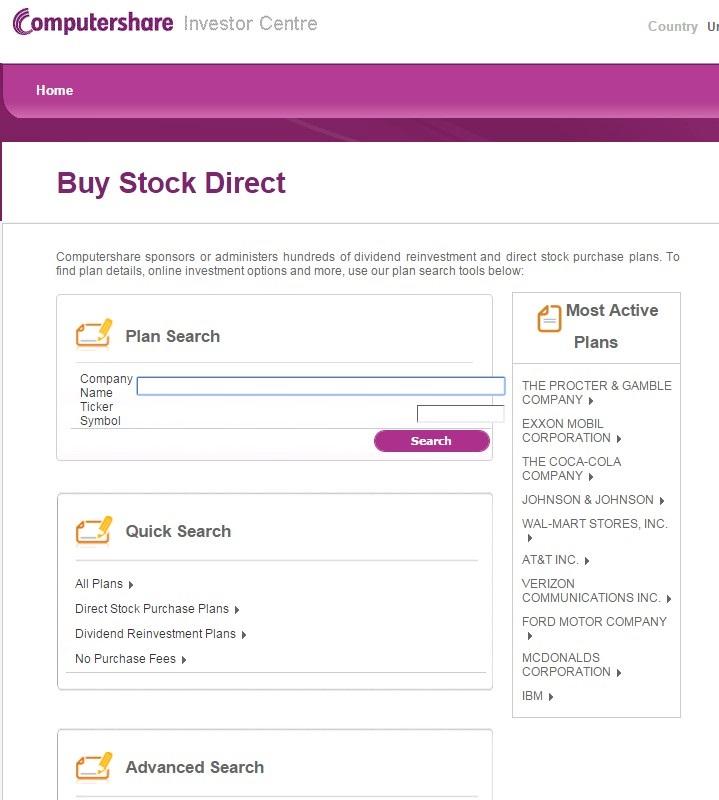
It’s important to note that there are often investment plans listed that are only available to employees and/or retirees. Be sure to click the investment plan that isn’t for employees and retirees (unless of course you’re checking out a company you work or worked at!)
To see more information about a particular plan, click “view.” A page displaying DSPP-specific information appears. This includes the plan’s brochure, enrollment forms and specific information regarding fees. Fees that are listed can include the initial set up fee, cash purchase fee, ongoing automatic investment fee, purchase processing fee, batch sale fee, batch sale processing fee, batch maximum sales fee, market order sale fee, market order processing fee (per share), market order sales fee and dividend reinvestment fee.
Computershare does not have all stocks that have DRIP plans in its database. Other transfer agents include American Stock Transfer and Trust, Broadridge, and Wells Fargo.
DRIPinvesting.org
DRIPinvesting.org is a DRIP investing resource center. When you first arrive at the website, you will see eight different options: info, tools and forms; community; First Share; articles; research; choices; books; and InvestMete. Once you’ve clicked one of these options, the categories appear in the upper left-hand corner of the website so you can easily move between pages.
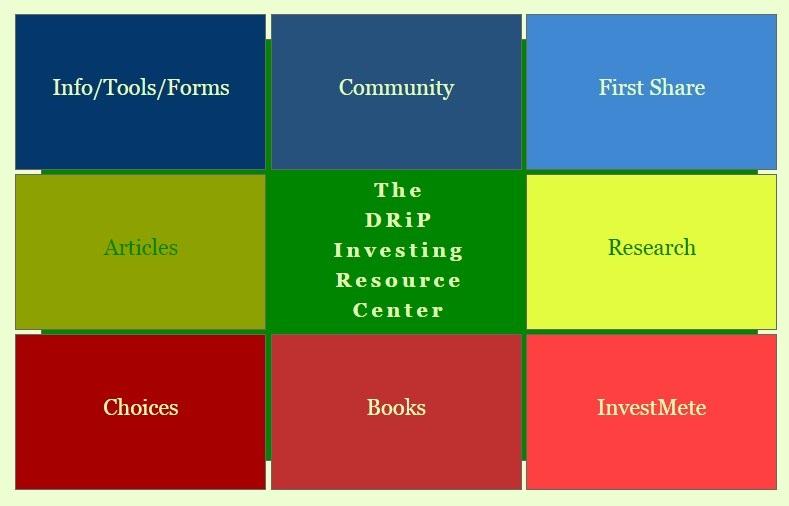
The info, tools and forms area of the website provides a list of U.S. dividend champions (U.S. companies that have paid a high dividend for 25 years straight), a list of Canadian dividend all-stars (Canadian companies with five or more consecutive years of dividend increases) and also a list of U.K. dividend champions.
The tools section offers a variety of spreadsheets including a DRIP purchase tracker, a “portfolio slicer” that lets you track your investments (stocks, ETFs and mutual funds) and a budget spreadsheet.
The articles area of the website includes write-ups by various authors regarding DRIPs and dividend investing. Titles include “Dollar Cost Averaging,” “DRIPs 101: DRIP Classifications” and “The Upside of DRIPs: Debunking Myths.”
I didn’t like the fact that the website didn’t have publication dates on the articles, but nevertheless, many of them could be considered “timeless” due to their educational nature. There were also links to DRIP resources and websites that were outdated or not working. The forums did have recent comments and topics posted.
DirectInvesting.com
DirectInvesting.com provides basic DRIP information, DRIP forms and news. The website is managed by Moneypaper Publications LLC. DirectInvesting.com also works with Temper of the Times Investor Services Inc., which is a self-clearing broker/dealer registered with the Securities and Exchange Commission (SEC) and a member of FINRA. The sole purpose of this brokerage service is to provide the initial share(s) required by many companies in order for an investor to join the company direct investment plan.
There are several different tabs across the top of the website including home, DRIP information, strategies, kids, forms, member benefits, order DRIP enrollments, subscribe and about us. Each tab has drop-down subtabs.
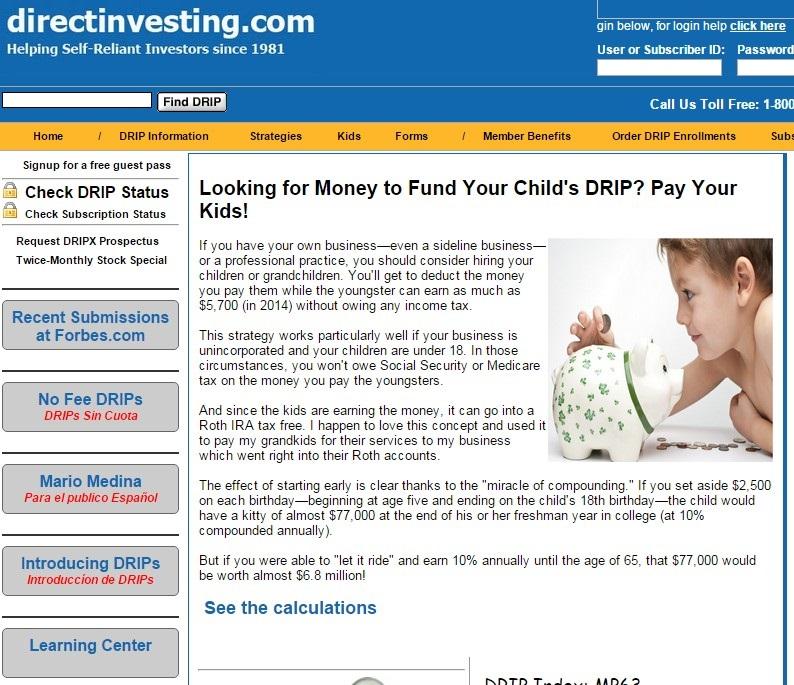
By hovering your mouse over the DRIP information tab, you will see several different subtabs including “search our DRIP database.” The database search is very useful and allows you to type in a company’s ticker symbol to view its DRIP information. For example, if you type (MSFT) for Microsoft Corporation and click search, another page appears with information regarding Microsoft’s DRIP information, including the plan’s minimum investment, maximum investment, shares to quality, recent price, investing fee and fee for dividends. There is a section for additional information that includes links to fees, the plan’s prospectus, transfer agent or the company’s website, but, the “additional information” section is only available to Club members. If you wish to order DRIP enrollment information, click the “Order DRIP Enrollment” button at the top of the page.
There are plenty of articles that can be accessed by clicking Introducing DRIPs, Learning Center, or Getting Started along the left-hand side of the website. Here you will find information on how DRIPs benefit you and also how to get started in DRIP investing.
You can become a DRIP Club member, which includes a 50% discount off the enrollment fee of any and all DRIPs (you will always pay $30, non-members pay $60), full access to all research and recommendations on directinvesting.com, a proprietary real-time calculator that helps you calculate optimal times to invest according to dollar cost averaging, unlimited access to the advanced DRIP database search, access to stocks in all six actively managed model DRIP portfolios and unlimited access to the Extra Dividend database. Direct Investing is currently running a special where six months of DRIP Club membership costs $79 (instead of $99) and a 12-month membership costs $129 (instead of $179).
If you click the “subscribe” tab along the top of the website you can see the different services that the website offers, including a link to purchase The Guide to Direct Investment Plans ($27). GuidetoDRIPs.com is an online version of the Guide. It allows you to search the DRIP database for companies that meet your criteria ($100).
DRIPInvestor.com
DRIPInvestor.com is a website based on the advice of Charles B. Carlson, CFA. DRIP Investor publishes a monthly newsletter that promotes a long-term buy-and-hold stock investing strategy. The website serves as an online version of the newsletter, but there is also a print version available. Subscribers have access to DRIP investing articles and archived commentaries from Carlson.

You can register for a couple of free tools, including a list of no-load stocks, DRIP Investor Tip of the Week email (sent on Mondays) and access to Tip of the Week archives. Currently the website is offering a free issue of DRIP Investor and 30-day access to the website.
The DRIP Investor publication is provided by Horizon Publishing. On Horizon’s website you can purchase a directory of dividend reinvestment plans for $16.95.
The DRIP Investor newsletter quotes a subscription rate of $109.00 per year and $10 for a single back issue.
Conclusion
While there are several websites listed above, I was somewhat disappointed with the lack of free coverage of DRIPs. It was somewhat confusing to research DRIP-investing websites, and once the websites were located, many were poorly organized. I was displeased with the lack of “data as of” information provided. It is hard to know how recent the information is if there is no date or time stated.
For information on a specific company’s plan, it is best to go to the website of the transfer agent, such as Computershare, and read the plan prospectus. These sites also provide the convenience of making your purchases directly online.
Two other sources worth mentioning are Motley Fool and Morningstar.com. Motley Fool provides a brief explanation of DRIPs and the advantages of DRIPs, as well as three kinds of DRIPs and how to get started. Although Morningstar.com doesn’t provide specific DRIP information, it is a good resource to quickly verify whether a company provides a DRIP or DSPP. After searching a ticker by typing it into the quote box at the top of the page, go toward the center of the individual company’s page on the right-hand side and look for the sub-category under the Dividends heading titled Purchase Options. Here you can see if a particular stock offers direct investment or a DRIP.
As always, we welcome comments from members who have found DRIP investing websites or publications that they enjoy or use. If we left out notable features of any of the websites mentioned above, please let us know!
Discussion
FREE REPORT

Michele Burier from FL posted over 10 years ago:
Jackie McClellan from IL posted over 10 years ago:
James Pulver from NY posted over 10 years ago:
Jackie McClellan from IL posted over 10 years ago:
Jim from NY posted over 10 years ago:
Jackie McClellan from IL posted over 10 years ago:
Eric Wingerson from CO posted over 10 years ago:
You need to log in as a registered AAII user before commenting.
Log InCreate an account