I always smile a little when the White House announces that the deficit has been reduced, when what actually has happened is that the rate of deficit increase has gone down.
Now I find myself in a similar situation with the AAII Model ETF Portfolio.
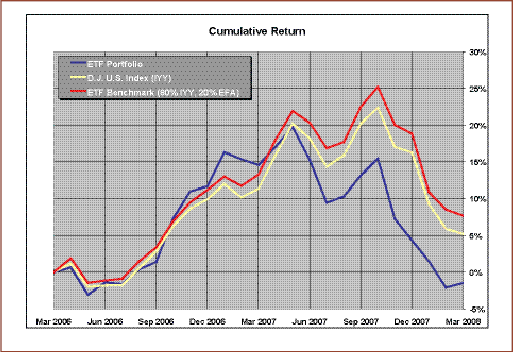
But I will report it without the spin: Our portfolio of exchange-traded funds (ETFs) continues to underperform the market as a whole, although the rate of underperformance has gone down and, in fact, year-to-date it is outperforming the market. Unfortunately, “outperformance” only means going down less.
The results of the Model ETF Portfolio can be viewed in Figure 1 and Table 1.
Value stocks, small-cap stocks and REITs, which are heavily weighted in our portfolio, had a long period of underperformance but are starting to again outperform the general market.
A Rough Start
It has often been said that the worst thing that can happen to new investors is to do extremely well in their first stock picks, thereby setting a level of expectation and over-confidence that cripples their investment performance for a long time.
|
Figure 1. Model ETF Portfolio vs. Benchmarks (Through 3/31/08)
|
|
CLICK ON IMAGE TO
SEE FULL SIZE.
|
|
We have had the opposite problem.
When we set up our experimental ETF portfolio two years ago, we chose our holdings based on long-term market behavior, only to have a period of unusual weakness where we had the most weight.
While there certainly was a temptation to make adjustments, I think history and research are on our side and that we are properly positioned for the long term. So we have made no changes in the investment direction of the portfolio, particularly in terms of the weightings by size and value.
While we feel comfortable with these weightings, we also want to make sure we have the best exchange-traded fund in each area.
Unfortunately it is difficult to make intelligent changes to our portfolio based on historical performance, because there is simply not enough history to evaluate. However, we will keep monitoring the specific ETFs we have chosen—particularly in light of the new possibilities (discussed below).
The Evolving ETF Marketplace
The development of the ETF market has gone through two stages, and is now moving into the third and final stage, which could lead to the gradual replacement of conventional mutual funds.
The first stage was the creation of the concept of the exchange-traded fund and its application to traditional stock indexes and, later, the bond indexes.
The second stage saw the creation of new, non-traditional indexes that could then be matched up with an exchange-traded fund. This led to a dramatic expansion of ETFs.
But even a created index has to be consistent with its rules over time, and thus still puts limits on the short-term investment decisions of the ETF.
Now the Securities and Exchange Commission (SEC) has approved the first ETF funds that are not index-based. Thus, we enter the third stage, where active ETFs can invest in a broad range of strategies and perhaps—the SEC willing—do everything a traditional mutual fund can do.
Advantages to the investor, of course, will depend on the fees charged by such funds, and by the tightness of bid/ask spreads. We certainly look forward to evaluating this new breed of fund. Ironically, the first active ETF was brought out by Bear Stearns, but it is a debt rather than an equity fund.
While the SEC is proposing new procedures for approving ETFs to reduce the backlog of applications, these new procedures may not apply to active ETFs and so they may appear slowly.
We will review the ETF portfolio again in the November AAII Journal, and should have more news about the new active ETFs.
In the meantime, you can keep up with changes at AAII.com.





MURALI P from OR posted over 4 years ago:
You need to log in as a registered AAII user before commenting.
Log InCreate an account