Quicken 2015 (Premier) for Windows

After a few years with minimal changes to its popular personal finance software, Intuit has made some valuable upgrades this time around.

Quicken, the popular personal finance software program, has released its latest update. While Quicken 2015 still offers the Starter & Deluxe editions, investors interested in tracking and managing their investments will need the Premier edition. The Premier version of Quicken for 2015 adds some new features that users may find useful. Versions are offered for both the Windows and Mac operating systems, though this review is limited to the Windows version. The Mac version of Quicken 2015 has received very mixed reviews, at best, as its functionality is limited compared to the Windows version. Many of the software features are carried over from the previous versions, so we only touch upon high-level features while highlighting on what’s changed.

In recent years, more and more competition has shown up to knock Quicken off of its perch. Services such as Mint.com, which Intuit bought, and Personal Capital continue to add services that directly compete with Quicken, but Quicken still easily retains the largest market and mind share of the personal finance software market. The software can be purchased directly from Intuit at Quicken.com for $104.99 (as of December 19, 2014), but can frequently be found for less at various retail outlets, including Amazon.com.

Quicken 2015 Premier, like all Quicken products, maintains bank-level security. Your information is encrypted and securely transmitted from your financial institutions into Quicken. This is unchanged from previous versions and is an expectation for any software or website that deals with the user’s financial information.

The installation process for me, as a new user, was flawless, and I was in the software within minutes of downloading it from the Quicken website. Other reviewers have confirmed a seamless experience. Connecting to one of my brokerage accounts was quite simple, and before I knew it my holdings were accurately imported and reflected in the Quicken program.

Nowadays, no desktop or Web-based software would be complete without applications for smartphones and tablets to support it. The app that Quicken offers, Quicken 2014/2015 Money Management, offers views and updates transactions in spending and investing, among other activities, but users have been a little disappointed. It’s currently rated two stars in the App store (iTunes). Most user complaints center on slow syncing to update information and limited functionality. I’m not sure that the complaints are entirely fair, given that we are talking about a free app to support the main software.

Spending and Saving Goal Setting

As with the previous versions of Quicken Premier, you will have to connect to a banking account to make use of the spending, bill-paying and planning features. Simply click the plus button at the bottom left of the program to add an account. A dialog box will appear that offers you the opportunity to add several different types of accounts.

Bill Pay

Quicken Bill Pay can do the same tasks you do with their online bill payment feature available from your bank, but Quicken charges $9.95 per month. Keep in mind that your bank offers similar bill payment features for no cost. Quicken Bill Pay provides for the immediate categorization of spending. This gives users a view of what types of expenses are driving spending. Although this feature is not unique, you can use your phone’s camera to take pictures of receipts for use later.

Additionally, under the Bills section, users can see projected balances adjusted for scheduled payments (Figure 1). In combination with the ability to set up alerts, I could see this being a particularly useful feature. For example, if your bank charges you a fee for having a balance of less than $1,500 at any point in the month, you can use projected balances and alerts to notify you before you get too close to that threshold. It’s a nice feature to have and a potential money saver.
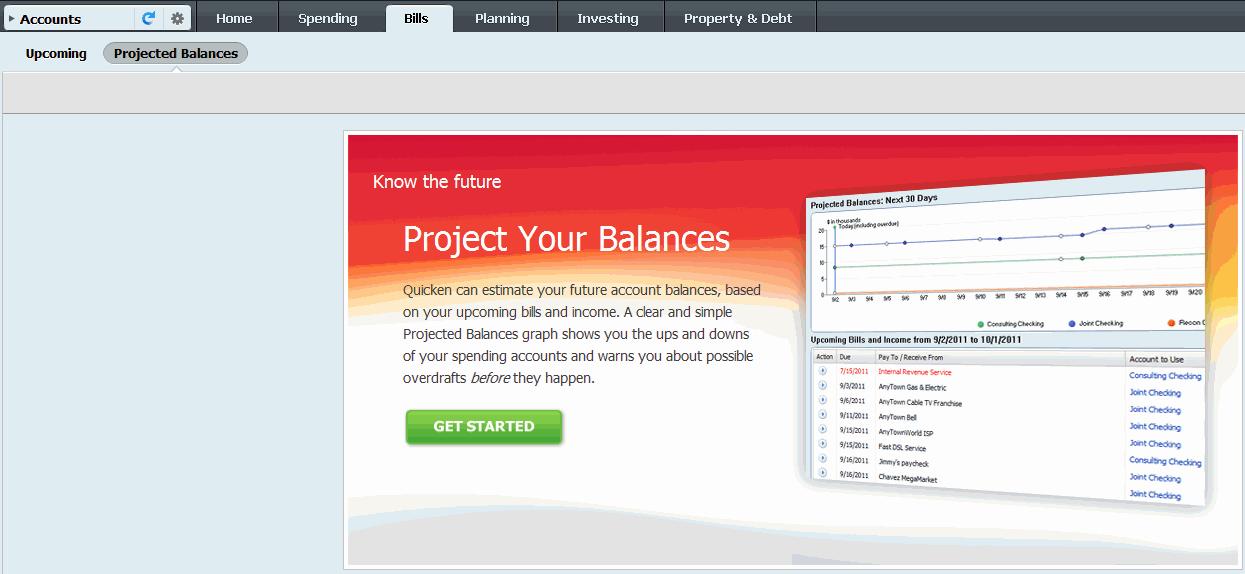
There are a few drop-down menus where you can customize the view. You can also switch between income and spending views, vary the period covered or even change the account (if you have multiple accounts).

Planning

One carryover popular among users is the Planning feature. Within the Planning feature is budgeting, debt reduction, lifetime planner, tax center and savings goals. The budgeting feature allows you to set a budget to suit your needs and then helps you stick to it. You can set an overall budget or set a budget for just one category, and then see at any point whether you are on or over budget (Figure 2). Graphics are used to illustrate budget/category status, which makes it easy for even the most inexperienced users to follow.
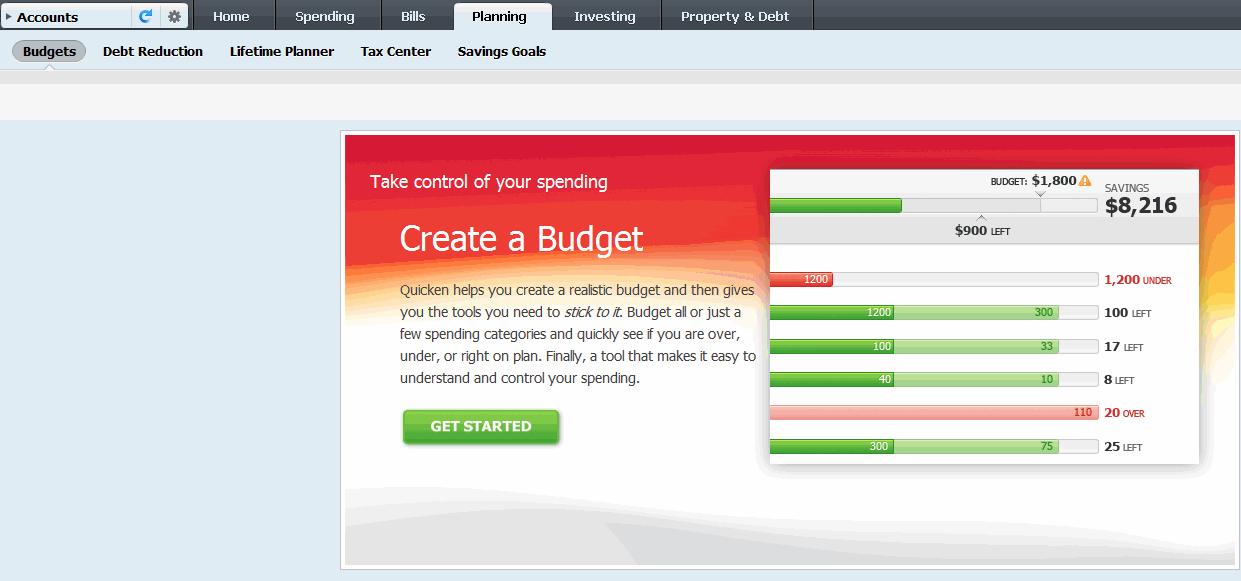
The debt reduction feature helps you plan how to reduce your debt load over time as well as save on your interest payments. It’s easy to change scenarios to examine the effect of interest savings on the monthly payment. This feature requires you to enter your credit cards and loans into Quicken.

The lifetime planner could be useful as you think about your financial future. This feature asks you questions about your income, tax rate, assets, assumptions about growth, etc., to help set a plan for your life goals. You can change assumptions and see how it effects planning and goals. You can also use the What If scenario builder to go into even more detail.

The tax center can help you get your head around your tax obligations, whether from income or capital gains.

Finally, the savings goal feature allows you to set amounts you’d like to save for specific goals such as vacation or a college fund. You can assign a monthly contribution amount and a target date and watch the balance grow over time as you close in on achieving your goal. Intuit describes it as a “virtual piggy bank.”

Investing

The Investing tab is the last tab on the right at the top below the drop-down menus. After clicking the Investing tab, four options are shown below the tabs; Portfolio, Portfolio X-Ray, Performance and Allocations. In combination, these tabs provide in-depth portfolio holdings details, such as geographic range, sector breakdown and more.

Portfolio & Performance

The Portfolio page serves as the ‘home page’ for the Investing tab and is the first thing you see. The page lists your connected brokerage accounts and shows holdings, shares, quotes, market value of position/account, etc. The Performance tab uses charts and tables to indicate returns generated by the brokerage account. A few options are presented, such as standard reporting periods and comparability with a few major indexes, but Performance doesn’t appear to be customizable otherwise. If any data is missing and the software has to adjust for that, a footnote will be shown to indicate that.

Users click to add an account and select from the brokerage accounts shown. All of the major brokerage companies are supported. After selecting your brokerage company, you simply have to input your login credentials for the brokerage account and Quicken will take it from there.

The software downloads your transactions from the connected brokerage account, which you can then choose to manually edit. You can also perform other actions, such as opening up a simple line chart, with a link for more complex charting options available. The link for the chart also shows you key statistics about your holding such as average cost per share, percent gain, price and shares held. The quotes are delayed by 20 minutes. The downloaded transactions also include interest earned as well as dividend payments. However, occasionally transactions do not come through as intended and manual adjustments must be made. Stock splits, for example, seem to confuse the software, which is disappointing given how often that could happen.

New Portfolio X-Ray Tool

The key new addition to the Investing tab is the Portfolio X-Ray portfolio analysis tool. If you are a paying user of Morningstar.com, you will be familiar with the X-Ray tool available on their website; it is the same tool that now appears in Quicken Premier (Figure 3). It is a very valuable way to slice and dice your portfolio to look at it in a number of ways. According to Morningstar, you can import a portfolio into the X-Ray tool, but many users find it difficult to do. The other option has been, of course, to manually create and input a portfolio, which many users find too cumbersome to attempt.
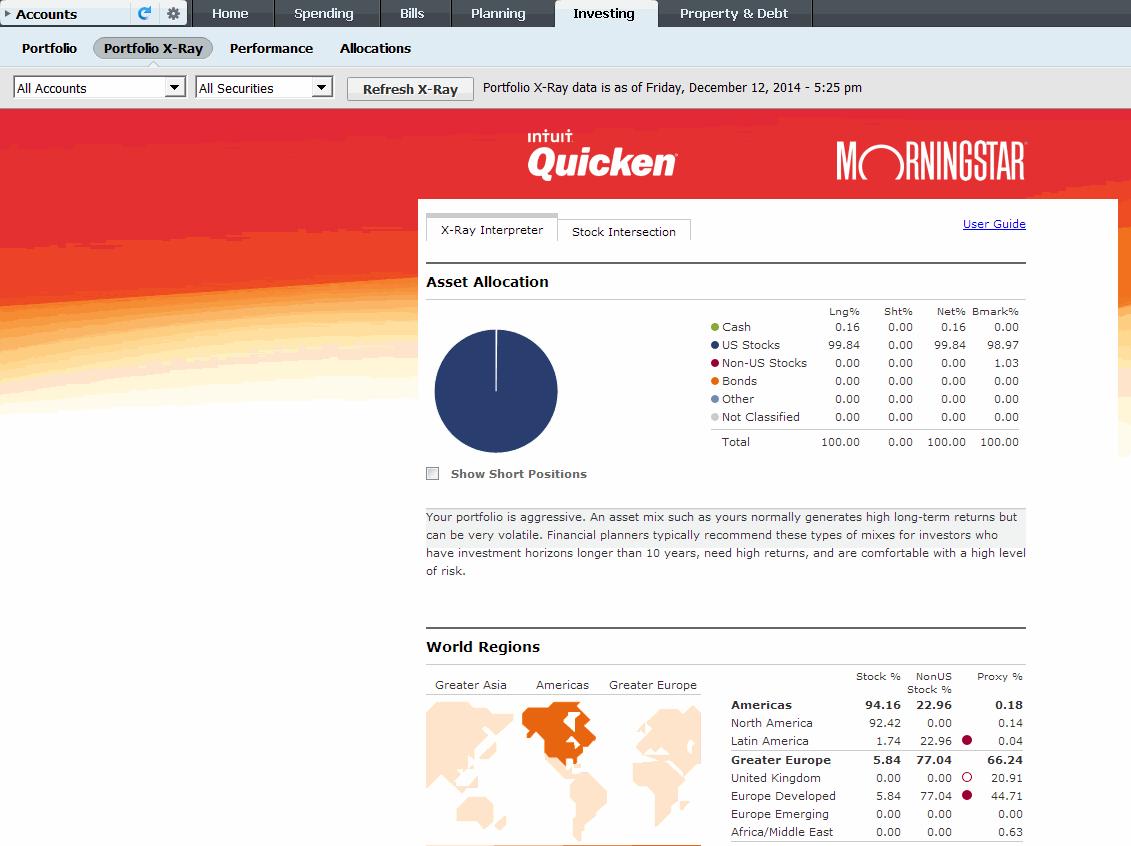
Those hurdles are now gone with the addition of Morningstar’s X-Ray tool to Quicken Premier. After you have successfully installed/updated Quicken Premier 2015, you must connect a brokerage account to the software to make use of the X-Ray tool.

When you initially select the X-Ray tool, it will have to validate your registration. However, the process is quick and shouldn’t take more than 15 seconds. You will also have to agree to Morningstar’s terms of use. After that, the tool will calculate the numbers for the selected brokerage account (if you have several accounts, you will have to select one). The X-Ray tool offers analysis ranging from asset allocation (U.S. stocks, non-U.S. stocks, bonds, etc.) to geographic distribution of your holdings to stock sectors and more. It is a fascinating look inside your portfolio. As expected, it correctly identified the portfolio as an aggressive small- to mid-cap portfolio when I connected Quicken Premier to the brokerage account for AAII’s Stock Superstars Portfolio holdings.

Allocations

One additional page of the Investing tab is called Allocations. Clicking that shows several pie charts. This appears to be an Intuit tool and not linked to the Portfolio X-Ray. While the X-Ray tool correctly estimated that the SSR portfolio was an aggressive small-cap/mid-cap portfolio, the pie charts under Allocations showed the same portfolio as more than 79% in large-cap stocks. That is concerning, as it clearly is not correct and makes any data produced on this page a little suspect. I will attempt to reach out to Intuit about this issue and will post any updates in the Computerized Investing blog.

Other Features

New Credit Tool

Another new addition to the Quicken Premier software is the free credit tool and credit monitoring, which Intuit does not charge extra for (Figure 4). It’s informational, meaning it provides static information about common factors that drive changes in your credit score as well as daily monitoring and alerts regarding identity theft. The sign-up requires some personal information, which you may have misgivings about providing, but the form is short and the software has bank-level security.

This tool is an interesting addition to the package, but not unique, as free credit reports are offered by any number of websites such as creditkarma.com. For some people it may be a value-add to have that information available in one place, but I’m not sure that it is a huge upgrade.

Reports

Another carryover feature is the reporting function, which allows a number of reports to be run with different views depending on your needs. From the Investing tab, for example, you can see a capital gains report, a transaction report or a cost basis report; most of the other tabs offer many report options as well.

Support

As with previous versions, there is a large and active Quicken community user base where you can find answers if you run into trouble. Alternatively, you can directly contact Intuit for help.

Should You or Shouldn’t You?

In summary, after a few years with minimal significant changes to the software, Intuit has made some valuable upgrades to Quicken. Most significant for investors is the addition of the Morningstar X-Ray tool, which is quite useful for portfolio analysis. Additionally, the free credit report is handy, though not an important upgrade to the software. Finally, the improved syncing of the apps, which users had complained about in their reviews of past editions, is a good sign that Intuit is paying attention to customer feedback.

In the end, whether it is worth it for you to upgrade to Quicken 2015 depends on your needs. If you already pay for Morningstar.com Premium (or another portfolio analysis tool, see Best of Web for options) separately and have a previous version of Quicken that works for you, then you may opt to skip this upgrade. However, if you don’t currently do any portfolio analysis and have an older version of Quicken, then Quicken Premier 2015 may be worth considering.

Discussion

Fred Dunfey from AZ posted over 11 years ago:

The Mobile App is advertised as key enhancement/functionality of versions of Quicken14 and 2015. It is not really free, you pay for it by buying Quicken newer version The Mobil App excludes all financial investment accounts. This is after two years! Perhaps it's because reviews such as this one are superficial rather than doing thorough reviews. The only reason I upgraded to Quicken 2015 was so my Wife could see our net worth and our whole financial situation on her IPAD. The mobile app fails miserably. This review doesn't reflect the ineptitude of Intuit from an investors point of view.


Tony Hausner from MD posted over 11 years ago:

Is there a comparison of the different investment software available from AAII or other sources? I like the idea of financial planning component. How does it compare to other such financial planning programs.


Jeff David from IN posted over 11 years ago:

Have they fixed all of the bugs from the 2014 version? 2014 is a buggy piece of crap, crashing at least once per week and having simple things sometimes just not work (like Ctrl-V for paste). Intuit isn't just inept from an investors point of view, it is inept from a programming point of view. The quality of the software has been going downhill since the 2011 version. Yes, they have added feature but at the expense of stability.


Jeff David from IN posted over 11 years ago:

Oh, and if you do not believe me about the instability of Quicken 2014, here's a list of 27 crash and freeze-related bugs Intuit says they have fixed in 2015: Intermittent crash while validating and repairing after sanitizing a data file Quicken crashes when user performs One Step Update for the first time in a day. Quicken crashes because, 'CheckAutorization return an exception when it fails to access the file “atsd” from path Quicken crashes during 'Validate & Repair" when Quicken failed to open the DB. Quicken crashes if user clicks 'Close' button while add account process is 'in Progress'. Quicken crashes if we stop update now while applying online patch Quicken crashes intermittently during conversion, while opening, closing and while working on a large data file (Data file specific) Quicken crashes on "Bill and Reminders" view while hovering a mouse on calendar Quicken crashes on opening a particular data file Quicken crashes once while editing tenant from Tenant List while automation execution Quicken crashes when "No" is selected for amount confirmation for a online transfer transaction. Quicken crashes when canceling restore backup file. Quicken crashes when try to create new data file with long name Quicken crashes when user closes 'Resolve Placeholder Entries' dialog Quicken crashes while closing (after adding investing account) Quicken crashes while doing One Step Update for Investment E*TRADE Account Quicken crashes while launching Quicken crashes while opening a particular data file Quicken crashes while validating large data file Right Click "New Security" causes Quicken to crash. While creating Loans account, Quicken crashed. Quicken freezes in rental properties Quicken freezes while opening account register after completing One Step Update. Quicken goes in the hang state after clicking on the Capital gain Estimator(Data file specific). Quicken goes in unresponsive state if user deselects all quotes and tries to update them from investing tab Quicken goes into non-responsive mode while switching between two files and doing One Step Update with different Identity & Access Management ID Quicken hangs when use closes different call out windows using 'Alt+F4' key


Bruce Wicklund from CA posted over 11 years ago:

The review should not have been written by a first time user. The incremental improvements could only by evaluated by someone who has used Quicken over time. 90% of this article simply repeated what users already know.


Long Time Quicken User from VA posted over 11 years ago:

Since Quicken for Windows 2011, I have only updated to the year-old version which gives a year the bugs get ironed out. (And the older version is cheaper.) Quicken makes you upgrade every three years or you can't do Bill Pay and some other things. In 2014, I upgraded to 2013. In 2016 I'll upgrade to 2015. etc. This also gives you a chance to review the blogs for the stability/functionality of the release you're going to. The 2014 version had lots of new "features" and bugs when first released and some are still there. Don't even consider the Mac version (Quicken Essentials).


Honest Conn Man from CT posted over 11 years ago:

Unfortunately, the best parts if this review are found in the user comments. As previously noted, writing a review of this long-neglected product as a first-time user was unduly difficult -- and it showed. Intuit has NOT been very receptive to feedback. Every three years, users are forced to upgrade to keep the update function working. And, when updating after a three-year hiatus, the user has been finding that he has simply repaid for the product in exchange for a few cosmetic changes. Investors, in particular, have not been well served by the new versions. When will Quicken handle options with some grace? Truly, the program has become not more useful with each new version but less useful. As for Turbo Tax . . . O.K. I won't go there.


Michael Clohossey from CA posted over 11 years ago:

I've been upgrading Quicken Premier annually for many years and agree with the comments above. I mainly use it to have one record of different investments/accounts. I find it difficult to track all of my stock investments though. Stock splits have been an issue for many years and they're not fixed as far as I can tell in the latest version. I find myself having to do more manual adjustments than I care to do and some can't even be completed. Bank account downloads aren't always clean either as Intuit doesn't have contracts with all banks for all accounts. I have gotten the run around for 3 years from Intuit and one of my banks about why downloads fail. They each claim it is a technology matter at the other that prevents automatic downloads. I surmise it is a conflict over revenue, timing of software upgrades, and new bank security measures that are trying to close potential back doors into bank records.The manual download function worked well up to the 2015 release but I've found some bugs I've reported to Intuit. Intuit also doesn't have acess to 401k investments for auto download as far as I can tell so it makes it hard to say this is a comprehensive software package that you can use to have a complete view of your investments. If someone feels differently please comment further. Thanks.


Robert Lassiter from IL posted over 11 years ago:

I use financial software primarily for tracking investments and networth. I'm not interested in budgeting or debt reduction. I used MS Money for many years even after MS stopped supporting it and providing auto-generated downloads. I switched to Quicken 2014 Premier to regain the software initiated downloads, but found many brokers and financial institutions do not allow auto downloads for security reasons. I have to download manually anyway. My reason for switching was voided. MS Money had its own idiosyncrasies, but Quicken has its issues, too. I don't have a smart phone or other devices, so Quicken 2015 is of no interest to me. When my three year period is up, I might go back to Money 2010.


Kenneth Woltz from FL posted over 11 years ago:

Needs improvement for Home and Business, P&L and cash flow need to be better designed. The Balance sheet is almost worthless and does not even report brokerage accounts correctly


GB from NJ posted over 11 years ago:

This is one of the most superficial reviews I have come across. Quicken has been unsuccessful in their efforts to provide a working mobile platform for several years now. In addition, they chose an architecture that forces all transactions through their servers rather than allowing direct access to the brokers and financial institutions. It is due to this choking point that Quicken controls users and enforces sunsetting and new version purchases. Quicken may be the market leader, but it definitely has its problems, none of which are addressed in this review.


Ronnie Spruell from LA posted over 11 years ago:

I haven't purchased Quicken 2015. I am running Quicken Premier 2014. There has been no improvement in Quicken's interface with financial institutions and brokerages in several years. IMO, the user interface gets worse with each new version. Quicken does not work well with Vanguard. The account set up at Vanguard seems to really confuse Quicken. There are a lot of manual adjustments that have to be made. I have NEVER been able to reconcile my Vanguard accounts in Quicken. Ditto with FolioFn. Fidelity works very well with only minor adjustments. Quicken doesn't handle options very well at all. I am disappointed that the X-Ray only works with one brokerage at a time. This seems like a waste of time. Fidelity offers a view of all accounts. I see that Quicken Premier 2015 has a rating of 3.5 stars on Amazon. This is very good for Quicken at this stage of the release cycle. I think I will pass on the upgrade.


Timothy Wheeler from PA posted over 11 years ago:

I agree with the comments here. How can a program as old as this not provide a better user experience? While I find the "update" features are working nicely now, the "reports" are maddeningly hard to customize. i use the program on my computer, so a mobile ap is not of interest to me.


Bud Sloan from Nevada posted over 11 years ago:

These comments mirror my experiences as well. I too am a former MS Money user who didn't know how good he had it until Microsoft decided it didn't want to compete with Intuit's marketing on applications software. I will try to keep my comments from becoming simply "sour grapes". First, I have quit using the Premier version of Quicken, because it doesn't really "do" anything that I am interested in that I can't do with the Deluxe version—and the price difference is not insignificant. I have used Morningstar's X-ray tool which is good for showing what is in mutual funds and ETFs but I found little practical use for it for the reason, previously mentioned by others, that it can only be used on one account at a time. Between my wife and I, we have five investment accounts (at one broker, for Christ's sake); one taxable investment account, two traditional IRAs, and two Roth IRAs. So, real world, it is of little value. Second, any serious investor/trader needs much more in the way of charting, analysis, and screening tools than the Quicken products provide. For net worth: I really don't care about tracking non-investment assets and liabilities like home, car, credit cards, checking and savings, etc., and have created a spreadsheet that shows me exactly what I want—it is even more colorful than what Quicken offers. And beside that, one doesn't need the Premier version to track those anyway. Third, anyone who relies on Quicken tax related data, whether downloaded to Turbo Tax or otherwise, without verifying it with end of year brokerage statements is just begging for a ton of IRS penalties with interest. So, to me, that is little more than Intuit marketing. And since I brought up Turbo Tax, I think it is a very good product; definitely superior to the closest H & R Block product. However, once again, Intuit is over-selling—and over-pricing—Turbo Tax Premier when compared with the Deluxe version. The only significant different being in the investment "help" area. And who needs Turbo Tax help when Google is only a quick away. Please note, I am referring to their handling of security investments only; I have no first hand knowledge of what can be done as far as rentals is concerned.


Gale Hamilton from VT posted over 11 years ago:

Great comments. This article should not have been written by someone unfamiliar with previous versions of Quicken. I too buy at least a year old version of the software because Quicken is very slow to correct bugs. I, too have endless trouble with automatic downloads from my brokers and have used Xray from Morningstar but found it not very good at aggregating asset allocation info for all the different accounts I have. And of course Quicken has never seen the need to be able to handle options trading.


J Patek from NY posted over 11 years ago:

I agree that this was very disappointing review. I just wish that Intuit would just do one update that fixed all the problems that seem to be there year after year. I'd be much happier being forced to upgrade if there was some value to the upgrade. Instead they add features of questionable value and generate new problems. I think they feel the need to use the features to justify the forced upgrade. Maybe AAII could interface with Intuit so experienced users could provide the fixes needed and then Intuit could focus on valuable fixes. I am sure a good list could be provided. Some other problems which waste my time are bond sales and purchases with transfer to the cash account which seldom work. A reconcile which often does not sum correctly if there are transactions that are after the statement date Long delays if one tries to enter prices in the portfolio.


Fred Brockman from FL posted over 11 years ago:

I also agree with the above. Quicken needs to be reviewed by someone who knows its history, quirks and limitations. This is an ancient response I made to Intuit: 2006 Quicken Questionaire One used to be able to create a scheduled transaction from a memorized transaction making the process quick and painless. Now, even after checking help, it appears one has to completely redo the process, even to addresses. I started using Quicken with DOS version 3 and followed it to ver 8. I bought the totally worthless Quicken for Windows ver 3, upgraded to ver 5 and finally found QfW ver 6 pleasant to use. Due to emergent bugs and the version being no longer supported I had to upgrade to QfW 2000 and then 2004. Suspecting that QfW 2004 Deluxe may have been made brain-dead, I bought QfW 2005 Premier Home & Business. And yes it does work better than the Deluxe version. BUT, &^%)($#@!, things that used to be there are gone! When I upgrade MS Excel I don't find 17% of the functions from the previous version gone and 17% more added as NEW!!! that were present in even earlier versions. I know this will have no effect on Intuit but I hope a better written version of this letter to the mastheads at PC Mag & PC World will have some effect on their glowing, airbrushed reviews of Quicken. 1)Loss of functionality. When I upgrade MS Word, Excel, etc. the new version has all the functionality of the old version plus the new features. Quicken loses certain functionalities in the new version only to have them reappear in a year or three later as NEW! 2) Ending support of QIF files sucks. Can't even export data from one account to another. I bought and am now using MS Money for exactly this reason - I can download info from my credit union, which does not support your new for-fee standard. I tried Money a few years ago - it didn't have anywhere near the functionality of Quicken. Now it is close and maybe in a few years will catch up completely. 3) Maybe I was spoiled by the DOS version of Quicken but Quicken for Windows has never had decent print output. Whenever I want to print a listing, I export the data to Excel. ============ I doubt that much has changed in 8 years. In retrospect I wish Microsoft would release the source code for Money to the open source community and see if we can come with a decent alternative. GnuCash is out there but I'm not sure how much it offers to investors.


Donald Jones from VA posted over 11 years ago:

Totally unhelpful review. With so many AAII folks using this product, including me, for years, next time a new version is reviewed, how about having a long-time user do it and let us know if any of the true problems have been addressed. Better yet, how about contacting Intuit on our behalf and get a response to when some of the real and persistent problems with this product will be addressed. AND/OR give us an alternative product to use. I would love to get off of Quicken, but I can't find anything else out there that is better. At least Quicken downloads my daily transactions from all banks/brokers and lets me look at a simple register for each account. That's about it. Messing with everything else, like reports, analysis, is just an exercise in frustration.


Steven Helton from IN posted over 11 years ago:

Great comments from all the users above. I upgraded to Premier 2014 as soon as it came out last year and was greatly disappointed. It took about 5 or 6 month of updates and bug fixes from Quicken before it was even close to usable. I don't even use it for investment tracking, just for checking and even that is not nearly as good as it could be. I won't be upgrading for at least 6 months and may just skip a year this time.


Hareesh N. Jayanthi from Illinois posted over 11 years ago:

Thanks to all for your comments. Believe it or not, I do read what people have to say and try it to use to make what I write better. I will definitely keep your feedback in mind moving forward. As far as the product itself, I was writing a high level review about my experience with it with particular reference to the investments section. I mentioned some of the issues with the product but my intent was to highlight what offerings there were and what bumps users might encounter. I agree that Intuit has some work to do to win back trust given some rather questionable releases of late. Instead of adding features, I think debugging should be a higher priority. For those who are interested in free web based alternatives, a website like waveapps.com (“Wave”) allows personal investment tracking and budgeting and might be appropriate for some. If there is interest I would be happy to do a review of Wave. Keep the comments coming! Hareesh Jayanthi


Sir Dodo from CA posted over 11 years ago:

The review missed another key feature for many users: support for Windows scaling. This enables Quicken to present readable windows when using high resolution monitors. I do not own Quicken 2015 and so I have not seen the new capability, but when I upgraded to a high res monitor a few months ago, Quicken 2013's presentation on that monitor was by far the most annoying of all the programs I own (and I have a lot), partly because I use Quicken so much. (I have since returned the monitor.) Unfortunately, the new X-ray function does not support Windows scaling. A separate point, I disagree with the author's contention that poor reviews on line are unfair when software is 'free'. If the function of an app is poor, it deserves a poor review, no matter what the price. A final thought: Quicken is essential to control of my finances and is central to big financial decisions that I make. I believe that Intuit have been treating the product as a cash cow for a decade or more - in other words, they take profits generated by Quicken and invest them in other businesses at Intuit, while minimizing the investment in Quicken itself. The problem is that there are no good alternatives to Quicken if quality slips further (if there are, I don't know of them). The availability of a reliable program like Quicken has more practical importance to me than a lifetime of AAII Computerized Investing issues. I would like to see AAII (and CI especially) step up to advocacy: promote alternatives to Quicken and highlight the need for improved Quicken quality. The annual review is a golden opportunity to do this. AAII missed the boat this year.


Peter Gollon from NY posted over 11 years ago:

I have been using 2013 Premier, and only upgrade when I am forced to do so every 3 years in order to get auto price download for listed securities. My main gripes are twofold: System often goes into an infinite loop when manually entering transactions, and I have to force a program shutdown and then restart it. The security symbol (stock ticker) is a field that can be displayed onscreen but NOT shown in a report, which sometimes makes it difficult to fully understand exported data: which class of mutual fund or stock is that, anyway? I've complained about this for years, but they ignore such an easy fix. The situation with bonds are even worse. Since I sometimes hold multiple bond issues from the same issuer (think munis), displaying the CUSIP is a good way to avoid ambiguity between several similar issues. But the program won't let you enter security symbols (i.e. CUSIPs) for "bonds". I have to create the security as a "stock", enter the CUSIP as the security symbol, then Edit Security Details to change it to a bond. How stupid is that?


Ronald Marr from IA posted over 11 years ago:

I have used Quicken since DOS days but finally gave up on using any version of Quicken to try and track investments. After countless battles with Quicken 2013 in trying to restore data, faulty updates, corrupted downloads and you name it, I finally moved our investments over to a program I found on AAII - Investment Account Manager (IAM). Unfortunately it took considerable data input, but the surprise was that IAM support was readily available, personal and helpful. In nearly a year of use, IAM has been flawless in downloading from Scottrade, Ed Jones and the major mutual fund families. I've relegated Quicken to a fancy checkbook register. You can learn about IAM and another portfolio program, Fund Manager,(both programs offer free trials) at: http://www.aaii.com/computerized-investing/article/2-the-top-portfolio-management-software


Robert Wilson from CA posted over 11 years ago:

Adding to the customer views above based on 25 years of Quicken use: AAII is a place I turn to for customer centric views. AAII failed me on this one. Intuit continues to raid classic accounting features (ex. report generation feature) in favor of new glitter (ex. cloud services). This leaves a hole in the market that cries for a customer centric mainstream household accounting product. I hate to admit it, but Quickbooks may be the next alternative I look at. Regards, BobW.


A Prophet from OR posted over 11 years ago:

I've use Quicken for several years now and I would consider it a "love hate relationship" at best. For example, it does a very poor job of tracking qualified dividends, probably because there is no uniform way for brokerage houses to report what is a qualified dividend vs. ordinary income to Quicken. And that's important when one is doing tax planning... too bad. So, Quicken next to useless as tax planning tool. What's now obvious, is Intuit is milking this product for profits and NOT making important/vital changes needed keep it current. Wake-up Intuit. Fix these problems or some competitor will come-along with a better solution. cheers, Andy


GURUPERF from CT posted over 11 years ago:

I missed this review when first posted and just caught up with it today. I agree that it is at best a superficial review, and with many of the comments that paint Quicken as an old program which periodically gets a new coat of whitewash, without any substantial improvements. As a former MsMoney user, I was forced to switch to Quicken when Microsoft gave up the battle. Not that MsMoney was the be-all & end-all of personal finance programs, but it did have good basic functionality, without the constant introduction of bugs as it was continually upgraded. As a former (I.E. retired) investment professional, the reporting is so simplistic and un-customizable (despite the "customize" tab)as to be virtually worthless. As one commenter said, it is basically a checkbook balancer - although they have not managed to get my bank (Webster) into their reporting network, forcing me to export and import to balance. I have not had the issues someone reported regarding Vanguard, which is always in sync, and the program works fairly well with Schwab although if you update on the day of a trade it causes some kind of balancing error. Quite frankly, I would switch in a minute if something better were out there, but I co-exist with Quicken because unfortunately, there's not. Not exactly a ringing endorsement, Intuit, when my rating would be, at best: almost barely adequate.


Charles Layfield from PA posted over 11 years ago:

I share your pain. I have used Quicken since Quicken for DOS (circa 1985). The product has gotten more sophisticated and more buggy. Intuit does not give one whit about whether they have a buggy product. All versions of Quicken are released as Beta, even though they charge full price. I happen to be lucky and usually change every other year. I use Quicken Rental Manager. It seems to operate without some of the bugs mentioned above, however, with respect to investments, a little bug can go a long way. Some downloads duplicate a position; some eradicate a holding. I have data from 1971 so I am their hostage. I also use IAM from Quantix. It does not do anything other than portfolio management and rarely gets stuck. However the Willms brothers are releasing new version about every two months with corrections or enhancements. Quicken is the best argument I can think of for competition and the free market. Their product sucks but with such a large installed base, it might as well be a public utility (relative to ease of entry).


Mary Ann Edson-Plumb from CA posted over 11 years ago:

I've used Quicken since 1991. I needed to upgrade soon as I was running 2012. I upgraded to 2015 about a month ago (partly encouraged by this review), and have been perfectly happy with it. There are no bugs that I've found in daily use of the Premier version. That said, I don't use the mobile app. I already had a Morningstar Premium account, so I didn't need the M* add-on but it is nice and easy. Overall, the investment functionality works fine. There are certain functions (such as the way they handle spin-offs) that could be better, but still are fine. Yes, Quicken isn't perfect because they are trying to satisfy both heavy users with many investment accounts and those who just want to track their checking accounts. They straddle this divide fairly well.


Kurt Salm from IL posted over 11 years ago:

I am new to AAII. I found the long litany of comments on Quicken 2015 extremely enlightening. I was just about to click the Amazon buy button for both the premier edition and the "official" guide book because I wanted to get serious about tracking my investment and checking/savings/credit accounts all in one place. I'm glad I avoided the click. I read glowing reviews on Amazon (I never buy ANYTHING from Amazon without looking over the reviews), but they did not ring true given my past experience with Quicken going back to DOS versions. I have been an on again, off again Quicken user because of the same frustrations voiced by so many of the previous comments. Bottom line is I will not be getting Quicken 2015 for anything related to investments. Back to basics as they say. Hello Quicken Basic (maybe).


Don B from VA posted over 11 years ago:

Mint (owned by Quicken) has a lot of functionality and works better than Quicken Deluxe or Premier for transactions and budgeting, and it is free. The investment section of Mint is good enough. Import from banks, brokerages and mortgage company is good. Transactions can be modified, remembered and split as needed. I was a long time user in the early days (even have the quicken credit card), but Mint.com is in my que. Quicken does not appear to learn from Mint...perhaps due to no competition.


Jackie McClellan from IL posted over 10 years ago:

Since there was so much feedback involved in this article, is there anyone who commented that would be willing to write a review for Computerized Investing. Many of you had excellent examples of some features the software lags, errors that you find and more. I am interested in getting someone to write a review that is very familiar with the software and has been using it for a long time. If you are interested, please email me at CI@aaii.com


John Izydorczyk from FL posted over 10 years ago:

I have been a Quicken user since 1987. The present size of my data file is 110 MB with over 60,000 investment transactions. With few exceptions I have upgraded every year simply for assurance that I had the latest and the best - yes, Quicken is that important to me. Even though Quicken Premier has all the features I need, in most cases I purchased Quicken H&B because it is less expensive than Quicken Premier when sold by vendors. Why, I have no idea. Do I like Quicken? Absolutely, for the price there is nothing that even comes close to the usefulness of Quicken for tracking investments and for its graphic interface (GUI) with Windows. Before continuing with this review it is important that readers be aware of how I use Quicken. I absolutely never get investment downloads from any institution, all of my Quicken entries were inputted manually. Why? Simply because I consider doing it this way, manually, a check to assure myself that my brokerage/bank did not make a mistake. Have I had problems with Quicken? Yes, and I can categorize all of them under three headings: 1) lockups while doing transaction, 2) lockups while doing reports, and 3) lockups while making changes to my Securities List. By lockups, I mean that the program freezes and must to closed and reopened to correct the condition. Let's get this out of the way. Never, never, have I lost data in my Quicken accounts. Every lockup resulted in total recover after a restart. 1) Lockups When Entering Transactions: These lockups can be totally eliminated and prevented by understanding one thing. Although not published by Quicken, Quicken has a limit to the number of transactions in any one account. I have found that limit to be somewhere between 2,000 and 3,000 transactions. How to circumvent the problem? Simple. Open a new account. For example, if I have an account named John, I simply open a new account named John1, John2 etc.. When you open the new account you tell Quicken to transfer all assets from the old account to the new account and Quicken does it in one stroke and automatically keeps track of all relevant information such a "lots". I believe that many of the complaints levied against Quicken are due to this one problem that is so easily rectified. 2) Lockups when doing reports: All of the lockups I encounter when doing reports are related to two things. The large size of the report, and any attempt to copy the large report to a file or the clipboard. This problem remains unresolved up to my present 2015 Quicken. My temporary solution is to make the reports smaller. For example, if I want to export all of my transactions to Excel via clipboard, I do it by chopping the reports over time. Like dates 1987 to 2000, 2000 to 2010, and 2010 to 2016, followed by a cut and paste in Excel. Hopefully, Quicken will resolve this some day since there is no excuse for this given todays' computers that contain 16 or more GB of RAM and HDDs' in the Terabytes. 3) Lockups While Making Changes to the Securities List: Once again I believe that this problem is due to the size of my Securities List, presently at 2010 which is over the suggested (soft) limit published by Quicken. If I am correct about the cause of this problem, there can be only one solution for me - Start a New File. Oh, how I would hate doing that! To be deprived of linking all of my historic performance reports would be unbearable. Hopefully, Quicken will fix this problem before I am forced to start a new file. Something I realize is just Hopeful Thinking. Conclusion: Through the years Quicken has met my needs for tracking my investments and bank accounts. Have I ever attempted to find a substitute? Yes, but every attempt to find a substitute has lead nowhere unless I am willing to shell out $1,000 or more. So call it cheap love, and call me addicted, but Quicken is for me.


Terry I from AZ posted over 8 years ago:

I have been a satisfied user of Quicken for many years, using it mostly for the check register and reporting functions. Currently using Quicken 2015 Premier. I do not need most of the investment functions. With Quicken 2018 now using a subscription payment model, I am going to seriously look for a cheaper alternative to managing my multiple accounts. Any suggestions?


You need to log in as a registered AAII user before commenting.
Create an account

Log In

Get your free copy of our special report analyzing the tech stocks most likely to outperform the market.

Download the FREE Report Here: