


In the September 2003 AAII Journal, I promised to be more specific about the Individual Investor’s Shadow Stock Portfolio (formerly the Beginner’s Portfolio) that we have been managing for almost 11 years.
This column fulfills that promise. In it, I’ll tell you what it holds, how it has fared and what its rules are. Most importantly, I want to focus on how the philosophy of the Individual Investor’s Shadow Stock Portfolio can help you invest in the micro-cap value sector of the market. For that reason I am not going to review the history of the portfolio. However, the April 2003 issue of the AAII Journal has extensive coverage of the portfolio’s history (“The AAII Beginner’s Portfolio: An Annual Performance Review”).
A Look At the Portfolio
We have made some changes in the decision rules over the last six months, and so our portfolio is in transition now and has stocks selected under older rules, along with newer stocks. Figure 1 shows the current criteria as set up in AAII’s Stock Investor Pro stock screening program. The box on page 24 outlines the current purchase, sale and management rules for the portfolio.
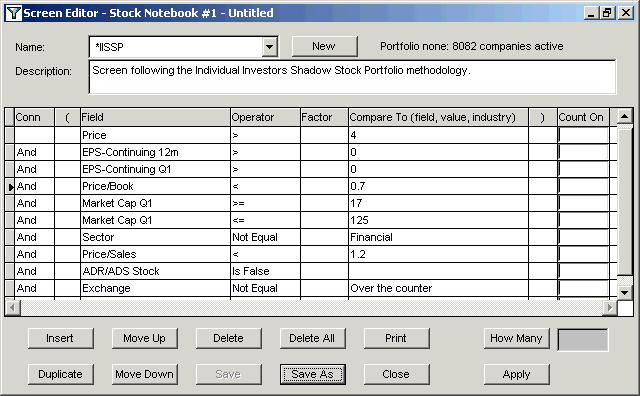
The current holdings are listed in Table 1. Recent purchases, chosen on the basis of the current selection criteria, are listed separately in the lower part of the table. In addition to the descriptive data there is a Notes column that indicates if the stock would currently qualify as a buy, if it is on probation, or if it has some other special condition.
Implementing the Screen
A major part of the process of selecting stocks under the rules can be accomplished by using the screens in Stock Investor Pro. In fact, this screen is now a standard screen that can be selected in Stock Investor Pro (see Figure 1). However, these same criteria can also be used in other screening programs that are available.
Using Stock Investor Pro, you can put stocks you select into a portfolio using Portfolio Editor. You can then run the screen in successive periods on stocks you hold to see if they still qualify and check for sell criteria.
Having said all that, I want to make it clear that this is not intended to be an advisory service. If we all tried to buy these micro-cap stocks at the same time, we would distort the prices and reduce the effectiveness of the approach.
Because of this, I feel the Individual Investor’s Shadow Stock Portfolio should be the beginning of the selection process— but not all of it.
Variations on the Philosophy
There are a number of ways the philosophy of the Individual Investor’s Shadow Stock Portfolio can be implemented without everyone buying the same 30+ stocks at the same time.
Table 1. Individual Investor's Shadow Stock Portfolio: Current Holdings
| Ticker Symbol |
Company Name | Exchange | Notes |
| ASV | AG Services of America | NYSE | |
| AXR | Amrep Corp. | NYSE | |
| AVL | Aviall Inc. | NYSE | |
| BONT | Bon-Ton Stores | Nasdaq | currently qualifies |
| BUCA | BUCA Inc. | Nasdaq | |
| CVCO | Cavco Industries | Nasdaq | currently qualifies |
| DUCK | Duckwall-Alco Stores | Nasdaq | currently qualifies |
| ELT | Elscint Limited | NYSE | on probation |
| ESP | Espey Mfg. & Electronics | Amex | |
| LTUS | Garden Fresh Restaurant Corp. | Nasdaq | being bought out |
| GEHL | Gehl Co. | Nasdaq | currently qualifies |
| HUBG | Hub Group Inc. | Nasdaq | currently qualifies |
| IPK | Imperial Parking Corp. | Amex | |
| INMD | IntegraMed America Inc. | Nasdaq | currently qualifies |
| LDSH | Ladish Company | Nasdaq | currently qualifies |
| MARSA | Marsh Supermarkets | Nasdaq | currently qualifies |
| MDTH | MedCath Corp. | Nasdaq | |
| MGPI | MGP Ingredients | Nasdaq | |
| NWPX | Northwest Pipe Co. | Nasdaq | |
| ORCT | Orckit Communications Ltd. | Nasdaq | |
| PMRY | Pomeroy IT Solutions | Nasdaq | |
| QFAB | Quaker Fabric Corp. | Nasdaq | currently qualifies |
| SFP | Salton Inc. | NYSE | |
| TESS | Tessco Technologies | Nasdaq | |
| WLFC | Willis Lease Finance Corp. | Nasdaq | currently qualifies |
| ZAP | Zapata Corp. | NYSE | |
| Recent Purchases | |||
| ANS | AirNet Systems | NYSE | currently qualifies |
| CPAK | CPAC Inc. | Nasdaq | currently qualifies |
| HGGR | Haggar Corp. | Nasdaq | |
| HDNG | Hardinge Inc. | Nasdaq | currently qualifies |
| ISH | International Shipholding Corp. | NYSE | |
| MRI.A | McRae Industries | Amex | |
| MLT | Metals USA | Amex | |
| TTES | T-3 Energy Services | Nasdaq | currently qualifies |
| USLM | United States Lime & Minerals | Nasdaq | currently qualifies |
First, investors can use different timing. For the sample portfolio, I buy and sell quarterly unless I am making a rule adjustment. I usually buy early in November, February, May, and August. You can choose your own time period.
Second, unless you have a continual inflow of money, you will come to the point where you are fully invested and can only buy when you have sold a holding. After a while, different investors will be on different schedules.
Table 2. The Individual Investor's Shadow stock Portfolio: Historical Performance (through 9/30/03)
| Portfolio | 1993–2002 | |||||
| 10-Year Return (%) |
10-Year Risk | 2003 YTD | 1-Year Risk | |||
| Volatility* (%) |
Risk- Grade** |
Return (%) |
Volatility* (%) |
Risk- Grade** |
||
| Individual Investor’s Shadow Stock Portfolio | 13.3 | 17.3 | 86.5 | 32.6 | 16.6 | 83 |
| Vanguard Index 500 Fund (S&P 500) | 9.0 | 20.0 | 100.0 | 15.9 | 19.6 | 98 |
| Vanguard Index Tr Small Cap Fd (Russell 2000) | 7.5 | 14.8 | 74.0 | 28.9 | 21.8 | 109 |
| *As measured by standard deviation—how much actual returns varied around the average from year to year. **RiskGrade is a measure of risk for any portfolio, and can be found at the RiskGrades Web site (www.riskgrades.com); it is free of charge for individual investors. It measures the volatility of a portfolio relative to all stocks worldwide during normal market conditions. For example, a portfolio RiskGrade of 77 implies it has a risk 77% as high as the average risk of all equities in the world. The RiskGrades Web site provides the mathematical details of the approach. | ||||||
Third, the one part of the decision process that is open involves the liquidity of a particular equity. Depending on the size of your portfolio and when you tend to act, there will be a difference in your interpretation of which stocks can be purchased without distorting the price.
These are variations that occur naturally. However, I believe that you should also create your own variations, using the Individual Investor’s Shadow Stock Portfolio as a general guide. I have managed up to $1 million with these rules. If you are managing less than $100,000, you have more flexibility—I believe you can find reasonable bid/ask spreads in stocks with lower prices (but not below $2.00). You can also select companies with capitalizations that are below $17 million, perhaps as low as $10 million.
You also may want to try different criteria that use your own market knowledge or adjust your micro-cap portfolio to tie in with your other holdings. If you apply other criteria, you can increase the price-to-book ratio, but don’t go over 0.90 or it is no longer a true value stock.
The price-to-sales ratio can be increased to 1.5 and still be considerably below average.
You may have regional preferences. In the Individual Investor’s Shadow Stock Portfolio, foreign stocks and ADRs are eliminated, mainly for accounting reasons. However, you may wish to include them.
Changes can be easily implemented in Stock Investor Pro. Select the Screen Editor, then the *IISSP screen. After you make any changes, make sure you hit “save as” and assign the new screen a different name.
A Place For Micro Caps
I will, of course, continue the Individual Investor’s Shadow Stock Portfolio, and I will apprise you of of its performance as well as any changes.
Micro-cap stocks should, in my opinion, be a part of your portfolio, and I will help you to manage that segment in this column.
Discussion
FREE REPORT

No comments have been added yet. Add your thoughts to the discussion!
You need to log in as a registered AAII user before commenting.
Log InCreate an account