


TipRanks ranks analysts according to objective criteria such as success rate and average return. One of the newest features is “news sentiment,” which allows individual investors to factor real-time news sentiment into their stock picks.
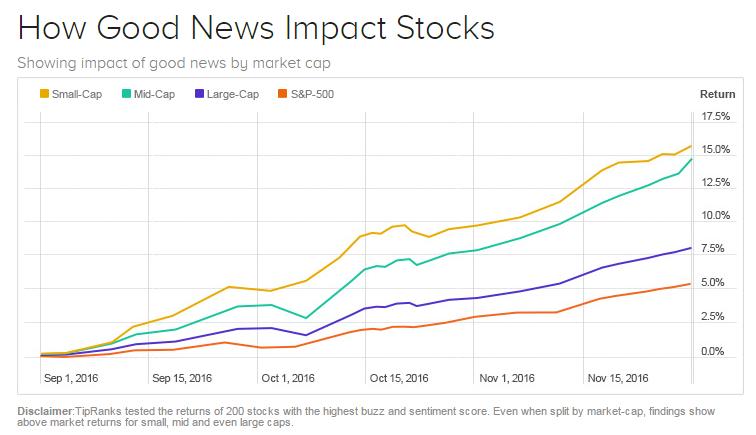
We know that there is a clear correlation between news and stock performance. Figure 1 shows that even when split by market capitalization, good news results in above-market returns for small-, mid- and even large-cap stocks. The study tested the returns of 200 stocks with the highest buzz and sentiment score from September 1, 2016, to November 15, 2016. A stock has a high buzz if the number of articles about the stock is very high compared to the stock’s weekly average, while the sentiment score measures the ratio of bullish to bearish articles on a stock in a particular week.
A Tale of Two Companies
One example of a stock benefiting from good news is shown in Figure 2. Celldex Therapeutics’ (CLDX) share price exploded in late 2016 following a preclinical data presentation on its new product candidate CDX-1140 for the treatment of cancer. Celldex’s share price (already on the rise due to an earnings release earlier in the month) surged to an impressive high of $4.91.
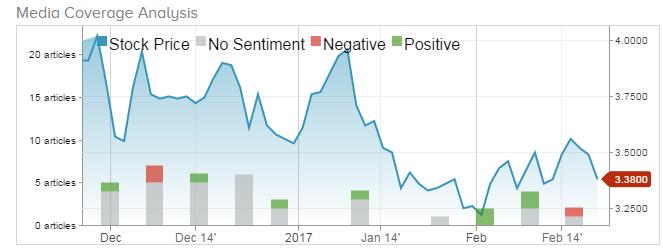
Although prices have since dropped, Celldex is still trading above its pre-November levels and analysts remain very bullish on the stock. The average analyst price target on TipRanks of $9 suggests a potential upside of 167.86% from the current (mid- February) share price of $3.38.
Tracking bad news is important too. A 2016 study by data scientists at the Federal Reserve revealed that positive news stories increase stock returns within a week, but negative news predicts low stock returns for up to three months. Furthermore, the incremental effect of positive sentiment is only positive for two or three weeks and then flattens out to negligible levels, while the impact of negative sentiment continues to be strong for the full 13-week period.
For example, in December, shares in psychiatric hospital chain Universal Health Services (UHS) slumped 12% following publication of a BuzzFeed article alleging that staff were under such pressure to fill hospital beds that suicide risks were exaggerated and patients were locked up unnecessarily.
The article, which attracted significant media attention, led Senator Chuck Grassley to request an update on a federal investigation into the company. Five-star Raymond James analyst John Ransom subsequently downgraded his UHS rating to hold as the additional scrutiny took “the political risk to a more dangerous level.”
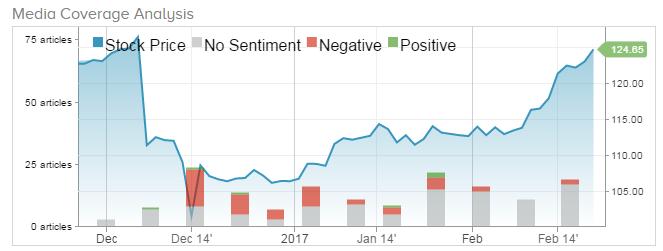
What does Figure 3 show about this chain of events? We can see that the share price declined on December 7, 2016, when the BuzzFeed article was published. We can even see how share prices continued to drop in the article’s aftermath, losing an additional 6.83% to a low of $101.55 on December 14 on the Raymond James downgrade.
The share price has yet to recover to pre-December 7 levels. According to TipRanks, news sentiment for Universal Health remains bearish compared to the health care sector average of 74% bullish/26% bearish (Figure 4). TipRanks is able to calculate this ratio by tracking news on the stock over the week.

The Challenge: Data Overload
Until now, finding relevant news quickly enough proved a challenge for investors, and assessing the overall news sentiment for specific stocks was even more difficult. According to Staples, the average adult reads 300 words per minute (to test your reading speed, check out Staples’ reading speed test). That’s two minutes for a 600-word article. In two minutes, a hundred articles could be published on just a few stocks. Multiply this figure out in both time and stock number and you can see the difficulty in monitoring stock news 24/7. Only a handful of well-established hedge funds can afford to license news sentiment analyzers, with quantitative hedge funds in particular using news sentiment as part of their trading strategy to predict stock price movements.
The Solution: TipRanks New News Page
The ultimate goal at TipRanks was to create a simple-to-use analytical tool for individual investors without becoming just another content news website. Last month, TipRanks released a new version of the stock analysis page where every stock page also has a news tab with all that stock’s recent news.
TipRanks combs the web for news on over 5,000 stocks listed on either NYSE or NASDAQ. Only news from reliable sources, such as Yahoo Finance or Bloomberg, is tracked and TipRanks has eliminated many less reputable sources from the data collection process. As a result, we are confident that the news is real and that “fake” news doesn’t corrupt the data.
Any relevant news is logged and then categorized using TipRanks’ unique natural language processing (NLP) algorithms. This data is converted into clear graphics so that users can immediately assess the overall news outlook for their stock.
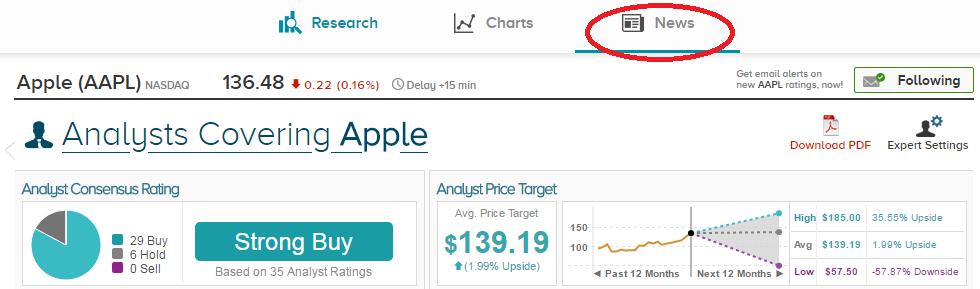
To get to the news page, enter the stock symbol into the TipRanks search engine and then click on the News tab (Figure 5) to get the full breakdown of bullish/bearish news for your stocks or any stocks of interest.
Discussion
FREE REPORT

Jim Shadid from CO posted over 9 years ago:
You need to log in as a registered AAII user before commenting.
Log InCreate an account