In 1995, investors were told that they should be invested in foreign stocks because for the prior 20 years, if you had invested in the S&P; 500 index you would have earned 14½% per year (Table 1). But if you had invested in the MSCI EAFE (Morgan Stanley Capital International Europe, Australia and Far East) index, you would have gained roughly 16% per year.
So people said that you’ve got to invest in foreign stocks.
| Table 1. Comparative Returns for U.S. and International Stocks: 1975-1994 |
| Standard & Poor’s 500 vs. Morgan Stanley Europe-Australia-Far East Index |
| Year |
S&P; 500 |
EAFE |
| 1975 |
37.31 |
37.10 |
| 1976 |
23.99 |
3.74 |
| 1977 |
–7.19 |
19.42 |
| 1978 |
6.39 |
34.30 |
| 1979 |
18.65 |
6.18 |
| 1980 |
32.39 |
24.43 |
| 1981 |
–5.26 |
–1.03 |
| 1982 |
21.53 |
–0.86 |
| 1983 |
22.59 |
24.61 |
| 1984 |
6.30 |
7.87 |
| 1985 |
31.80 |
56.72 |
| 1986 |
18.67 |
69.94 |
| 1987 |
5.25 |
24.63 |
| 1988 |
16.60 |
28.27 |
| 1989 |
31.68 |
10.54 |
| 1990 |
–3.10 |
–23.45 |
| 1991 |
30.47 |
12.13 |
| 1992 |
7.62 |
–12.17 |
| 1993 |
10.07 |
32.56 |
| 1994 |
1.31 |
2.68 |
| Comparative Performance Over 20 Years: 1975-1994 |
| Index |
Cumulative |
Annualized |
| S&P; 500 |
1,519% |
14.57% |
| MSCI EAFE |
1,920% |
15.92% |
| Shading denotes the years when the EAFE
outperformed the S&P; 500. |
The Dollar Still Matters
Figure 1.
Dollar Performance:
1971-1995
|
|
CLICK ON IMAGE TO
SEE FULL SIZE.
|
|
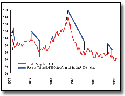
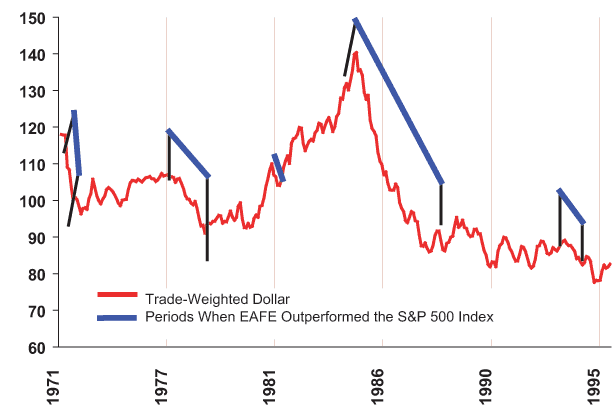
When you invest outside the United States, part of your return is due to the performance of securities in the local currency and part is due to the change in the currency values relative to each other. We wondered what happened to the currency during the years when the EAFE outperformed the S&P; 500. So we constructed a chart of the trade-weighted dollar (the foreign currency price of the dollar) for the period (Figure 1).
We found that in each of those periods when the EAFE outperformed the S&P; 500, the dollar was going down, and these were the only times when the EAFE outperformed the S&P; 500.
In early 1995, it looked to us like the dollar was below where it should be, so we concluded that it wasn’t a good time to invest in foreign securities.
What has happened to the EAFE since 1995?
Let’s look at the updated data in Table 2 that brings us through 2004.
For the period from 1995 to 2002, the EAFE underperformed the S&P; 500 as the dollar continued to strengthen against other currencies. Investing in foreign stocks in 1995 would not have been a wise choice.
Table 2. Comparative Returns for U.S. and International Stocks:
1995 Through 2004 |
| Standard & Poor’s 500 vs. Morgan
Stanley Europe-Australia-Far East Index |
| Year |
S&P; 500 |
EAFE |
| 1995 |
37.10 |
11.21 |
| 1996 |
20.30 |
7.90 |
| 1997 |
33.40 |
2.06 |
| 1998 |
28.12 |
20.33 |
| 1999 |
21.04 |
27.30 |
| 2000 |
-9.10 |
–13.96 |
| 2001 |
–11.67 |
–21.21 |
| 2002 |
–18.67 |
–15.64 |
| 2003 |
28.18 |
39.16 |
| 2004 |
9.04 |
18.66 |
| Comparative Performance Over 30 Years: 1975-2004 |
| Index |
Cumulative |
Annualized |
| S&P; 500 |
4,631% |
13.64% |
| MSCI EAFE |
3,301% |
12.36% |
| Shading denotes the years when the EAFE outperformed
the S&P; 500. |
Figure 2.
The Dollar Risk: EAFE vs. the S&P; 500
|
|
CLICK ON IMAGE TO
SEE FULL SIZE.
|
|
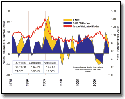
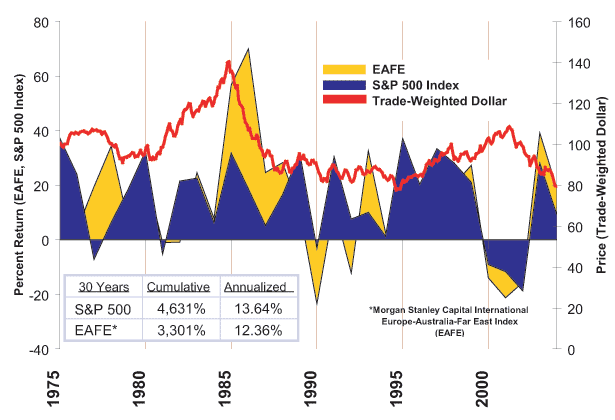
Figure 2 plots the trade-weighted dollar, the S&P; 500 and EAFE from 1975 to 2004. Any time you see the yellow above the purple, it’s a period when the EAFE outperformed the S&P; 500—and each of those is a period when the trade-weighted dollar is falling relative to other currencies. From 1995 to 2004, there were two periods when the EAFE outperformed the S&P; 500.
Measuring Value
The lesson to learn is this. You can’t just extrapolate the past to arrive at the future. You have to have some measure of value. This allows you to make a judgment as to whether recent price trends are sustainable or have overshot the mark, resulting in fundamental over- or undervaluation. Markets are partly valuation and partly trends and momentum. You want both working for you.
By the end of 2002, it looked like the dollar was beginning to roll over. It looked like it was a little overpriced, and foreign stocks started to look interesting for the first time in a decade. It was at that point that we started to do some work on them.
Any time you invest outside of the United States you take two additional risks. One is accounting risk (and with a little help from Enron, we have found out that we have more accounting risk in the United States than we thought we did).
The other is currency risk. Figure 2 shows you that when it comes to foreign investing, the currency is at least as important as an individual company’s financial performance.
In roughly 1994 and 1995, Morgan Stanley came to town and talked about all these great companies they were going to bring public in India and China, and how we ought to invest in them and make a lot of money.
What do I know about a company in India or China?
What I concluded was that if they are going to bring all these companies public, the company that I know is going to make money is called Morgan Stanley. They get paid up front. So we bought Morgan Stanley, and it worked out rather well.
Sometimes it helps to be a little simplistic.




No comments have been added yet. Add your thoughts to the discussion!
You need to log in as a registered AAII user before commenting.
Log InCreate an account