


Related

Growth Investing
Charles Rotblut leads a class in AAII's new Essential Investing Video Course. Go to https://www.aaii.com/ves for more information and to subscribe.
Laura Geritz manages the Wasatch Frontier Emerging Small Countries Fund (WAFMX). We spoke at the Morningstar Investor Conference about the opportunities and challenges of investing in these nascent economies.
—Charles Rotblut
Charles Rotblut (CR): Could you define what a frontier market is and how it differs from an emerging market?
Laura Geritz (LG): A frontier market is usually defined as one that has a low gross domestic product (GDP) per capita or that is less liquid than an emerging market. I think the best way to think about frontier countries is that they’re just more fragile economically than emerging market countries, less developed or less liquid.
CR: Is there a line separating the two, or is it more of a judgment call?
LG: It’s more of a judgment call. As we were working on our emerging markets small-cap products, we kept discovering that our companies were expanding into frontier countries like Vietnam, Laos, Cambodia and Myanmar. So we just started to study those markets and think about “Are they interesting for our investors? Could we form a separate strategy with this asset class?” And, what we found was that it just looked a lot like all the other things that we had done at Wasatch Funds, where there were inefficient markets, great opportunities for growth, great opportunities to go out and just dig deep and get to know the companies and do something differentiated.
Getting back to your original question, “how do you tell the difference?” It’s a blurred line, in my opinion. A lot of times what an index defines as a frontier market is more of an emerging market. It gets to the question of “How is Greece, the home of philosophy and democracy, going to be an emerging market country and Egypt a frontier market country?” I think the lines are very blurred.
We do tend to think about frontier as consisting of low-GDP-per-capita countries that can get better.
CR: Is there a difference between geographic regions, say, between East Asia and South America, or in the case of Africa, between northern Africa and southern Africa?
LG: I’ll speak to South America first, because it’s more simplistic. These markets are closer to the U.S., where there’s a big capital pool and, as such, what you tend to see is people willing to travel there more frequently—it’s easy to do so. You have companies that list in the United States, so they’re more liquid, and what I’ve seen in those markets a lot of times is overvaluation because of the large capital pool that’s very close to those markets. We’re quality investors who look for companies that generate good, sustainable returns on capital and, because we invest in fragile countries, we want companies that can survive anything to protect our investors. It’s just harder to find those companies in South America. Because it’s easier for them to get capital, they don’t treat it as dearly. There have been good opportunities in the region, but they are just fewer and farther between.
Africa is one of the poorer regions of the world. People often refer to Africa like it’s a country. It’s a continent, and it’s got a lot of different opportunities, depending on the region and where you are.
You mentioned North Africa. Even North Africa is vastly different. You have Egypt coming out of a revolution and getting better—a lot better, quickly, under new leadership. You have Tunisia, which to me is a really interesting country—it’s the place where the Arab Spring started. I think the reason it could start there is because you have a more democratic place located amid pretty disturbing countries, like Libya and Algeria. Democracy is not always clean; it’s messy. So you have change happening there—an evolution—but the opportunities are really good, the companies are good. Then you have Morocco, which is more heavily tied to Europe’s prosperity. They get a lot of tourism from Europe.
Sub-Sahara is broad. You have commodity countries like Nigeria, gold countries like Ghana, diamond countries like Botswana. You have Tanzania that has a great port—great proximity to the Asian trading lanes. And you have Kenya, which is opening up and inviting in new businesses, technology industries. It’s trying to be a hub for Africa. So, I think Africa is just a broad set of opportunities; it’s not one place.
Asia is fantastic right now. In a lot of places, there is the perfect demography, like Vietnam where the demography looks like what Korea looked like before it started its big boom, or what Japan looked like, too, or even China…a young, vibrant population. I think the government is employing some really good policies and it’s got a port, and a highly educated population. I think that’s one of the things Asia has in the frontier that maybe other regions don’t have as much: a very highly literate population and cheap labor to compete with China.
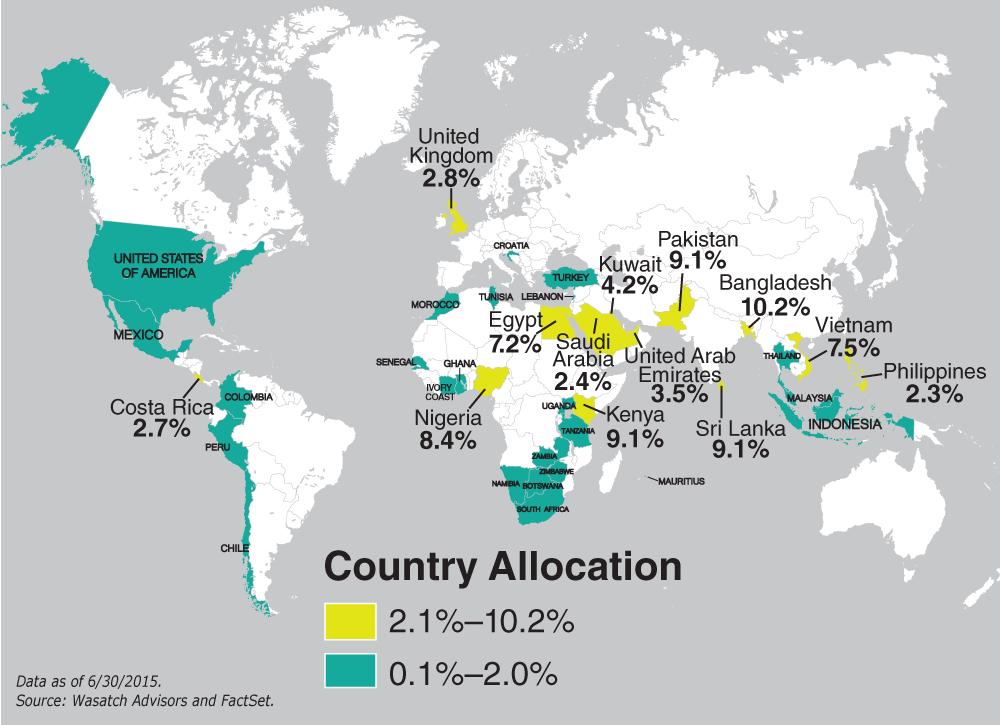 (WAFMX)" border="0" src="https://www.aaii.com/files/images/articles/9564-figure-1.jpg" width="250" />
CR: Is there one key driver of these economies? Is it a case where they all catch a cold at the same time, or is it all different?
LG: I think it’s probably the most diverse set of economies you can invest in. They’re all small countries with very different drivers. So, when you look at how one country behaves versus another, you have—from a fund manager’s perspective—almost the perfect ability to put together countries that when one zigs, another zags. Botswana is a diamond-mining country. It tends to do well when the Western world is prosperous. Nigeria does well when oil does well, whereas Bangladesh does well when oil doesn’t do well, because it’s an oil importer. So, frontier is a broadly diverse set of countries that don’t really follow the global path. Frontier has more idiosyncratic risk, more political risk than global risk.
CR: How do you invest through political risk, or even civil strife, which can be a big problem in countries like these?
LG: In the frontier world, you have to manage risk very carefully and you have to think about how fragile these places are and how fragile the consumer is in these places. So, what you need to do is run a diversified basket of countries. That’s something the indexes do not do. If you look at the MSCI Frontier Index, it’s heavily concentrated in Kuwait, Nigeria and Argentina. You aren’t getting a broad set of countries. What we can do, as active managers, is broaden the country holdings and hopefully mitigate risk. We also, at Wasatch, have a long 30-plus-year history of running a high-quality process where we focus on cash flows and balance sheets and sustainable growth. We can’t protect you from everything—there will be surprises—but we do our very best to protect shareholder money.
CR: What about correlations? I know that when there’s a bear market in the U.S. or Western Europe, we see correlations rise globally. Is that the case with frontier markets, too?
LG: They have not been following the same path as the rest of the world, especially of late. I almost look forward to the days when the markets are down, because my fund tends to do relatively well on those days. If you look at the last year, when you’ve had big recoveries in places like Japan and China, frontier markets have lagged. But that’s because people look at the index, the MSCI Frontier Index, and it’s heavily skewed, as I mentioned, to Kuwait and Nigeria, which are oil-producing nations. So, people say “Frontier equals oil. If oil is down, sell frontier.” But frontier is much more than oil countries.
People often refer to frontier countries as the next BRICS [the emerging economies of Brazil, Russia, India, China and South Africa]. I actually prefer to refer to them as Silk Road economies since a lot of frontier countries lie along the old Silk Road paths.
I think one of the positives people aren’t factoring in as much yet, that they probably should be over the next five to 10 years in frontier, is that China wants to become a global superpower and, in doing so, they’re building up the old Silk Road trading routes in the ocean and along the roads and railways. A lot of our countries are big beneficiaries of that.
So I think it shouldn’t be correlated.But if you look at what happens in big market drops, I think everything goes down, but fundamentally the frontier countries and their companies should do better.
CR: Do you face any particular challenges with targeting small-cap companies in frontier markets?
LG: We have a long history of covering micro-cap companies at Wasatch. We still have one of the only micro-cap-focused funds in international. One of the things I love about frontier and emerging small countries is that they’re nascent economies, so even a small-cap company or a micro-cap company can be an oligopoly or a monopoly, because it’s just a small country. So, a small company can be very strong, very good. For example, Nestlé Sri Lanka is a micro-cap company. As a result, when the actual quality of the fund is defined by return on equity (ROE) or return on assets (ROA), it ranks among our firm’s highest-quality funds. You find really good companies in these markets.
People do expect higher returns on capital because theoretically it’s higher risk. Now, that varies by region. If you consider frontier to be Middle East, a lot of countries in that region are dollar-pegged and have a very low cost of capital, basically at the U.S. rate of inflation. So, it really varies by country, but the quality of the companies is exceptionally good and you have more separately listed multinationals in this asset class than any I’ve worked in.
If you look at the structure of my fund, you’ll see names that you recognize, like Nestlé and Unilever, but you’ll see ones you don’t that are actually multinationals. Lion Brewery in Sri Lanka, for instance, has Carlsberg as one of its parents. That happens for multiple reasons. There might be a tax reason, such as in Bangladesh. They’ll give tax incentives for these companies to come in and to encourage the development of the stock market. International companies do it because it helps to mitigate political risk. They’re thought of as local companies.
CR: I presume that’s why you hold a lot of beverage companies.
LG: The reason we own some of the beverage companies is because—if you look at Africa, for instance—the beverage story is exceptionally good. You have low consumption per capita in the formal market. The formal market means you go to a store, or you go out somewhere, and you have a branded beer. In the informal market, people are drinking, but they’re just drinking at home where they’re home-brewing. What happens is that as people’s incomes go up, they start to go for convenience and they go to the store. There is debate about the rate at which this is occurring, but Africa has a phenomenal long-term growth story for beverages because it’s got a higher growth rate.
The number of 19- to 30-year-old males in Africa will be double that in China by 2050, so the growth story for beverages is absolutely superb. And they’re good businesses. They generate cash flow, they pay dividends.
Another way we mitigate risk is to focus on companies that direct their capital very cautiously and, hopefully, grow their free cash flow and pay dividends. There’s always been a history of that in frontier, too, because investors have been more fickle with the asset class. Plus, there are a lot more pension funds as you look around the frontier universe—local pension funds—and they expect dividends. So, it’s been a higher-yielding asset class through time.
Investors seeking broad exposure to frontier markets have limited choices. As of June 30, 2015, there are only two mutual funds widely available to individual investors and just four exchange-traded funds (ETFs). The Closed-End Fund Association does not list any frontier market closed-end funds as currently being available.
There are some country-specific funds, but not enough to give exposure to a broad market of frontier countries. Plus, these funds are riskier because they are directly affected by the economic health and political stability of a specific country. There are also regional and international funds with exposure to frontier markets, but they are not pure plays or necessarily global. Global X’s Next Emerging and Frontier ETF (EMFM) falls on the cusp of this, blending both emerging market exposure with a specific frontier market strategy.
The challenge of investing in frontier markets is also what gives this region some of its allure. Because these markets are more difficult to invest in, many investors (both institutional and individual) are less likely to be attracted to them. The lower level of liquidity increases trading costs, which is partially why frontier market funds have higher expense ratios. Economic growth in any single country can be interrupted by political strife, lack of adequate infrastructure and other hurdles beyond what is typically seen in developed countries. These factors, and concerns about them, can lead to mispricing and thereby opportunities for risk-tolerant investors who are willing to take a long-term view.
Table 1 shows six mutual funds and ETFs I was able to identify that specifically target frontier market funds. Note that only one fund, Guggenheim Frontier Markets (FRN), has been in existence for more than five years. Despite its longevity, the fund is the smallest of the group, with assets under management totaling just $59.1 million.
—Charles Rotblut, AAII
Table 1. Frontier Market Mutual and Exchange-Traded Funds
|
|
Wasatch Frontier Emg Sm Inv  (WAFMX) (WAFMX) |
Harding Loevner Frontier (HLMOX) | EGShares Beyond BRICs ETF (BBRC) | iShares MSCI Frontier 100 (FM)* | Global X Next Emg & Frontier ETF (EMFM) | Guggenheim Frontier Markets (FRN) |
| Type | Mutual Fund | Mutual Fund | ETF | ETF | ETF | ETF |
| 2015 YTD (%) | -3.9 | -3.9 | -3.3 | -3.5 | -4.8 | -4.0 |
| 2014 (%) | 1.6 | 5.8 | -0.9 | 4.0 | -2.7 | -12.7 |
| 2013 (%) | 18.0 | 16.5 | -3.8 | 25.6 | — | -13.3 |
| 2012 (%) | — | 19.8 | — | — | — | 11.0 |
| 2011 (%) | — | -21.4 | — | — | — | -20.8 |
| 2010 (%) | — | 24.5 | — | — | — | 33.4 |
| Yield (%) | 0.5 | 0.2 | 1.4 | 2.4 | 1.8 | 3.2 |
| AUM ($ Mil) | 1,161.3 | 569.1 | 285.8 | 577.3 | 135.2 | 59.1 |
| Expense Ratio (%) | 2.24 | 2.22 | 0.58 | 0.79 | 0.58 | 0.71 |
| Largest Country Allocations |
Bangladesh, Pakistan, Sri Lanka, Vietnam |
Asia, Africa |
South Africa, Mexico, Qatar, Malaysia |
Kuwait, Nigeria, Argentina, Pakistan |
Malaysia, Mexico, South Africa |
Kuwait, Nigeria, Argentina, Pakistan |
| Largest Sector Allocation | Consumer Staples | Financials | Financials | Financials | Financials | Financials |
|
*The AAII Model Fund Portfolio holds the iShares MSCI Frontier ETF (FM), which tracks the MSCI Frontier Markets 100 Index. Source: AAII’s Quarterly Low-Load Mutual Fund Update and “Individual Investor’s Guide to Exchange-Traded Funds 2015.” Data as of June 30, 2015. Bold returns are in the top 25% of all funds within in the investment category. |
||||||
CR: In terms of investing, if an individual investor wanted exposure, are there enough ADRs (shares of foreign stocks listed on U.S. exchanges), or is it a case where one has to use a fund that buys shares in the foreign markets?
LG: I would really encourage active management. The key reason is because if you buy an exchange-traded fund (ETF) pegged to an index, you may not be getting frontier. You’re getting exposure that’s highly concentrated in a few countries that, to me, aren’t even necessarily that frontier. So, I think you’re better off focusing on an active manager who’s looking at quality, who’s doing deep due diligence—because these economies are fragile—and who’s spreading out risk.
Investors also have to really be cautious of allowing themselves to become impatient if a manager is underperforming the index for a while. The indexes are very poor; they’re too concentrated. They also allocate too much to financials. If an investor is patient, I think the asset class will do very well. But one has to be patient. And the liquidity means that when the asset class springs back, it springs back fast. So, if an investor tries to chase the returns, he will probably miss the quick bounces. That occurs because of the liquidity pool. If you look right now, I think there’s less than $20 billion dedicated to the asset class. It’s tiny.
CR: Yes, a small amount. So, for investors allocating to frontier, is there a time horizon they should be thinking of when they go into this?
LG: I dollar-cost average, personally, and I hold a lot of my own funds. So, dollar-cost average and just be patient. We try to have a five-year holding horizon, so I would recommend investors think about the possibility of maintaining an allocation to frontier markets for at least that long.
CR: How easy is it to buy and sell stocks in these markets?
LG: The first year or two that we did this, you’d get pinged every night, and if you didn’t respond right away, you may not get those shares, because they’re so scarce. So, every night, at about midnight, Sri Lanka would start hitting and we’d get Vietnam and then Vietnam has T plus zero settlement, meaning the cash has to be there already. You have to prefund it.
It was also not unusual for us to be told, “We have this amount of stock available. Do you want it or not?” It’s very, very different. It’s not like these big liquid markets investors in the U.S. are used to. The first time I went to Zimbabwe, they didn’t have electronic trading, so, it was just a group of guys and gals just sitting around a desk and the entire market traded in 45 minutes.
CR: That’s very short trading day!
LG: It’s just a very different landscape. Most of the markets are electronic. I think the really big positive with frontier is that they’ve seen the mistakes that have been made in emerging and they’re trying to adapt. They’re adapting quickly and they’re willing to listen. So, that’s another big difference. In emerging, I mainly just met with companies. In frontier, I spend a lot of time sitting in with central bankers and heads of stock exchanges and we talk about what mistakes have been made and what can be done better…they’re very open to listening. I think it’s such a competitive landscape in these countries now. They want to become emerging or developed—that’s meaningful for them. It lowers their cost of credit, too.
There are still barriers to entry in these places, however. As an example, recently, we were working on a Vietnamese stock trade, and my right-hand guy on our operations team has a stack of paperwork to do on that trade. It takes about nine months to get approval to trade in Vietnam. So that’s why the flow of assets to these places is so slow, because the barriers to entry are so high.
One of the best stories in frontier is just that these barriers are coming down, and quickly. That will be a huge catalyst, because if that market gets more open…it’s a big market. With frontier, you have a structural change from the movement of power in the region, but you also have incremental change, which I think is a big driver.
CR: As a fund manager, then, you probably have to allow for a longer period to buy and a longer period to get out?
LG: Yes. I’m a big believer, from every study that you read on small caps, that you want to own something that’s less discovered, typically that’s an oligopoly and that has lower liquidity. Those stocks tend to do really well over time, and frontier has that in abundance.
Hear from Charles’ interview with Laura Geritz about what to look for in a frontier stock and lessons she’s learned.
Growth Investing

Stock Strategies

AAII Stock Ideas

James D from VT posted over 11 years ago:
Charles Rotblut from IL posted over 11 years ago:
Michael Murray from VA posted over 9 years ago:
You need to log in as a registered AAII user before commenting.
Log InCreate an account