


Article Highlights
-
This four-ETF portfolio can be used as a complete equity portfolio or as part of a larger portfolio.
-
Changes to the portfolio should be relatively rare. Newer ETFs with promising approaches will be monitored before being considered as potential candidates.
-
Rebalancing the portfolio should be achieved through the addition or withdrawal of funds, though the need to rebalance will vary by investor.
The Level3 Passive Portfolio grew out of the founder of AAII James Cloonan’s book “Investing at Level3” (www.level3investing.com).
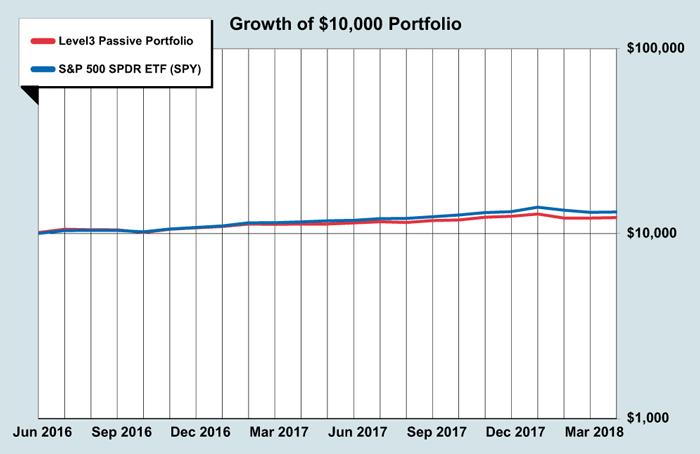
The Level3 Passive Portfolio is composed of four exchange-traded funds (ETFs). Tracking of the portfolio was begun May 31, 2016, as shown in Figure 1.
Portfolio Composition & Weighting
For individual investors who wish to manage their own portfolio but do not have the desire to get involved in individual stock selection, the Level3 Passive Portfolio can be used as a complete equity portfolio. For those who may wish to select individual stocks and actively managed funds on a limited basis but keep the majority of their portfolio in index funds, it can be used as one portion of a whole portfolio.
Large-cap stocks as measured by the S&P 500 index have offered investors a long-term annual rate of return of around 10%. The Level3 Passive Portfolio looks at how investors can potentially improve upon the long-term return of the market-cap weighted S&P 500 by incorporating index funds that extend the reach of the S&P 500 into smaller companies, value-oriented stocks and real estate. As a portfolio, it is more diversified than the S&P 500, which may reduce portfolio downturns influenced by the impact of a few sectors dominating the movement of the capitalization-weighted S&P 500 at a given point in time.
In a capitalization-weighted index, the proportional weights of the companies in the index are determined according to the total market value of their outstanding shares. Apple Inc. (AAPL), Microsoft Corp.  (MSFT), Amazon.com Inc. (AMZN), Facebook Inc. (FB) and JPMorgan Chase & Co. (JPM) are the top five components of the S&P 500 and account for 13.7% of the index. With a capitalization-weighted index, popular overpriced stocks become an overweighted segment of the index, leaving the underpriced stocks underweighted. By design, smaller companies compose a smaller percentage of capitalization-weighted indexes.
Changes to the Level3 Passive Portfolio should be relatively rare and will occur only when a new or different ETF is felt to be more effective at accomplishing a similar objective than one of the current holdings. There are some new index ETFs with promising approaches, but there will be a period of observation before they can be considered. Many of these ETFs are called smart beta indexes in that they vary the weighting of stocks held in the index using factors such as valuation or momentum instead of the more common market-cap weighting.
When investing in these smart beta funds it is important to understand that they are designed to provide concentrations of segments such as value and momentum, making them more like actively managed stock funds. The performance over short periods will probably diverge (for better or worse) from traditional index funds. The Level3 Passive Portfolio continues to lag the S&P 500 since its formation (Table 1). This is partly due to the continuing dominance of the mega-cap stocks for the last several years and partly due to the underperformance of the real estate sector.
Table 1. Level3 Passive Portfolio Annual Performance
|
Average Annual Return (%) |
Cumulative Growth of $10,000 ($) |
|||
|---|---|---|---|---|
| Level3 Passive Portfolio | S&P 500 SPDR ETF (SPY) | Level3 Passive Portfolio | S&P 500 SPDR ETF (SPY) | |
| 2016* | 7.5 | 8.0 | $10,749 | $10,805 |
| 2017 | 15.5 | 21.7 | $12,414 | $13,148 |
| 2018** | -1.6 | -0.4 | $12,218 | $13,094 |
| Since Inception** | 11.0% | 15.1% | $12,218 | $13,094 |
|
*May 31 to December 31, 2016. **Through Apr 30, 2018. Portfolio was started on May 31, 2016. |
||||
The weights of the holdings in the portfolio may change over time based on experience. The following are the four ETFs that currently make up the Level3 Passive Portfolio.
PowerShares S&P 500 Equal Weight Portfolio ETF (RSP)
Invesco, the world’s fourth-largest ETF manager, completed its acquisition of Guggenheim Investments’ ETF business back in April and quickly reorganized the Guggenheim ETFs into corresponding PowerShares ETFs in a tax-free transaction. Guggenheim S&P 500 Equal Weight (RSP) was reorganized into the PowerShares S&P 500 Equal Weight (the ticker symbol is unchanged). This exchange-traded fund has outperformed the cap-weighted S&P 500 over the 14 years of its existence. Other indexes also indicate that equal weighting provides higher long-term returns. Equal weighting gives more weight to value stocks and smaller-cap stocks in an index compared to capitalization weighting, which has led to superior performance over the long run.
This fund is given a portfolio weight of 30% in the Level3 Passive Portfolio.
PowerShares Russell 1000 Equal Weight ETF (EQAL)
This ETF includes securities in the Russell 1000 index, which consists of the top 1,000 stocks by capitalization size. This ETF is equally weighted across the nine sector groups, with each security within the sector given an equal weighting. The fund and the index are re-weighted at the close of the third Friday in March, September and December. The index is also re-weighted at the close of the last Friday in June when the Russell 1000 is reconstituted. This index provides some additional exposure to mid-cap stocks over that found in the S&P 500. Mid-cap stocks historically have had higher returns than large caps. It is a newer fund, however, and uses an innovative approach that needs some observation before comparing it to PowerShares S&P 500 Equal Weight ETF.
It is weighted at 30% of the Level3 Passive Portfolio.
Vanguard Mid-Cap Value ETF (VOE)
This ETF tracks the CRSP U.S. Mid Cap Value Index, which targets stocks representing the value and lower-growing half of the mid-cap market and weights the stocks by market capitalization.
CRSP classifies value securities using book to price, forward earnings to price, historic earnings to price, dividend-to-price ratio and sales-to-price ratio. To measure growth, CRSP looks at future long-term growth and short-term growth in earnings per share, historical growth in sales and earnings, current investment-to-assets ratio and return on assets.
Historically, mid-cap value has had higher returns than large stocks or mid-cap growth stocks. The ETF is weighted at 30% of the portfolio.
Vanguard Real Estate ETF (VNQ)
The Vanguard REIT ETF is transitioning to a new tracking index. As of February 1, 2018, the fund is temporarily tracking a transition benchmark, MSCI U.S. Investable Market Real Estate 25/50 Transition Index. This change is intended to minimize impact to the fund as it moves to its destination index, MSCI U.S. Investable Market Real Estate 25/50 Index, sometime in the third quarter of 2018. Prior to this, the Vanguard REIT ETF tracked the MSCI U.S. REIT Index, which includes domestic-equity REITs, or firms that manage properties. The index doesn’t include mortgage REITs or specialty REITs.
Under the new index, investors in the ETF will still have exposure to equity REITs and will also gain exposure to certain specialized REITs as well as real estate management and development companies. The fund’s name also changed from Vanguard REIT Index to Vanguard Real Estate to reflect is broader reach.
Historically, the returns of real estate investment trusts (REITs) have exceeded the returns of the S&P 500 over the long run and provide diversification as well.
The ETF is weighted at 10% of the portfolio.
Portfolio Management Notes
For the Level3 Passive Portfolio, the initial weightings are as previously indicated and shown in Table 2. The approach to rebalancing is to keep it to a minimum.
Table 2. Level3 Passive Portfolio
| Fund (Ticker) | Weight | YTD Return % | 1-Yr Return % | Return (%) Since 5/31/2016 |
|---|---|---|---|---|
|
PowerShares S&P 500 Equal Weight (RSP)* |
30% | -0.7 | 11.1 | 27.4 |
|
PowerShares Russell 1000 Equal Weight (EQAL) |
30% | -1.0 | 10.0 | 25.2 |
|
Vanguard Mid-Cap Value (VOE) |
30% | -1.0 | 9.6 | 28.3 |
|
Vanguard Real Estate (VNQ)** |
10% | -7.3 | -3.8 | -0.6 |
| Weighted Avg of ETFs in Portfolio† | -1.5 | 8.8 | 24.2 | |
| Actual Level3 Passive Portfolio†† | -1.6 | 8.4 | 22.2 | |
| Comparison: | ||||
| SPDR S&P 500 (SPY) | -0.4 | 13.1 | 30.9 | |
|
*Formerly Guggenheim S&P 500 Equal Weight (RSP). **Name changed from Vanguard REIT Index. †A weighted average return of the ETFs in the current Level3 Passive Portfolio. ††Performance of actual Level3 Passive Portfolio, including reinvested dividends. Source: Morningstar, Inc. Data as of 4/30/2018. |
||||
While momentum is less of a factor with funds than it might be a factor with stocks, and transaction costs for funds are much less than they are for stocks, rebalancing frequently is a distraction and can make taxes a significant consideration.
You should be able to achieve almost all the rebalancing necessary when you add and withdraw funds or when changes are made in the holdings.
Rebalancing decisions will have to be made by the individual since every investor will add or have added assets at a different time, so everyone’s weights will be different. But the following are some general guidelines:
-
Don’t rebalance any holding unless you have held it for over a year.
-
If a holding is 25% below where it should be in relation to the planned weight, bring it back to the appropriate level by selling some overweighted holdings to provide funds.
-
If a holding is 33% above where it should be in relation to the planned weight, bring it back to the appropriate level by selling the excess and using the funds to buy underweighted holdings.
The next review of the Level3 Passive Portfolio will be in the November 2018 AAII Journal.
Discussion
FREE REPORT

Peter Barnum from Maryland posted over 8 years ago:
Randy Williams from KY posted over 8 years ago:
John Landry from Texas posted over 8 years ago:
Warren Scholl from WA posted over 8 years ago:
Jean Henrich from AAII posted over 8 years ago:
Fradkin from NY posted over 8 years ago:
Mike Mickelson from FL posted over 8 years ago:
Robert from IL posted over 8 years ago:
Ishwarlal Bhuta from AL posted over 8 years ago:
Patrick Shanahan from KY posted over 8 years ago:
David Devendorf from NC posted over 8 years ago:
Leon Oswalt from OR posted over 8 years ago:
Yefim Revutsky from CA posted over 8 years ago:
Andrew Hoffman from IL posted over 8 years ago:
Andrew Hoffman from IL posted over 8 years ago:
Andrew Hoffman from IL posted over 8 years ago:
Dave from NY posted over 7 years ago:
David Raymond from Canada posted over 7 years ago:
You need to log in as a registered AAII user before commenting.
Log InCreate an account