



No one likes to see his or her investments turn into a losing position.
And yet such declines are an almost inevitable result for one who manages even a modest-sized portfolio, particularly if it is diversified. Such losses on paper actually offer an opportunity for those who are willing to harvest them. Every dollar of paper loss is potentially worth some percentage of its amount as a tax shelter.
Taxpaying investors who itemize are allowed to deduct up to $3,000 of net losses annually in determining their taxable income.
This means that an investor who realizes a $3,000 investment loss can reduce his or her tax liability by the product of the loss times his or her marginal tax rate. Thus, by realizing that loss, someone in the 25% bracket can reduce his or her tax liability by $750 ($3,000 loss  (T) 25% tax rate = $750 reduction in taxes owed).
Similarly, an investor who has already realized gains on his or her portfolio can reduce or eliminate the resultant tax liability by realizing losses that offset part or all of the gains. Moreover, any capital losses that cannot be used in the current year can be carried forward to subsequent years. They do not expire.
Realizing Capital Losses
To realize an investment loss for tax purposes, one must sell a capital asset (such as stocks, bonds or mutual funds) held in a taxable account for less than its cost basis. In most cases, the basis is the amount that was paid for the asset including any commissions. If capital has been returned to you via distributions, the cost basis must be adjusted accordingly.
Many investors, while aware of the opportunity to harvest losses, are reluctant to sell their losers. They may believe that their investment will recover and eventually show a profit. They would, however, like to be able to take the loss for tax purposes while preserving the opportunity to recover if the investment’s price rises sufficiently. How can they do that?
One obvious way is prohibited. An investor cannot simply sell at a loss and then just buy the security back. That constitutes what is called a wash sale.
If the stock (hereafter we will assume the investment is a stock unless stated otherwise, but it could be any investment asset) that was sold is repurchased within a 30-day window of the sale (either before or after), the transaction is classified by the IRS as a wash sale.
Wash sale losses cannot be deducted for tax purposes. Moreover, one cannot get around this rule by selling in a taxable account and repurchasing the substantially identical investment in a tax-advantaged account, such as a traditional IRA or a Roth IRA.
To qualify as a legitimate capital loss for tax purposes, the combined transactions must involve some risk of additional loss. In other words, the combined transaction cannot leave the investor in the same position that he or she would have been in had nothing been done.
The Wash Sale Rule
Per IRS publication 550, you cannot deduct losses from sales or trades of stock or securities in a wash sale unless the loss was incurred in the ordinary course of your business as a dealer in stock or securities.
The Rule
A wash sale occurs when you sell or trade stock or securities at a loss and within 30 days before or after the sale you:
- Buy substantially identical stock or securities,
- Acquire substantially identical stock or securities in a fully taxable trade,
- Acquire a contract or option to buy substantially identical stock or securities, or
- Acquire substantially identical stock for your individual retirement account (IRA) or Roth IRA.
If you sell stock and your spouse or a corporation you control buys substantially identical stock, you also have a wash sale.
If your loss was disallowed because of the wash sale rules, add the disallowed loss to the cost of the new stock or securities (except in #4 above). The result is your basis in the new stock or securities. This adjustment postpones the loss deduction until the disposition of the new stock or securities. Your holding period for the new stock or securities includes the holding period of the stock or securities sold.
What Is Substantially Identical?
In determining whether stock or securities are substantially identical, you must consider all the facts and circumstances in your particular case. Ordinarily, stocks or securities of one corporation are not considered substantially identical to stocks or securities of another corporation. However, they may be substantially identical in some cases. For example, in a reorganization, the stocks and securities of the predecessor and successor corporations may be substantially identical.
Similarly, bonds or preferred stock of a corporation are not ordinarily considered substantially identical to the common stock of the same corporation. However, where the bonds or preferred stock are convertible into common stock of the same corporation, the relative values, price changes, and other circumstances may make these bonds or preferred stock and the common stock substantially identical.
Tax Swaps
A combination of trades that largely preserves the investor’s position but is somewhat different can pass muster under IRS rules. One is a so-called “tax swap” with bonds. This is an example of a combination trade that allows the investor to realize a loss for tax purposes, but maintain the essence of his or her position. With such a trade, one sells a bond at a loss and then purchases a similar but different bond. Suppose the investor is holding A-rated 20-year General Motors bonds at a loss. If those bonds are sold and an equivalent amount of A-rated 20-year Ford bonds are purchased, the investor can report the loss on the GM bonds. Presumably, the two bonds will behave very similarly going forward. Thus, the loss is realized for tax purposes, but the investor’s basic position is largely maintained.
Clearly, one could do a somewhat similar thing with stocks or other investment assets. If an investor were holding shares of AT&T (T) at a loss, he or she could sell the stock and turn around and buy stock in Verizon (VZ). More generally, an investor with a loss in a big oil, banking, or pharmaceutical stock (or another company in any other industry) may be able to find an otherwise similar stock in that same industry.
One could even make such a switch with mutual or exchange-traded funds (ETFs). For example, an ETF tracking the S&P 500 index could be replaced by an ETF tracking the Russell 1000 index. For such a situation, the sale of the loser is replaced by the stock or fund of a peer. The resultant loss would be recognized for tax purposes by IRS.
Of course, this still exposes the investor to the possibility that the asset that was sold might outperform that of the one that replaced it. However, if the two companies or funds are likely to face similar economic and business environments, their performance is likely to be similar.
Option Strategies for Maintaining Exposure
The use of options provides another way of realizing a loss for tax purposes while maintaining the essence of the position. Indeed, a number of different strategies are possible. For example, one could buy a call on the stock that was sold and then exercise it more than 30 days after the sale. That would leave the investor holding the same stock after the 30 days have elapsed.
One disadvantage of this strategy is the extra cost of buying the call. Calls are almost always priced above their so-called intrinsic value (the amount by which they are in the money). For example, one might want to buy a call option on stock ABC with a strike price of $35 when the stock is selling for $36. The option would be in the money by one point, the amount by which $36 exceeds the option’s striking price of $35. (The strike price is the price at which the option can be exercised for. In the case of a call, it is the price the option’s owner is allowed to buy the stock at.) Such a call might be quoted at $1.50.
The difference between the call’s intrinsic value of $1.00 and its market price of $1.50 is the time value. In this example, the investor’s additional cost of using this approach would be the time value paid for the call plus the additional transactions costs. On the other hand, the trade would give the investor a chance to do a bit better by repurchasing the stock at a more attractive price. An option holder can choose not to exercise the option. In this example, if after 30 days the stock’s price had fallen to $34, the rational investor would not use the call to buy the stock at $35 when he or she could simply buy the stock on the open market for $34.
A more complicated way of using a call to harvest a loss would be to acquire additional shares of the stock to be sold and simultaneously write an in-the-money call on the stock with an expiration date of 30 days into the future or next month, whichever is longer. As Strategy 1 in Figure 1 explains, the call would be written with a strike price below the stock’s current strike price, hence being “in the money” since the option holder could exercise the right to buy the stock at a more favorable price than its current market value. This would give the investor a covered call position on the older block of stock (the original shares plus the short position on the option contact) and a newer block of the same stock.
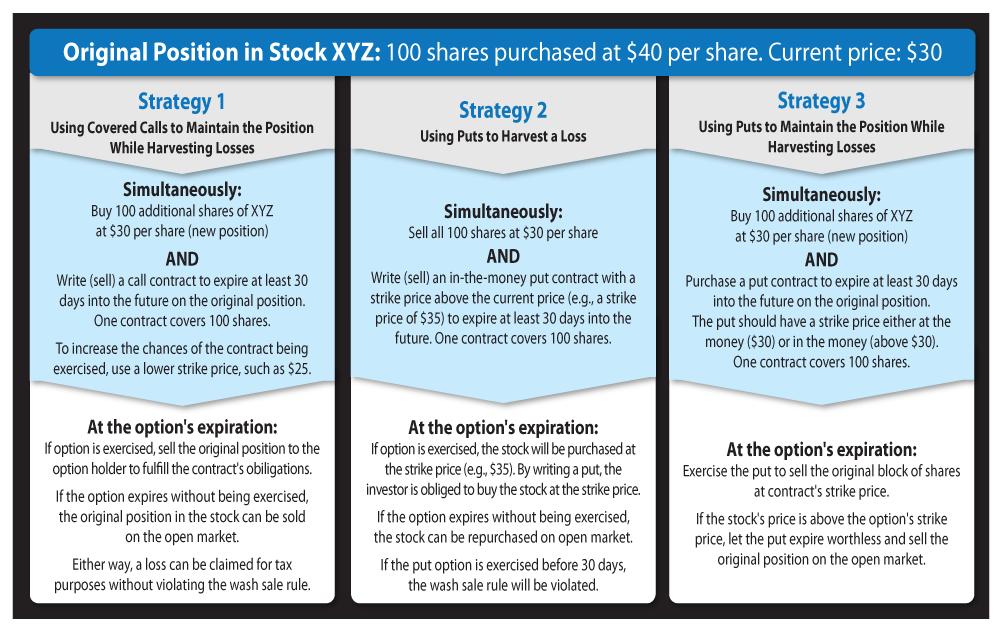
Assuming the call remains in the money at expiration, the option holder would exercise the contract at the strike price. The writer of the contract—who holds the covered call position—would sell the older block of shares to fulfill the obligations of the option contract. If the strike price of the contract is below the cost basis of the older block of shares, a loss on the older block of stock would be recorded for tax purposes. The newer block of shares would be carried on the investor’s books at its cost.
An advantage of this strategy is that the time value on the call would accrue to the investor. But the trade is complex and involves some risk. In particular, if the stock price falls below the strike on the call, the call will not be exercised and the investor will end up with twice as many shares as he or she started with. To reduce this risk, the investor should choose relatively deep in-the-money calls to write to increase the odds of the contract being exercised at expiration. Thus if the stock is trading at $30, one might write a call on it with a strike of $25.
An investor could also structure a set of trades using puts. In one such approach, shown as Strategy 2 in Figure 1, the investor would sell the stock at a loss and at the same time write (sell) an in-the-money put on that same stock. This gives the option holder the ability to sell the stock to the option writer at the strike price. The put would need to have an expiration more than 30 days beyond the date on which the stock is sold. Presumably the put would be exercised at expiration, restoring the shares to the investor’s portfolio beyond the 30-day time frame.
This trade also has some pitfalls. The put will only be exercised if it remains in the money. Thus if the stock’s price rises above the option’s strike price, the put will be allowed to expire unexercised. For that reason, the investor should choose a put with a strike price that is well above the stock’s current price such that exercise is very likely. There is also a very small chance of the put being exercised before 30 days have passed, thereby causing the option writer to violate the wash sale rule. (In such instances, the cost basis of the new position can be adjusted by the disallowed loss on the older position.)
In an alternative strategy involving puts, one would simultaneously buy both more of the stock (doubling the position) and an at- or in-the-money put on the older block of stock. Shown as Strategy 3 in Figure 1, the investor would then wait 30 days to exercise the put on the older block of shares trading at a loss. (If the stock’s price is above the expiring put’s strike price, the stock would be sold on the open market instead.) This exercise would leave the investor’s portfolio with the same number of shares as he or she originally had. As with the similar strategy of buying a call contract, the investor would bear the cost of the put’s time value, but would retain the ability not to exercise the put if the stock’s price rises above the contact’s strike price.
Caveats and Considerations
So we see that an investor who wants to harvest his or her losses while retaining the essence of his or her position has a number of available avenues. Each has some advantages as well as some potential pitfalls. But used carefully, each is likely to work effectively the vast majority of the time. As with any kind of investing, particularly one that involves more complex trades and tax treatment, one needs to be aware of various potential pitfalls.
One important consideration in all of these strategies is effective timing. While losses can be carried forward, they cannot be carried backward. This means that in order to recognize a tax loss in the current year, the transaction must be completed in the current year. Accordingly, it is a good idea to start the process of harvesting losses well before year end. November is a good month to start a tax-loss-harvesting program. (September or October are also good for those planning ahead to future tax years.) Be aware that when figuring your capital loss carryover, short-term capital losses must be used before long-term losses.
Another important consideration in investing generally and in tax-loss harvesting in particular is the impact of transactions costs. Commissions and bid-ask spreads and other costs of trading (such as the charges made by load mutual funds) can be substantial. Only proceed with the tax-loss harvesting if the tax savings are large enough to overcome the costs of making the trade.
If one uses a strategy of writing (as opposed to buying) either puts or calls, the issue of possible early exercise arises. Options traded on U.S. exchanges are what are called “American options.” Such options can be exercised by the owner at any time up to their expiration date. Under the vast majority of circumstances, the owner will find it advantageous either to hold the option until expiration or to sell it. In one situation, however, early exercise of a call may be attractive. That is, if the call option is already close to expiration but it is about to go ex-dividend before expiration, an early exercise will capture the dividend payment that would otherwise be lost. So when writing call options, avoid writing options over time periods that include the ex-dividend date. While put options can also be exercised early, the chance of that happening is very low.
One final set of concerns relates to the application of tax law. This article focuses on the individual investor. Tax laws for corporations are different and may not apply to the strategies discussed here. Moreover, tax laws can change. I believe that all of the strategies discussed in this article are consistent with current tax law. I have discussed all of them with an expert in tax law and tax accounting who is both a CPA and has a law degree. He assures me that as far as he knows, no current IRS rulings would disallow any of the strategies discussed. The IRS could in the future issue rulings that disallow some of these strategies.
Discussion
FREE REPORT

Henrik Martens from WA posted over 9 years ago:
Thomas Higdon from TX posted over 9 years ago:
Thomas Higdon from TX posted over 9 years ago:
lrisius from Illinois posted over 9 years ago:
Steven Sears from IA posted over 9 years ago:
Andy from CA posted over 6 years ago:
You need to log in as a registered AAII user before commenting.
Log InCreate an account