

Related

Financial Statements
This annual report, required by the SEC, offers insight into a company’s business and the potential risks shareholders may face.
by Charles Rotblut | July 2015

Charles Rotblut leads a class in AAII's new Essential Investing Video Course. Go to https://www.aaii.com/ves for more information and to subscribe.
One document widely read by financial professionals is the 10-K filing. This is an annual report required to be filed with the Securities and Exchange Commission (SEC) for exchange-listed U.S. companies. It explains what a company does, reveals the risks it faces and gives a comprehensive look into its finances.
The 10-K should not be confused with a company’s annual report. An annual report is essentially a public relations document prepared by a company for its shareholders. The purpose of the annual report is to highlight the key developments the executives believe are important and, often, to build and maintain goodwill among shareholders. The 10-K is a regulatory filing with specific requirements for what should be included.
The SEC categorizes the 10-K into four primary sections, or “parts.” Each part offers a different level of detail, and understanding what is included in each section can help you determine when to pay closer attention and when to skim through the document.
The first part of the 10-K gives an overview of the company’s business model. It explains what the company does (e.g., makes products, provides services, etc.). Depending on the company, key customers, suppliers, and geographic markets will be specified. Some companies will also discuss industry conditions. Key questions to ask when reading this section are: Is it clear what the company does? How broad or targeted is the company’s business? The clarity provided here varies. A good rule of thumb is to avoid those companies whose business models you do not understand.
Risk factors and legal proceedings will also be included in this section. The SEC defines risk factors as the “most significant risks that apply to the company or to its securities.” These can be specific risks to the company, or they can be broader in nature, such as the possible impact of a change in interest rates. Since companies may list broad risks such as climate change to prevent being sued for non-disclosure, the key is to seek out risks that pose a direct risk to the company’s business or its financial health. These can include—but are in no way limited to—the forthcoming expiration of a key contract or patent, past problems with sourcing needed supplies, or accounting irregularities and deficiencies in accounting oversight. The key when reviewing risks is to think about whether something seems either unexpected or specific to the company (e.g., government regulators halting production at a company facility).
Legal proceedings should also be considered in terms of the potential threat they pose to the company. A patent lawsuit regarding a key product may be more risky than a former employee suing over his or her termination. Pay particular attention to any lawsuit a company says could have “material” impact on earnings.
The second item in the 10-K discusses the company’s stock and its financial condition. Some companies include a chart comparing the performance of their shares against their peers. More interesting is any commentary made about the dividend and share repurchase policy.
Financial statements and supporting supplementary data are provided. The statements may be provided in summary form in this section, with complete statements published in Part IV. The data will reveal the company’s growth trends and whether or not it has maintained profitability.
A discussion by the company’s management about its financial performance will be listed here. The discussions should provide insight into trends and why sales and profits rose or fell. Seek out not only explanations for changes in sales and profits, but also explanations for big changes in expenses or debt. They may be attributable to a specific expense, a debt offering or some other notable event.
Also read the commentary about the accounting policies. While every accounting policy does not need to be studied in detail, it is helpful to understand why a company may choose to deviate from generally accepted accounting principles (GAAP). Pay particular attention to Item 9: “Changes in and Disagreements with Accountants on Accounting and Financial Disclosure.” A disagreement with auditors can be a sign of accounting irregularities; however, change in accounting firms should not be a cause for concern under normal conditions.
Information about who serves on the board of directors and how much the executives are paid can be found in this section. This information can shed more light on how much largesse there is in the compensation plans.
A key part can be Item 13: “Certain Relationships and Related Transactions, and Director Independence.” This section reveals any potential conflicts of interest between executives and board members. These potential conflicts can include investments in other companies and transactions between the company and its directors, officers and their family members.
This section contains all financial statements as well as exhibits and schedules. Some of these may be referenced as addendums to the 10-K.
This section can contain a large amount of disclosures and tables. The number depends on the complexity of the organizational structure. Though some of the information included here will not be significant for determining whether or not a stock is attractive, disclosures that could influence your opinion of the company may also be here. This is why some analysts and portfolio managers like to start at the bottom of Part IV and work their way up through the filing, as opposed to starting at the beginning of the document.
Depending on the length of the filing and how a company organizes its filing, various exhibits may be included with the 10-K. These are intended to provide additional information and may or may not contain pertinent information to your decision process. The main filing will reference them and give you an idea of what is in the addendums.
The 10-K filing can be very lengthy. Plus, since it is a regulatory document, there will be information that is intended to disclose specific information as opposed to being interesting to read. For these reasons, investors read the document with the intention of seeking out key information.
Among the key points to seek out are what the company does, what the key risks to its business are, how financially strong the company seems, whether there are any issues brought up by the company’s auditors, and whether there is anything that either seems odd or is not in the best interest of shareholders. A big key is to look at the filing from the viewpoint of an outsider and to use common sense. Reasons for concern can include expressed cautionary statements by auditors over the health of the company or its accounting procedures, a conflict of interest between the board members and acquisitions of other companies, excessive compensation, privileges given to the executives (e.g., allowing the CEO’s friends access to the corporate jet) and lawsuits with the potential to disrupt the business (such as a patent lawsuit regarding the company’s key product). Also be wary of companies whose business models you do not understand or whose filings suggest a history of previous problems. Be sure to review the footnotes included in the document, as they can be a key source of important information.
Though companies are required to follow a common format for the 10-K, the filings themselves vary widely. As such, there are no single warning signs to watch out for; rather, common sense needs to be applied. If something seems odd, risky or simply not in the best interest of shareholders, there is a reasonable chance that you should avoid the stock.
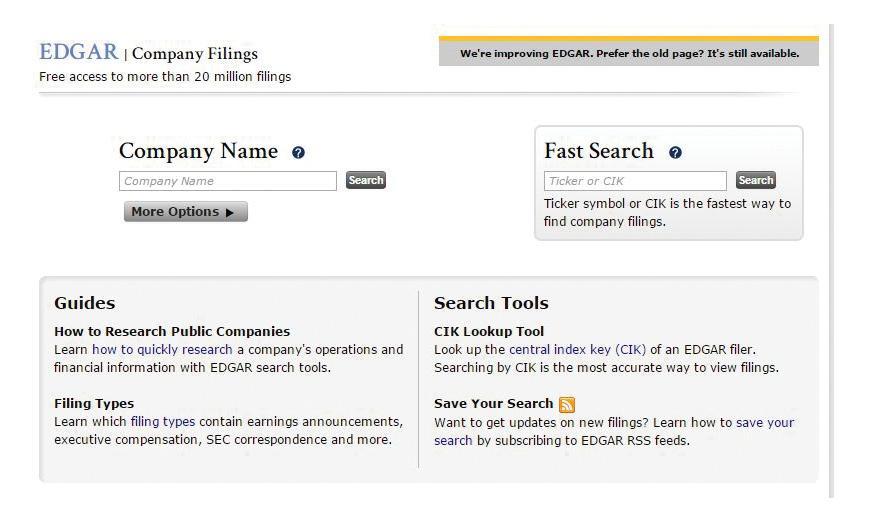
The SEC’s EDGAR is a comprehensive database for company filings, including the 10-K. As Figure 1 shows, companies can be searched by name or ticker symbol. Some companies will also make their latest 10-K and other regulatory filings available in the investor relations section of their website. The 10-K may also be included as an addendum to the annual report.
—By Charles Rotblut, CFA, Editor, AAII Journal
Financial Statements

Stock Strategies

Financial Planning

Doug from NY posted over 11 years ago:
Charles Rotblut from IL posted over 11 years ago:
Jeffrey Fernald from FL posted over 10 years ago:
Charles Rotblut from IL posted over 10 years ago:
You need to log in as a registered AAII user before commenting.
Log InCreate an account