Illustrating the Value of Retirement Accounts

Two examples show the considerations to be taken into account when deciding between a taxable account, a traditional IRA and a Roth IRA.

Article Highlights:

  • Even if a higher tax rate is expected to be incurred in the future, the ability to defer taxes combined with a long enough time horizon can make a retirement account more valuable than a taxable account.
  • Roth IRAs can allow you to enjoy the tax benefits on a larger amount of money if the initial upfront taxes are paid with non-IRA assets.
  • Roth IRAs can extend the longevity of tax deferrals by not requiring distributions while the account owner is alive and then allowing the heir to take withdrawals based on their required minimum distribution schedule.

There is immense value provided by retirement accounts stemming from not having to pay taxes on investment income and rebalancing (i.e., dividends, interest and capital gains).

This was the subject of a recent article I wrote that was republished in the June 2018 AAII Journal (“Quantifying the Value of Retirement Accounts”). Unfortunately, the crux of the article was lost on many—as evidenced by the feedback I received.

To be fair, I take responsibility for some of the confusion. A graphic included in the article (republished as Figure 1 here) intentionally made some strawman assumptions that I debunked later in the article. However, it seems that many people did not get past the first few paragraphs. I hope this article will help clear up the confusion.

The first section in this article describes a general framework highlighting the primary variables I believe are relevant to making decisions around retirement accounts. The second section presents examples that should help clarify how one can sensibly leverage the results from my prior article where I attempted to quantify the tax benefits of retirement accounts.

A General Framework

As I highlighted in my previous article, many people are making incorrect assumptions around the purpose of retirement accounts. For example, many (even financial professionals) claim that deferring income taxes is the primary benefit of establishing and funding 401(k)s and IRAs. This is simply not true and can actually backfire. More generally, I believe it is just plain dangerous to rely on rules of thumb for financial planning. A comprehensive and robust framework is necessary to ensure good decisions. That is why this section attempts to summarize the primary variables relevant to retirement planning.

In general, one cannot allocate funds to a qualified retirement account [e.g., 401(k) or IRA] unless they are earning money. (One can purchase annuities without these limitations. However, annuity fees often outweigh their benefits.) So here I will observe the fate of an earned dollar through various retirement contribution scenarios up until it is ultimately spent. In my view, there are three moving parts we must account for in order to calculate how much each dollar will grow into and be available for spending. (To be sure, there are other factors worth considering and I highlight some in the examples section. However, I focus on these three variables here to make things simpler and enable me to express the combined effects in a single mathematical formula.)
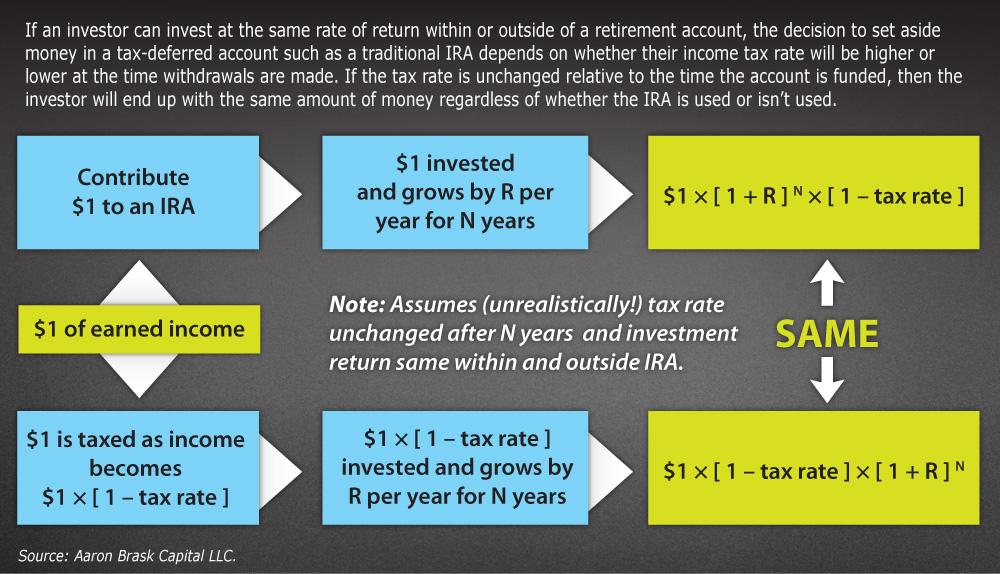
 

The first factor is the relevant income tax rate. One could choose to pay taxes when the dollar is earned (e.g., taking the cash outright or funding a Roth-type retirement account), or they could defer those taxes by contributing to a retirement account like a 401(k) or traditional IRA. While calculating one’s current tax rates is typically straightforward, knowing which earnings/tax bracket or what the corresponding income tax rates will be is naturally less predictable. Notwithstanding, there are many cases where one may be able to assume that their tax rates will be significantly higher or lower down the road.

The second factor affecting the growth of this earned dollar is the rate of return it experiences while it is invested. In particular, dollars in qualified retirement accounts will enjoy significant benefits in the form of bypassing taxes on dividends, interest and capital gains. This was the primary focus of my previous article, where I attempted to quantify the benefit as an annual rate of return.

The third factor I consider here is the time frame. This directly relates to the second factor, as it determines how long the rate of return will be compounded. In my experience, many investors and investment professionals overlook or underestimate this variable in the planning process. However, it can have a very significant impact.

Figure 2 illustrates these three variables and mathematically expresses their combined impact on the future value of an earned dollar. It is important to consider these variables in aggregate and not just in isolation since they interact with each other. Based on the feedback from my previous article, it is clear that many people (even practicing financial professionals) do not get this point and sometimes focus on only one variable.
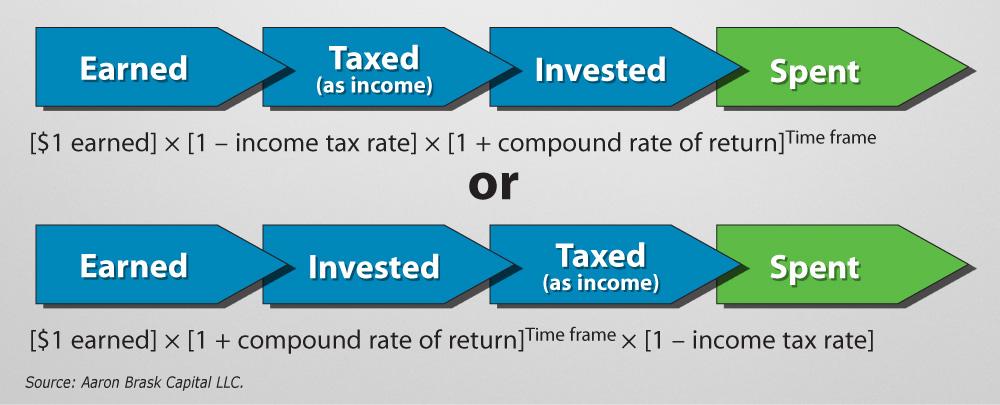
It is also important to simulate different outcomes for these variables since we cannot predict them in advance (e.g., returns or future tax rates). Indeed, it is possible for a small change in one variable to have a significant impact on the overall result. The examples in the following section help illustrate these points.

Lastly, the mathematical expression corresponding to the top diagram in Figure 2 appears to impose the income tax before the money is invested, while the mathematical expression corresponding to the bottom diagram appears to impose the income tax after the money is invested. In the case of a 401(k) or IRA contribution, the tax would be imposed after the investment period. In the case of a Roth type of account or no contribution, the tax would be imposed before the investment period. However, my point is just that the order of the figures in those mathematical expressions does not actually matter due to the commutative properties of multiplication (e.g., 3 × 4 = 4 × 3).

Useful Examples

I’ll give two examples to illustrate how one can sensibly use the results from my previous paper to facilitate decisions around planning with retirement accounts. The first example compares an investment dollar allocated to a retirement account versus a taxable brokerage account. The second example compares a traditional IRA to a Roth IRA.

In my previous article, I used historical market simulations to make precise calculations for various investor scenarios (e.g., tax brackets, portfolio composition and intention to liquidate or not). My goal was to come up with rules of thumb to summarize the potential tax benefits of retirement accounts. As such, the following two examples will leverage those results and rules of thumb rather than rerun the simulations. This will avoid many of the tedious details (e.g., portfolio rebalancing and tax lot optimization) and should help illustrate what I believe is a useful conceptual model for planning with retirement accounts.

Note that these examples are for illustrative purposes only. Financial planning should be conducted on a holistic basis as there are other relevant variables and tools that should be considered. For example, exchange-traded funds (ETFs) provide another potential tool for tax deferral. As such, it is important to understand both the investment strategies and vehicles (e.g., mutual funds versus ETFs)—especially in cases where wealth will not be spent but passed on to heirs or charities (i.e., may receive step-up).

Example 1: Retirement Account Versus Taxable Brokerage

I might label this first example as a strawman scenario, as most people recognize the benefits of contributing to a retirement account versus not doing so. The point of my prior article was to quantify that benefit. So, my goal here is to illustrate how to leverage those results. That is, I am not arguing for or against contributing to retirement accounts. Instead, I am providing a framework and some useful results that should help facilitate such decisions.

Let us consider a dollar earned by someone in their early 40s who does not plan on spending it until they are retired at, say, 65 years old. As highlighted by Figure 2, this dollar will be subject to income taxes at some point, and the investor has some control over when that is. For this example, we will consider two options. The first is to pay taxes now and place the net amount in a taxable brokerage account. The second option is to effectively defer those taxes by putting this dollar into a 401(k) or traditional IRA.

In this scenario, let us further assume that this person’s current tax bracket results in a 25% tax on income. Moreover, they expect to increase their earnings and wealth in such a way that they will land themselves in a 40% tax bracket down the road. If one only considers income taxes, then these tax rates indicate paying (lower) taxes sooner rather than later is better. However, this means their investments would not enjoy the benefits provided by retirement accounts (note: a Roth IRA example is coming next).

As my prior article highlights, the average tax benefit from investing within a retirement account amounted to approximately 1% more per year. Thus, this situation boils down to weighing the lower income tax rate combined with a lower return in a taxable brokerage account (due to taxes on dividends, interest and capital gains) versus the higher tax but with higher returns. Given this time horizon of 25 years, the retirement account benefit would likely outweigh the higher income tax. For simplicity, let us assume the taxable return was 4% and the non-taxable return was 5%. Mathematically, this becomes a choice between ending up with $1.99 in a taxable brokerage account and pulling $2.03 out of an IRA or 401(k) after 25 years. The figure for the taxable brokerage account is actually worse (lower) than $1.99 because some of the $0.99 profit in the brokerage account will likely be subject to capital gains tax (i.e., it still carries tax liability) if the investments are liquidated for spending.

This example should help illustrate that one should not focus on just one variable (e.g., minimizing one’s relevant income tax rate). It also shows how one can leverage the results from my last article to make some useful planning decisions. Of course, this example was contrived so as to illustrate these points. Indeed, the next example shows some more (Roth) options investors typically have at their disposal to help optimize their planning.

Example 2: Traditional Versus Roth IRA

The previous example was limited to a traditional IRA/401(k) or a taxable brokerage account. However, another consideration for many investors is using a Roth instead of a traditional retirement account. In my experience, the Roth option is a tool that is underutilized by many investors who would like to optimize their financial planning and aftertax returns. Unfortunately, this is likely the result of the complexities involved as well as some conflicts of interest. (Less scrupulous advisers may prefer their clients to avoid Roth contributions or conversions since it often translates into fewer assets for them to manage and thus lowers their fee income.)

Here, I highlight two tax-related benefits provided by Roth contributions/conversions. The first is the ability to get more into retirement accounts. This is a relatively straightforward point, but one that many people miss. Assuming you have a maximum contribution limit and can choose between a Roth and a traditional IRA, the Roth option can allow you to enjoy the tax benefits on more money. However, one must have extra post-tax money to pay the taxes externally (i.e., not use the IRA assets to pay the tax). The following example should help illustrate this point.

Consider a hypothetical $4,000 contribution limit for someone who is currently paying a 25% income tax (at the margin) and expects to stay at that rate. Let us also assume that this person has an additional $1,000 of post-tax money to be invested. In the case of a $4,000 contribution to the IRA, they will invest the other $1,000 in a taxable brokerage account. On a post-tax basis, there is effectively $3,000 invested in the IRA (because 25% tax will ultimately be imposed). However, in the case of a $4,000 Roth IRA contribution where the taxes are paid with the external $1,000, the full $4,000 will enjoy the tax benefits of the retirement account. Et voilà, an impressive 33% increase in the retirement account contributions and benefits ($4,000 versus $3,000).

The second benefit of a Roth IRA I highlight is that it extends the longevity of tax deferral. This is especially beneficial when wealth will likely be passed on to heirs (more so for younger heirs). In the case of traditional IRAs, one is required to start evacuating their IRAs via required minimum distributions (RMDs) once they turn 70½ years old. When these distributions leave the IRA, that money no longer enjoys the tax benefits afforded by the retirement account. Roth IRAs have no such RMD requirements. As such, they can extend the longevity of those tax benefits—assuming the money is not required for spending.

The benefits of avoiding RMDs via a Roth IRA can be twofold. On the one hand, money that would have been distributed via RMDs stays within the Roth IRA and thus enjoys the associated tax benefits while the owner is still alive. On the other hand, it also allows for passing on more money within the IRA. This can amplify the tax longevity of tax benefits as it can then be distributed according to an inheritor’s RMD schedule. The value of this strategy can be significant. For example, I have met folks over 80 years old who still draw from inherited IRAs.

Consider an investor who just turned 70½ and is thus subject to RMDs for traditional IRA assets. Moreover, let’s assume their income and long-term capital gains tax rates are 25% and 15%, respectively. This person has an expected life-span of approximately 16.5 years, according to IRS mortality tables. Over these 16.5 years, RMDs will require approximately 60% of the IRA to be distributed (I have used constant returns for this example for purposes of making a point)—presumably to a taxable brokerage account (see Figure 3). So, these distributed assets would no longer benefit from the IRA’s tax advantages.
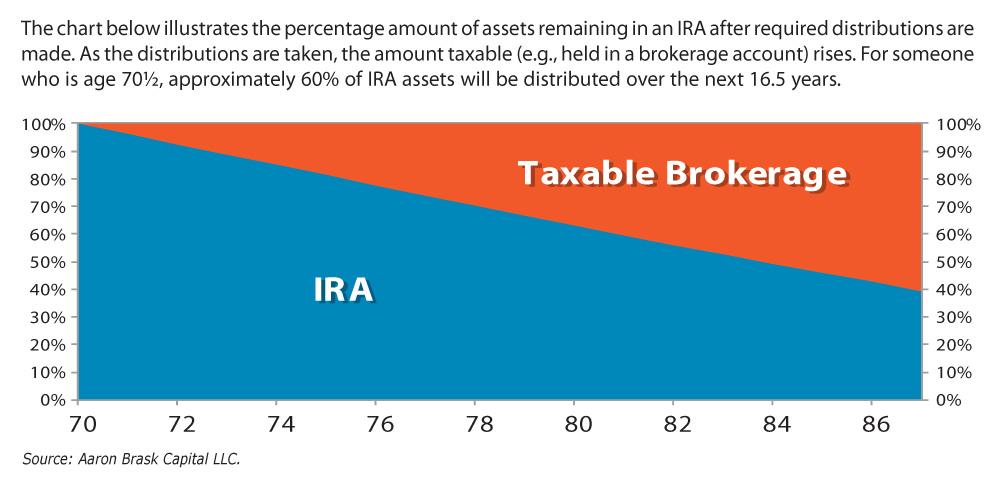
Leveraging the results from my previous article, let’s assume that the IRA tax advantages amount to an additional return of 1% per year—say, 5% returns in a taxable account and 6% in an IRA (Roth or traditional). In this case, a Roth IRA, which avoided RMDs, would result in a little over 5% more money than a traditional IRA if the owner lived this expected 16.5-year life-span.

This last example assumes the IRAs would be liquidated when the original owner dies. However, this is typically not the case, and it is certainly not the optimal way to leverage the IRA benefits. Indeed, an inherited IRA (traditional or Roth) can significantly extend its tax benefits as they can be distributed according to the RMD schedule of the inheritor (based on their presumably longer life expectancy).

Thus, instead of assuming the IRA would be liquidated with all taxes being paid upon the death of the original owner, the IRA could be distributed over a potentially much longer period (e.g., decades).

So, let’s consider $1 inherited by a 55-year-old in an IRA versus a brokerage account using the same return and tax assumptions above (inheritors will likely have different tax rates, but I make this assumption for simplicity). Applying the IRS rules for inherited IRA distributions (and assuming the inheritor lives at least as long as it takes for RMDs to evacuate the IRA), the inherited dollar in the IRA becomes worth $4.24 versus $3.48 if inherited in a brokerage account (again assuming liquidation and all taxes paid). So, this extension of the retirement account benefits increased the wealth by an impressive 22%.

In the case of a 25-year-old heir with an even longer distribution period, each inherited dollar would turn into $19.54 for the IRA versus $13.87 for a taxable brokerage account. That is a greater than 40% increase. The bottom line here is that extending the longevity of assets within retirement accounts can provide significant benefits.

To be clear, the figures above should not be added (i.e., 5% and 22%). In fact, the net effect is slightly lower. This is because this differential only applies to the extra dollars the Roth IRA keeps within the retirement account (by avoiding RMDs) relative to a traditional IRA (recall that the IRA distributed over half of the assets to taxable accounts, whereas the Roth IRA did not). As such, I simulated the total benefit that would occur during and after the original IRA owner’s lifetime.

These scenarios highlight the tremendous benefits of passing wealth on via an IRA. In the case of Roth IRAs, the benefit is naturally greater, as the absence of RMDs allows for more money to receive these benefits. In these examples, I assumed the income tax rate was the same throughout (including for the beneficiary). As unrealistic as that may be, these examples highlight the magnitude of income tax differential that Roth IRAs can potentially overcome. As a corollary, this shows that relative income tax rates are not the only consideration when making decisions around retirement accounts.

This analysis does not include the first benefit I highlighted with respect to Roth versus traditional IRAs. In particular, the Roth IRA allows one to put more money into retirement accounts when accounting for the tax liability that a traditional IRA carries. Loosely speaking, $1 in a Roth IRA is worth more than $1 in an IRA plus $0.25 in a brokerage account. As such, the benefits could be even greater than those presented above.

Conclusions

My goal with this article was threefold. First, I wanted to clarify some misconceptions and misinterpretations of my previous article on retirement account benefits. That is why I laid out a simplistic model to quantify the tax benefits of retirement accounts, to ensure that all comparisons would be apples to apples. The various factors I highlight must be considered together—not just on an individual basis. Indeed, it is entirely possible that one may be better off actively choosing to pay higher income tax rates (as I show by example) if the other factors more than compensate for the tax differential.

Second, I wanted to provide examples showing how to leverage the results I quantified in my previous article. While that first analysis was tedious and required much effort, the corresponding results are straightforward and can be sensibly used in many contexts involving retirement account decisions.

My third goal was to once again illustrate the tremendous tax benefits retirement accounts can provide. I hope my hypothetical examples served this purpose. Indeed, the potential to increase wealth anywhere near the magnitudes in these examples should encourage more investors and professionals to conduct better due diligence around retirement decisions. 

Disclaimer: I am not a tax professional. This article is not and should not be construed as tax advice. Investors should seek advice from a CPA or qualified tax professional for any questions or issues related to taxes.

Discussion

Thomas Schaber from OH posted over 7 years ago:

I'm confused. Since we are talking about "Investing For Retirement", I assume that MOST people will need to take their RMD; their first concern is making sure they have enough to live on - not leaving a larger amount for heirs. If leaving a larger amount for heirs is the first concern then that's another discussion. Second: "In particular, the Roth IRA allows one to put more money into retirement accounts when accounting for the tax liability that a traditional IRA carries." HUH? I thought you showed, and I agree that the traditional IRA "allows one to put more money into retirement accounts" because one doesn't have to pay the taxes on what gets invested. Isn't that what you showed in figure 1? Further, I believe that there are so many unknowns that making any definitive statement about which is better is folly. To wit: Your income over all your employed years. Income tax rates during employment. Income tax rates during retirement. How many years you will work. How many years you will live in retirement. Income during retirement. For example, the amount one can contribute to a traditional IRA may change considerably for a 30 year old before s/he retires.


Thomas Schaber from OH posted over 7 years ago:

Say what? "Roth IRAs can allow you to enjoy the tax benefits on a larger amount of money if the initial upfront taxes are paid with non-IRA assets." What are "non-IRA assets"? Hmm? Why not put those "non-IRA assets" into the market which would allow them to grow tax free until you have to withdraw them. Without the caveat of "non-IRA assets", the analysis doesn't work.


Dave Gilmer from WA posted over 7 years ago:

Let’s start with the article highlights (somewhat shortened for clarity) and see how they could be mis-understood: 1. “Even if a higher tax rate is expected in withdrawal, the tax advantage of retirement accounts make them more valuable than a taxable account.” It is generally accepted knowledge that a taxable account is always going to either tie or lose to a traditional IRA or a Roth account, given equal taxes in and out. Can’t dispute that. I will say from practical experience and hundreds of tax returns that there are a lot of people whose tax brackets are lower in retirement, making the traditional IRA the retirement account that is going to give you more spendable money in retirement, despite what the author alludes to. Personally my tax brackets went from the 25-33% marginal rates while working to 12% now in retirement. 2. “Roth IRA’s can allow you to enjoy the tax benefits on a larger amount of money if the initial upfront taxes are paid with non-IRA assets.” Not at all true as Thomas also tried to point out. Once again as I pointed out in the author’s first article this is an apples to oranges comparison. The author should refer back to his Figure #1 or Fig #2. It does not matter where the taxes are paid from, all that money has to be earned and you have to compare “earned dollars A” to “earned dollars B” in which A & B are equal. In one case you earn $10,000 and put it in a traditional IRA, in the second case you earn $10,000, sit $2500 aside in a non-IRA asset (to pay the tax) and put $7500 in the Roth, or you could put $7500 in a taxable account. Those are really your only three options for an apples to apples comparison. Splitting the money between taxable & IRA in one transaction only confuses the novice reader, much like saying if I max out my Roth 401k instead of the traditional 401k, I will have more money in retirement, because the taxes have already been paid. 3. “Roth IRAs can extend the longevity of tax deferrals …” My question is will that really be helpful if the person receiving the money has less spendable income because you “unwisely” put too much money in the Roth side of the equation while you were working at a higher tax rate. Please go back to Fig 1. Unless you assume a tax differential that is unknown in the future, the time value of money in an IRA over the money in a Roth, is irrelevant. Finally, the author states on the first page, “I believe it is just plain dangerous to rely on rules of thumb for financial planning.” Then on page three he states, “My goal was to come up with rules of thumb to summarize the potential tax benefits of retirement accounts.” I will agree with the opening statement that “There is immense value provided by retirement accounts,” but I just feel he left the audience wondering how to unlock that value. In my opinion the value of retirement accounts is not in comparing them to a taxable account as the author tries, but in knowing how to decide wisely between the traditional IRA (401k) and the Roth IRA (401k). The taxable account is in most cases only for money once the first two have been maxed out or in some cases for a little "tax diversity."


Dave Gilmer from WA posted over 7 years ago:

Aaron, Please when you display a financial chart like Figure 3 it would be helpful to know what the "constant returns" were that were assumed to build this chart. A little inspection seems to indicate that you assumed zero returns for the IRA, as that is essentially the only way to pull down the IRA by 60% after only 16.5 years. If you assume only a modest 4% return for the IRA, then the account is only down by 20% and not 60%.


Aaron Brask from FL posted over 7 years ago:

Hi Thomas – Fair point regarding investing for retirement vs leaving assets to heirs. I agree there are many moving parts here. However, I do not agree you can *never* make a definitive statement regarding which approach is better. Sure, some situations are more unpredictable than others, but some are relatively straightforward. Moreover, even if a situation is challenging, I don’t think throwing your hands in the air and giving up is the right solution. I am simply trying to provide a useful framework once you have tied down some of those loose ends (made assumptions/forecasts regarding tax rates, income levels, etc). I do not think you understand the point I am making regarding contribution limits. An IRA contribution carries the (income) tax liability whereas the Roth does not. I think the example I provided made this clear. And yes, you should pay that tax bill (Roth contribution) from money outside the Roth if you can. Regarding your second comment…Not sure if that was a rhetorical question or not. Just in case, non-IRA assets are assets sitting outside an IRA (e.g., taxable brokerage). You then ask why not just invest them with tax-free growth. Two reasons: (1) Most investments pay some dividends and/or interest which get taxed + (2) You pay tax on the gains when you “withdraw” them. Roth can protect against both of these.


Aaron Brask from FL posted over 7 years ago:

Hi Thomas – Fair point regarding investing for retirement vs leaving assets to heirs. I agree there are many moving parts here. However, I do not agree you can *never* make a definitive statement regarding which approach is better. Sure, some situations are more unpredictable than others, but some are relatively straightforward. Moreover, even if a situation is challenging, I don’t think throwing your hands in the air and giving up is the right solution. I am simply trying to provide a useful framework once you have tied down some of those loose ends (made assumptions/forecasts regarding tax rates, income levels, etc). I do not think you understand the point I am making regarding contribution limits. An IRA contribution carries the (income) tax liability whereas the Roth does not. I think the example I provided made this clear. And yes, you should pay that tax bill (Roth contribution) from money outside the Roth if you can. Regarding your second comment…Not sure if that was a rhetorical question or not. Just in case, non-IRA assets are assets sitting outside an IRA (e.g., taxable brokerage). You then ask why not just invest them with tax-free growth. Two reasons: (1) Most investments pay some dividends and/or interest which get taxed + (2) You pay tax on the gains when you “withdraw” them. Roth can protect against both of these.


Aaron Brask from FL posted over 7 years ago:

Hi Dave – Using your numbering… [1] I tried to be careful not to go down the rabbit hole of different income tax rates (at time of potential contribution vs during retirement). I was not trying to avoid the issue as it is, of course, relevant. In fact, I highlighted this multiple times within the article. However, even if your rates are different, this framework can still be used. To be clear, I am not saying Roth is always better. The difference in your marginal rates looks to be one of those cases where traditional IRA is better. [2] I am not immune to making mistakes, but I am generally a stickler for detail and only making apples/apples. I think I see where our views differ on this now. I am not assuming the money is coming from the *current* earnings/income. Many people have post-tax savings outside of IRAs. So the starting point is, say, $5k of current earnings earmarked for an IRA (trad or Roth TBD), an assumed tax rate is 25%, and $1250 cash in a taxable brokerage. So there is $6,250 and a potential tax liability (if trad IRA) floating around here. Scenario A: Contribute to traditional IRA and keep $1,250 invested in taxable brokerage. Scenario B: Contribute $5k to Roth and use $1,250 to pay tax. I think you will arrive at similar conclusion and agree this is all apples/apples once taxes are paid upon IRA withdrawal in scenario B. [3] As I highlighted above, tax differentials (marginal rate at time of contribution vs retirement) matter. I am not saying to ignore them. I assumed these were equal to make some other points. Everybody’s situation should be considered individually. Apologies if anything in my articles was not sufficiently clear, but given your concluding thoughts, I think we are in agreement on pretty much everything. We are always dealing with some level of uncertainty. We should optimize our selections where we can and but sometimes have to acknowledge this uncertainty and sometimes diversify strategies accordingly. As for your second comment, please note that figure does not depict account values; it shows the % of assets remaining in the IRA vs taxable brokerage.


Dave Gilmer from WA posted over 7 years ago:

Aaron, 1] I do understand that taxes are different for everyone but you have to make an assumption one way or the other to prefer the Roth over the traditional IRA or vice versa. I am only pointing out that IMHO, when you consider that someone does not change their lifestyle all that much from working years to retirement, the results of that are an overwhelming favorite to traditional IRA savings. The reason being while working, clearly 40% of most of that money is going towards things that don't exist in retirement. So with no assumption about tax rates it's pretty easy to see that in almost all cases you will need less gross income in retirement than when you were working. Add to that the fact that if a person is approaching or in retirement today (say over 50) then they have had a lifetime of tax rates becoming lower on an absolute, or even an inflation adjusted basis. Once again favoring the tIRA. The one caveat is a working married person who then spends there entire retirement as a single person.


Paul from NY posted over 7 years ago:

Although this article began to lose me the further I read, it did make one mathematical point early on that many investors - and some financial planners - fail to grasp. That is, whether you put money into a tax-deferred vehicle (IRA/401k) or a tax-free vehicle (Roth IRA/Roth 401k), if your tax rate is the same when you make the withdrawal as it was when you made the contribution, you will always end up with the exact same amount of money! Some will assume that it is better to "pay tax on the seed than on the harvest". But the math proves otherwise. I've actually heard a financial advisor use that very quote while making this elementary mathematical error (scary, isn't it?) I've even seen this mathematical error printed in at least one investment book! Here's a simplistic example to illustrate the point: Farmer A and Farmer B both have enough seeds to plant 100 acres. Their tax rates are both 30%. Farmer A decides to pay tax on his seed, leaving him with only enough seed to plant 70 acres. Farmer B decides to pay tax on his harvest, leaving him with enough seed to plant the entire 100 acres. Come harvest time, Farmer A gets to keep the harvest from all 70 acres he planted since he previously paid the tax on his seed. But Farmer B must now pay the 30% tax on his 100 acre harvest, thus leaving him with 70 acres worth of harvest... THE SAME AS FARMER A!!! I hope that settles it.


Paul from NY posted over 7 years ago:

Another point comes to mind regarding tax-deferred (IRA/401k) vs. tax-free (Roth IRA/Roth 401k). When you contribute to a tax-deferred vehicle, the money is being taken off the TOP of your tax bracket. So if you have income that exceeds the 25% tax bracket, then the first dollar you contribute to an IRA/401k avoids 25% in taxes, and so on down the tax bracket as each dollar gets contributed. Point being, the most heavily taxed money get sheltered from taxes first when contributing to a tax-deferred vehicle (because it's lowering your overall income and thus reducing your tax exposure at the top tax bracket). But when you withdraw that very same money in retirement, you pay taxes starting with the LOWEST tax bracket! In other words, you're "filling up" your tax brackets from the bottom, so that the money you contributed on which you originally saved 25% in taxes might now be withdrawn at a tax rate of only 15% or even 10% (depending on what the tax brackets look like when you are in retirement). Remember it this way: when looking at the tax bracket "funnel", contributions save taxes from the top-down (the widest part of the funnel where the highest taxes reside), whereas withdrawals pay taxes from the bottom-up (the narrowest part of the funnel, where the lowest taxes reside). You're nearly always going to come out ahead unless the lowest tax bracket during retirement exceeds the higher tax bracket you were in during your contribution years.


David from SC posted over 7 years ago:

One Roth IRA benefit I did not see in your article is the use of the "backdoor" contribution to a Roth. If your income is such that you can not contribute to a Roth IRA directly and you can not contribute pre-tax dollars to a traditional IRA then you could make a back door contribution to the Roth IRA. i.e. contribute post-tax dollars to the traditional IRA and then convert the money in that account to a Roth IRA. It is kind of weird quirk in the tax law -- but it gives you an opportunity to participate in the long term benefits of the Roth. What are your thoughts on this?


Aaron Brask from FL posted over 7 years ago:

Thanks again for the comments. My thoughts: Dave - I am not sure why anyone has to assume Roth is better than traditional IRA or vice versa. I consider each situation individually and suspect you would/do too. In the example you highlighted, I agree 100%. I think it is fair to say your example highlights the situation of most people (relevant income tax is lower in retirement and thus makes traditional IRA advantageous). My Roth examples were not necessarily representative of most Americans' situations. I used them to make a point that is seemingly counter-intuitive to many (i.e., it can be advantageous to pay a higher income tax rate). Paul - One caveat to this mathematical equivalence: The Roth allows money to remain inside the IRA for longer. So the tax benefit can be greater. One your second point, you are 100% right. You have to figure out the relevant income tax rates. This is similar to what Dave was saying (income during earning years is typically higher because your earnings are for current ANY future living expenses. It is also worth noting that traditional IRA contributions will be taxed at the marginal rate upon withdrawal since that money is effectively commingled inside the IRA and increases all RMDs.


Aaron Brask from FL posted over 7 years ago:

Hi David - You are right; I did not address that specifically. However, the math is the same. You should compare both income tax rates as well as the Roth's marginal benefits. So I am a big fan of using these opportunistically. When the numbers are similar, I tend to lean toward Dave's concept of 'tax diversification' to sway the decision. That is, we don't know what will happen to tax rates (and brackets) going forward, so diversifying tax strategies can make sense. Truth be told, I did not intend to focus on any of these examples or try to provide a complete treatise on the topic. My original goal was just to quantify the benefit of retirement account tax benefits and allows others to leverage them. However, there was some confusion and I decided to use some examples to make some specific points. Thanks for your comment!


Dave Gilmer from WA posted over 7 years ago:

I want to take one more stab at the illustration above between the Taxable, Roth, and Traditional mixture ($5000 Roth with taxes paid from taxable). The premise of the article is that Retirement accounts (Roth and Traditional) are more beneficial so let’s go with that thought and create the same example above for a couple that wants (needs) to see it in an apples to apples comparison. I will try to make the story-line short, but I hope all will see the importance of understanding the math. Setup: Newlyweds where husband is the only one with an employer 401k Roth. Wife has only a 401k Traditional. Through some important pre-marriage counseling they have agreed he will contribute only to the 401k Roth and she will contribute only to the Traditional. There is no employer match in either case. It is also agreed since they have no future knowledge of tax rates that any money saved will be saved equally from pretax earnings into both accounts. They both came into the marriage with $1250 in a Taxable account, which is now $2500 in a joint Taxable account. Contribution: In year one they decide their budget can afford $10,000 of after-tax money into their retirement accounts. Husband suggests he put $5,000 into his 401k Roth and pay the taxes of $1250 later from the Taxable account. He also suggests that she put $5000 into her Traditional and keep her $1250 inside the Taxable. After reading a recent AAII article she immediately calls “foul” on that idea and suggests a more equitable way to handle this, recognizing that the goal is to work down the taxable account in favor of the retirement accounts, but in a way that does not favor “higher” or “lower” taxes in retirement because that is unknown at this time. Her solution: “Since the employer is already withholding taxes at a 25% rate we can easily do the following to accomplish the same goal in a manner that keeps our pre-marriage agreement intact. With some simple math we know that $5000 out of our budget is $6,667 of earnings ($5k/(1-tax rate)), so both of us need to allocate $6,667 of pretax money to this transaction. This will of course put a strain on our budget of $2500, which is surprisingly the amount of one property tax payment. I will pay that payment from the $2500 in the Taxable account, thus keeping our budget in balance.” Why the math works: He puts $5000 in the Roth and the other $1667 is allocated to taxes. She puts $6667 in her Traditional account getting her a “tax rebate” against her transaction of $1667. Net result no new taxes on their return. Both parties get an effective $5000 of retirement post-tax income if tax rates stay the same. If new information becomes available in the future they will have to work to “adjust” their two accounts to maintain their “agreement.” An important PS for married couples: It is important that both parties talk about and understand finances. Sorry for the length, but did my best!


Aaron Brask from FL posted over 7 years ago:

Dave - I trust you wrote this before our email exchange, right? I am not sure what point you are trying to make here as I am in agreement with everything in your example. However, I would note the following two points: (1) There are limits on retirement account contributions. If that limit was $5k in your example above, then you would not be able to make the $6667 pre-tax contribution to her traditional 401K. That is how the Roth route can allow one to get more money into your retirement accounts (assuming taxes paid with external $ - the $1250 in your example). (2) Roth has no RMDs. So 100% of that money (if non needed) can go onto heirs and enjoy tax-deferral for much longer time (that can add up as my article showed). RMDs typically evacuate 50% or more of traditional IRAs and thus only allow those benefits on half or less of the (unneeded IRA money).


Dave Gilmer from WA posted over 7 years ago:

Aaron, The point I am trying to make is unless your article’s main point is somehow about contribution limits let’s leave them out of the discussion, at least for now at least. I know you are trying to use them to make a “minor” point but please defer on that for the moment. Can we tell the story by assuming Congress has passed a law removing all limits from all retirement accounts? Can your article be re-written without using the reference to “contribution limits” and still offer something for the reader? Now your article would apply to a much larger audience as there is a larger and larger audience that can do both Roth or Traditional in a 401k for which they never reach the contribution limit. So I am just wondering how your story would change. How does the investor decide where to put his money? Does she have a taxable account at all? In your article you highlight a tax benefit of the Roth IRA as being: 1) “The first is the ability to get more into retirement accounts.” Does having no limit cause this tax benefit to go away?


Aaron Brask from FL posted over 7 years ago:

Dave, Your last comment basically asks the same question (if there were not contribution limits ...) three different ways. The answer is yes (x3); if there are no limits on contributions, then the concept of tax-deferring 'more' dollars via a Roth versus traditional IRA is moot. Even if we ignore this angle, my article does indeed still offer some potentially (not necessarily for everyone) useful perspectives. My second point above (no RMDs for Roth) is one of them. Please note this article does not claim Roth's are best for everyone. I only used the Roth examples to illustrate some points. How and where to allocate money is too general a question. I wrote this and the prior article to illustrate some of the relevant math and logic, but there are many other moving parts. Best regards, Aaron


Dave Gilmer from WA posted over 7 years ago:

Aaron, I am not trying to say Roths are better either, I am just trying to point out the shortcomings in your math that suggests the Roth is preferred if you can pay taxes from the Taxable account. Lets summarize what you seem to be implying: 1. If limits come into play for the Traditional/Roth account then I will have more tax-advantaged money by maxing out the Roth rather than the Traditional, if I can pay the taxes out of the Taxable account. 2. If the above continues then I am essentially working down my Taxable account and building up my Roth. This seems like a reasonable goal for an investor. 3. What I am in effect doing is taking money out of the “taxable pocket” and putting it in the “Roth pocket.” Now let’s go back to the contribution limit case and see what that implies: A. If I don’t have enough earnings to fund my retirement savings then some (or maybe all) can be taken out of a taxable account to my advantage. Your solution is to put it in the Roth because it will give you more money in retirement. Let’s see if that is really true. B. Taxable account has $5000 in it, investors both earn $100,000 and spend all of their $91,261 take home pay. Their MFJ marginal tax rate is 12%. C. Investor1 does his taxes next Feb and puts the $5000 from the taxable account in his 2018 Roth IRA. D. Investor 2 also does her taxes in Feb but decides to put $5000 in her 2018 Traditional IRA, then take the IRS refund of $600 [5000/(1-tr)] and put that $682 [600/.88] in her 2019 Traditional IRA account the next day. Conclusion both investors have not affected their take home pay and one has $5000 in a Roth IRA, while the other has $5682 in the Traditional IRA. They both reached the goal of draining the Taxable account so they could have “more in retirement.” It just took the Traditional investor one extra day. I simplified the example by making the Taxable account small. A larger account just takes longer, but once all money has been moved from Taxable to Traditional or Roth, putting it in either location results in the same “spendable income” in retirement. In case the point is once again lost, it is not about the fact that there are ways around the contribution limits to gain whatever Roth / Traditional you think is appropriate to your tax situation. The point is that paying the tax out of your "left pocket" (after-tax pocket) rather than your "right pocket" (pre-tax pocket) does not change the math in any way.


Aaron Brask from FL posted over 7 years ago:

Dave - The last paragraph of your comments makes it clear you are conflating two related but distinct notions. You are focusing on the difference between pre- vs post-tax money, but I am talking about taxable (brokerage) vs tax-deferred money (Roth) - both of which are pre-tax. There is obviously an advantage to growing money in a (Roth) IRA vs leaving to grow in a taxable brokerage. The former avoids taxes on dividends, interest, rebalancing, and (critically) the appreciation. I have already explained this point in my article, the comments above, and our email exchange, but I will address your example one last time. All of the above is fine until you hit point D. Right before point A, you say you will consider contribution limits. However, you do not mention or impose any limits. If the limit was $5k, then the 'extra' contribution to the traditional IRA would be ineligible. That is the point. I am not sure I can explain it any better. If I have not convinced you, perhaps you will take Vanguard's word for it. The context is slightly different (a conversion vs contribution), but the logic and point is the same. There is a benefit to growing money within an IRA vs outside in a taxable account. Here is a link to the article: https://personal.vanguard.com/pdf/ISGROH.pdf


You need to log in as a registered AAII user before commenting.
Create an account

Log In

Get your free copy of our special report analyzing the tech stocks most likely to outperform the market.

Download the FREE Report Here: