



Related

Portfolio Strategies
Concentrated investing has always been a controversial subject (especially so these days).
What we attempted to do in the book we co-wrote with Tobias Carlisle, “Concentrated Investing” (John Wiley & Sons, 2016), is to learn from a number of great concentrated investors about how they ended up as concentrated investors and what made them so successful.
Before we start, we will give a note of caution—akin to a warning from the surgeon general—that concentrated investing is not for everybody. In fact, it may be dangerous to your financial well-being!
Our book and the investors profiled in it agree with the proponents of efficient market theory on two points:
If one is determined to run a concentrated portfolio, one needs to be capable of a lot of hard work and a lot of soul searching.
Our book grew out of a conversation that we had about why some very good analysts we knew were lousy money managers and why some less-than-brilliant analysts produced outstanding returns. In thinking about this, we came up with at least two key characteristics that many of the most successful investors we knew possessed:
Asked in 2011 whether intelligence or discipline was more important for successful investors, Warren Buffett responded to business school students in India (recorded by NDTV) that temperament is key:
“The good news I can tell you is that to be a great investor you don’t have to have a terrific IQ. If you’ve got 160 IQ, sell 30 points to somebody else because you won’t need it in investing. What you do need is the right temperament. You need to be able to detach yourself from the views of others or the opinions of others. You need to be able to look at the facts about a business, about an industry, and evaluate a business unaffected by what other people think. That is very difficult for most people. Most people sometimes have a herd mentality, which can, under certain circumstances, develop into delusional behavior.
“The ones that have the edge are the ones who really have the temperament to look at a business, look at an industry, and not care what the person next to them thinks about it, not care what they read about it in the newspaper, not care what they hear about it on the television, not listen to people who say, ‘This is going to happen,’ or, ‘That’s going to happen.’ You have to come to your own conclusions, and you have to do it based on facts that are available. If you don’t have enough facts to reach a conclusion, you forget it. You go on to the next one. You have to also have the willingness to walk away from things that other people think are very simple. A lot of people don’t have that.”
Individual investors are in a unique position in that they do have a permanent source of capital: their own. What then are the characteristics that are necessary to be successful at running a concentrated portfolio, and what can be learned from history and from the outlooks of the very successful investors profiled in our book?
First, what is concentrated investing? It is investing in such a way that one is not relying on diversification to keep the effect of individual errors in one’s portfolio remaining tolerably small. To put it a different way, it is investing in a sufficiently small number of positions such that if any individual position is a mistake that results in the permanent loss of capital, it will be an unpleasant mistake. A concentrated investor invests in from 10 to 30 positions typically, with more than half of the portfolio exposure coming from the top 10 positions. If this sounds risky, it is, but the successful practitioners of this style of investing find ways to mitigate the risk.
A portfolio’s value can vary through fluctuations in the share prices of its holdings, either in absolute terms or relative to the market. Absolute variability, or a swing in price, is known as tracking risk. This differs from the risk of incurring a permanent loss of capital, since the variability in price allows the portfolio not only to recover from a downward move, but actually grow to a large amount.
For example, concentrated investor John Maynard Keynes’ stock portfolios exhibited higher tracking error and greater volatility than the comparable market index. This allowed him to outperform, but the trade-off was periodic underperformance and portfolio volatility. He also benefited from an arrangement with King’s College at Cambridge University that allowed him to invest for the long-term and ride out any periods of market volatility.
The original concept of running a concentrated portfolio of value stocks was developed—as far as we know, independently of one another—by two of greatest investment minds of the 20th century, namely Benjamin Graham and, perhaps somewhat surprisingly, Sir John Maynard Keynes. Graham is famous for being possibly the first to formalize how to think about investing in securities. His landmark book “Security Analysis” was first published in 1934 while he was teaching at Columbia University’s nascent business school (classic 1934 edition reprinted in 1996 by McGraw-Hill Education). Keynes is best known as an economist and as the author of “The General Theory of Employment, Interest and Money” published in 1936 (reprinted in 1965 by Harcourt, Brace & World). A lesser-known aspect of Keynes’ life is that he was in fact an active speculator and investor. In his early career, he speculated widely on commodities and currencies based on what he deemed to be his “superior knowledge” of business cycles. This led to several instances of his losing 80% or more of his own and his investors’ assets. It also led to a tangible increase in his modesty and his development into a concentrated value investor, as he explained in a 1934 letter to business associate F. C. Scott:
“I get more and more convinced that the right method in investment is to put fairly large sums into enterprises which one thinks one knows something about and in the management of which one thoroughly believes. It is a mistake to think that one limits one’s risk by spreading too much between enterprises about which one knows little and has no reason for special confidence.”
Keynes eventually became an unusually long-term investor, holding a typical stock for more than five years at a time. Keynes also formulated the concept of intrinsic value and margin of safety much in the same vein as Graham, as shown in this excerpt from a 1942 letter to Scott:
“There are very few investors, I should say, who eschew the attempt to snatch capital profits at an early date more than I do. I lay myself open to criticism because I am generally trying to look a long way ahead and am prepared to ignore the immediate fluctuations . . .
“My purpose is to buy securities where I am satisfied as to assets and ultimate earning power and where the market price seems cheap in relation to these.”
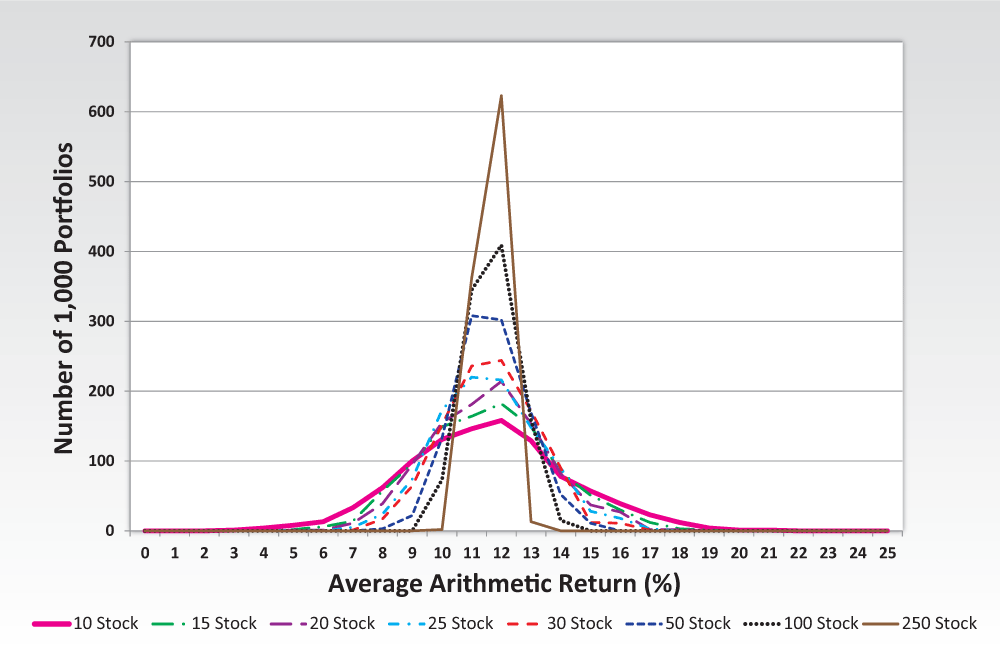
Figure 1 and Table 1 show the average arithmetic returns for equal-weighted portfolios holding between 10 and 250 stocks. Stocks were randomly selected from the S&P 500 index to create 1,000 portfolios for each of the eight different-sized portfolios (for total of 8,000 portfolios per year). Annual returns were calculated for the period of January 1999 through October 2014. The portfolios were compared against the equal-weight S&P 500 index.
The 250-stock portfolios didn’t deviate much from the S&P 500 equal-weight index. In contrast, the 10-stock portfolios had the widest distribution of returns, indicating that smaller portfolios are more likely to have returns different than the index.
Table 1. Average Arithmetic Annual Returns
| Return (%) | |||
| Portfolio | Average | Minimum | Maximum |
| 10 Stock | 12.0 | 3.7 | 21.3 |
| 15 Stock | 12.1 | 5.4 | 20.0 |
| 20 Stock | 12.1 | 5.3 | 18.7 |
| 25 Stock | 12.1 | 5.9 | 17.2 |
| 30 Stock | 12.1 | 7.5 | 17.3 |
| 50 Stock | 12.2 | 8.1 | 15.8 |
| 100 Stock | 12.2 | 10.1 | 14.8 |
| 250 Stock | 12.2 | 10.7 | 13.5 |
| All Stocks | 12.2 | 12.2 | 12.2 |
| Source: “Concentrated Investing: Strategies of the World’s Greatest Investors” (John Wiley & Sons, 2016). | |||
|
These are the average returns for the 16-year period for the various portfolios. The minimum is the single worst arithmetic average across 16 years out of 1,000 scenarios conducted for each portfolio (e.g., 10 Stock, 15 Stock, etc.); the maximum is the single best. |
|||
In the exceptional investors we studied, the two concepts of intrinsic value and margin of safety are key components of their investment methodology. The concept of intrinsic value is that every equity is a proportional share of a business and that business has a true or intrinsic value that is independent of, and sometimes vastly different than, its market price. The margin of safety is the difference between the current market price and the minimal intrinsic value of the company or share.
Let us take a more tangible example. Suppose you are investing in the stock of a jewelry company that sells simple gold jewelry. One can think of two ways to value this company: 1) as an ongoing concern and 2) as the value of its inventories in gold. The company may have a promising future and a big upside, which is great and exciting. A concentrated investor, however, must first and foremost think about the downside risk.
What is the best way to do that? Figure out what the inventories are worth and compare that to what one is paying for the company. If the gold inventories are worth 90% of what one is paying for the company, that’s a pretty good margin of safety. It effectively means that your downside risk is only the loss of 10% of your investment. (We are making some simplifying assumptions here, the major one being that the price of gold is stable.) What if the value of the gold is twice the value of the company? Well, that is even better, but it may sound farfetched. It is not: Such situations actually do exist on occasion.
Lou Simpson is a man many of you may not have heard of, but we are sure most of you are familiar with the GEICO Gecko. Well, Lou Simpson is the man Warren Buffett chose to run insurance company GEICO’s portfolio, something he did with outstanding results over 31 years. As Buffett put it in his 2010 letter to Berkshire Hathaway shareholders:
“Lou has never been one to advertise his talents. But I will: Simply put, Lou is one of the investment greats.”
One of the many great investments Lou Simpson made while at Berkshire was NIKE Inc. (NKE). What was it about NIKE that attracted Simpson? Simpson tries to avoid businesses with political risk, preferring mundane businesses that are under the radar screen and not dependent on government decisions.
Simpson recalled in 2011 that Buffett asked him about Nike:
“Which company has the better franchise, Coke or NIKE?”
“NIKE,” Simpson responded.
“Why would you say that?” Buffett asked.
“NIKE has a much more open-ended chance of growing. They really have just skimmed the surface outside of the U.S., whereas Coca-Cola is powerful all through the world.”
Simpson notes that NIKE’s valuation was never “super” cheap, but neither was it outrageous (on a free cash flow basis, it traded at a yield of 7.0% to 7.5%). When Simpson bought it, it was approaching an 8% free cash flow yield. What attracted Simpson to NIKE was the strength of the franchise and the fact that the brand traveled well around the world, although it had not yet penetrated a number of places such as India. It is also a simple, understandable business with a pretty good return on reinvested capital. Forecasting a simple business is much easier than trying to forecast something very complicated.
Another nice thing about running a concentrated portfolio is that you can have low turnover and therefore only need to find two to three new ideas a year. As Simpson said, “We do a lot of thinking and not a lot of acting. A lot of investors do a lot of acting, and not a lot of thinking.”
In fact, as Lou Simpson and several of the other investors profiled in our book point out, a lot of activity is not the sign of a good investor. One needs to be able to sit still and think for prolonged periods of time. Some people just do not have the discipline to do this on a regular basis.
Other things Simpson and most of our super investors like are companies with low levels of debt or leverage and companies that are “financial cannibals,” such as companies that buy back a lot of their own stock.
Another super investor you may not have heard of is Kristian Siem. Siem is often referred to as the Warren Buffett of Norway. Unlike the other investors in our book, he is generally a buyer of whole businesses. Since all the investors we discuss think of their investments as investments in businesses, this distinction is smaller than it may seem. Siem does draw an important distinction between the common form of fund management and the way he thinks about investing in businesses, as he explained in 2012:
“Industry, by nature, is long term, and the fund management business, by nature, is short term. Financial investors come in and out: They can push a button any day and get out. The principal industrial investors don’t have that luxury. They have to think for the long term. I believe the success of industry is that you always think long term, so even if incidents like mergers or takeovers cause you to be out in the shorter term, you take the long-term decision as if you were to be the owner forever. That is healthy for the industry, and therefore also for its shareholders. I think that has been the success of our operation.”
Siem is also unusual in that all of his deals were done in a pretty narrow space of either offshore drilling or shipping and cruise lines—areas in which he was an expert. This, however, did not stop him from getting into trouble at times and seeing vast swings in the value of his portfolio. He recalled the outcome of one particular investment in the British shipping firm Common Brothers:
“In those days the officers onboard the Common Brothers vessels met for drinks every evening in a bar. It was really shiny. The rest of the ship was falling apart. I think that was very symptomatic of all the assets and the care.”
He did not make money on this investment, but learned an important lesson from it: Do your due diligence first, then invest. He was seduced by owning a high-class asset that turned out not to be so high class. Common Brothers was a mess that would take Siem four years to clean up. The problem, he says, was that the two members of the founding family who ran it were not interested in the details of shipping. Siem described them as “gentlemen who were a pleasure to deal with,” but also observed that the company had no controls, and the two men had lost grip of the financial details. In retrospect, much of this could have been uncovered by more thorough due diligence.
All of our subjects have some common characteristics and express some common themes. These include:
Finally, these great concentrated investors demonstrate an interesting mix of two key characteristics, namely modesty and self-confidence. One needs the self-confidence to invest as a contrarian and the modesty to admit to yourself when you are wrong. Finally, one needs a willingness to absorb and ignore the opinions of society as a whole, or as Keynes put it in “The General Theory of Employment, Interest, and Money”:
“If he is successful, that will only confirm the general belief in his rashness; and if in the short run he is unsuccessful, which is very likely, he will not receive much mercy. Worldly wisdom teaches that it is better for reputation to fail conventionally than to succeed unconventionally.”
Portfolio Strategies

Stock Strategies
Value Investing

Robert Albers from IL posted over 9 years ago:
Joe Woo from IL posted over 9 years ago:
Ram from NJ posted over 7 years ago:
You need to log in as a registered AAII user before commenting.
Log InCreate an account